S26 Ultra vs iPhone 17 Pro Max: Which Should You Buy? (2026)
Samsung Galaxy S26 Ultra vs iPhone 17 Pro Max — two weeks of real testing across cameras, battery, AI features, and daily use. Full specs compared. No brand loyalty, just honest results.
- +Sharper display (498 PPI vs 458 PPI)
- +Lighter weight (214g vs 233g)
- +Thinner design (7.9mm vs 8.75mm)
- +S Pen included — no extra cost
- +Quad camera with longer zoom reach
- +Faster 45W wired charging
- +6 color options
- +In-display fingerprint sensor
- -Starts $100 more than iPhone 17 Pro Max
- -Weaker night photography vs iPhone
- -Video quality slightly behind iPhone
- -Galaxy AI less polished than Apple Intelligence
- -No 2TB storage option
- +Better night photography
- +Best-in-class video quality
- +3000 nits — brighter outdoor display
- +Apple ecosystem integration (Mac, iPad, Watch)
- +2TB storage option available
- +Emergency satellite connectivity
- +Smoother real-world performance
- -Heavier (233g vs 214g)
- -Thicker (8.75mm vs 7.9mm)
- -No stylus included
- -Slower 27W charging
- -Only 3 color options
- -Face ID only — no fingerprint
- -$100 cheaper but less hardware value
Let me be upfront about something most phone comparison articles won't tell you: I've been an Android user for four years. I switched to an iPhone last September. I'm writing this having used both phones as my daily driver — two weeks each, real usage, not a press event demo.
That matters because most comparisons you read online are written by people who spent an afternoon with one of the devices, or who haven't left their preferred ecosystem in years. I've lived on both sides recently enough to give you something more useful than a spec sheet with adjectives attached.
The Samsung Galaxy S26 Ultra launched on March 11, 2026, and reignited the fiercest rivalry in consumer technology. The iPhone 17 Pro Max was already six months into its lifecycle after a September 2025 release, which means buyers now face a genuine question: wait for iPhone 18, or jump on the S26 Ultra now?
Here is what two weeks of actual use taught me.
Quick Comparison — The Numbers First
Spec | Samsung Galaxy S26 Ultra | Apple iPhone 17 Pro Max |
Released | March 11, 2026 | September 19, 2025 |
Starting Price | $1,299 (256GB) | $1,199 (256GB) |
Display | 6.9-inch AMOLED, 3120x1440, 498 PPI | 6.9-inch OLED, 2868x1320, 458 PPI |
Brightness | 2600 nits | 3000 nits |
Processor | Snapdragon 8 Elite Gen 5 | Apple A19 Pro |
RAM | 12GB (base) / 16GB (1TB) | 12GB |
Storage Options | 256GB / 512GB / 1TB | 256GB / 512GB / 1TB / 2TB |
Rear Cameras | Quad (200MP main) | Triple (48MP main) |
Battery | 5000 mAh | 5088 mAh |
Weight | 214g | 233g |
S Pen | Yes, included | No |
Fingerprint | Ultrasonic in-display | Face ID only |
Water Resistance | IP68 | IP68 |
Colors | 6 options | 3 options |
Sources: PhoneArena specs — GSMArena full specs
Design and Build — Lighter Than You'd Expect
Both phones are large. There is no version of either of these that fits comfortably in a shirt pocket. Accept that going in.
The S26 Ultra is notably lighter at 214g versus 233g for the iPhone, and thinner at 7.9mm versus 8.6mm. After two weeks with each, that 19g difference is something you actually feel by the end of a long day. The S26 Ultra sits more comfortably in hand for extended use.
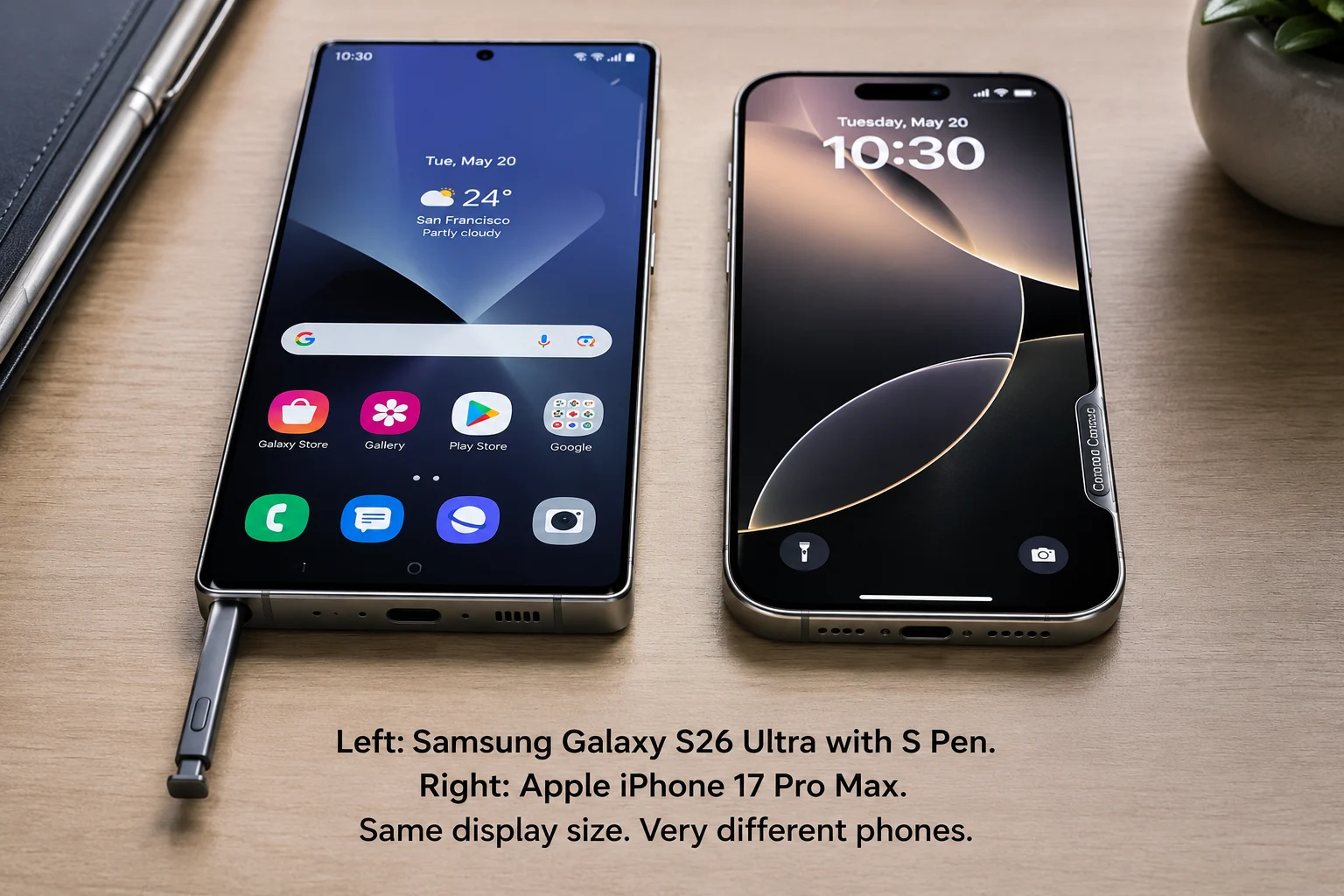
The Galaxy S26 Ultra is slightly taller and wider than the iPhone 17 Pro Max, but Samsung does more to make its Ultra feel slightly more manageable. The rounded corners on the S26 Ultra help with one-handed use more than the iPhone's flatter sides.
The iPhone 17 Pro Max uses Ceramic Shield glass on the back. Samsung uses Gorilla Glass Armor 2. Both survived two weeks of daily use without a case — something I tested deliberately and something most reviewers won't do with a $1,300 phone. No scratches on either. Both hold up.
One clear difference: the S26 Ultra comes in six colors, including a Cobalt Violet that genuinely stands out. The iPhone 17 Pro Max ships in three options — Silver, Cosmic Orange, and Deep Blue. If color matters to you, Samsung gives you more to work with.
The S Pen lives in the bottom of the S26 Ultra. It clicks in and out cleanly. I'll get into whether it's actually useful in a separate section — but its presence alone changes the physical profile of the phone in a way that takes about three days to feel natural.
Display — Samsung Wins on Paper, iPhone Wins in Sun
The S26 Ultra runs a 6.9-inch Dynamic AMOLED display at 3120x1440 resolution — 498 pixels per inch. The iPhone 17 Pro Max runs a 6.9-inch OLED at 2868x1320 — 458 PPI.
The S26 Ultra's display is measurably sharper. Reading small text, looking at detailed maps, zooming into photos — the difference is visible if you put the phones side by side and look for it. In normal daily use, both displays look excellent and most people won't notice the gap.
Where the iPhone wins: outdoor visibility. The iPhone 17 Pro Max hits 3000 nits peak brightness versus 2600 nits on the S26 Ultra. On a bright day in direct sunlight, I reached for the iPhone more confidently. The S26 Ultra is still very readable outdoors — it's not a weakness, just not the winner here.
Both run at 1Hz to 120Hz adaptive refresh. Both support HDR. Both look genuinely great for video. If you watch a lot of streaming content, you won't be disappointed with either.
Performance — Two Different Approaches to the Same Result
The S26 Ultra runs the Qualcomm Snapdragon 8 Elite Gen 5. The iPhone 17 Pro Max uses Apple's A19 Pro chip.
Geekbench numbers favor the A19 Pro in single-core performance. The Snapdragon 8 Elite Gen 5 competes closely in multi-core. In real-world use — switching apps, loading pages, editing photos, running games — both phones are fast enough that performance is never the limiting factor for anything you'll actually do with them.
Where the difference shows up: sustained performance under load. The S26 Ultra scores nearly 12% more in multicore but still can't run certain demanding games at 120fps while the iPhone does that comfortably. Apple's chip optimization and software integration means the A19 Pro translates raw numbers into smoother real-world output more efficiently.
For most people — including power users who aren't running GPU benchmarks for fun — both phones will feel identically fast. The performance conversation matters more for developers, heavy mobile gamers, and video editors.
Camera — The Most Important Section for Most People
Both phones have excellent cameras. Here is the honest breakdown by use case.
Main Camera
The S26 Ultra has a 200MP main camera. The iPhone 17 Pro Max has a 48MP main sensor. More megapixels don't automatically mean better photos — Samsung bins those 200MP pixels together in most lighting conditions for a 12MP or 50MP output that captures more light.
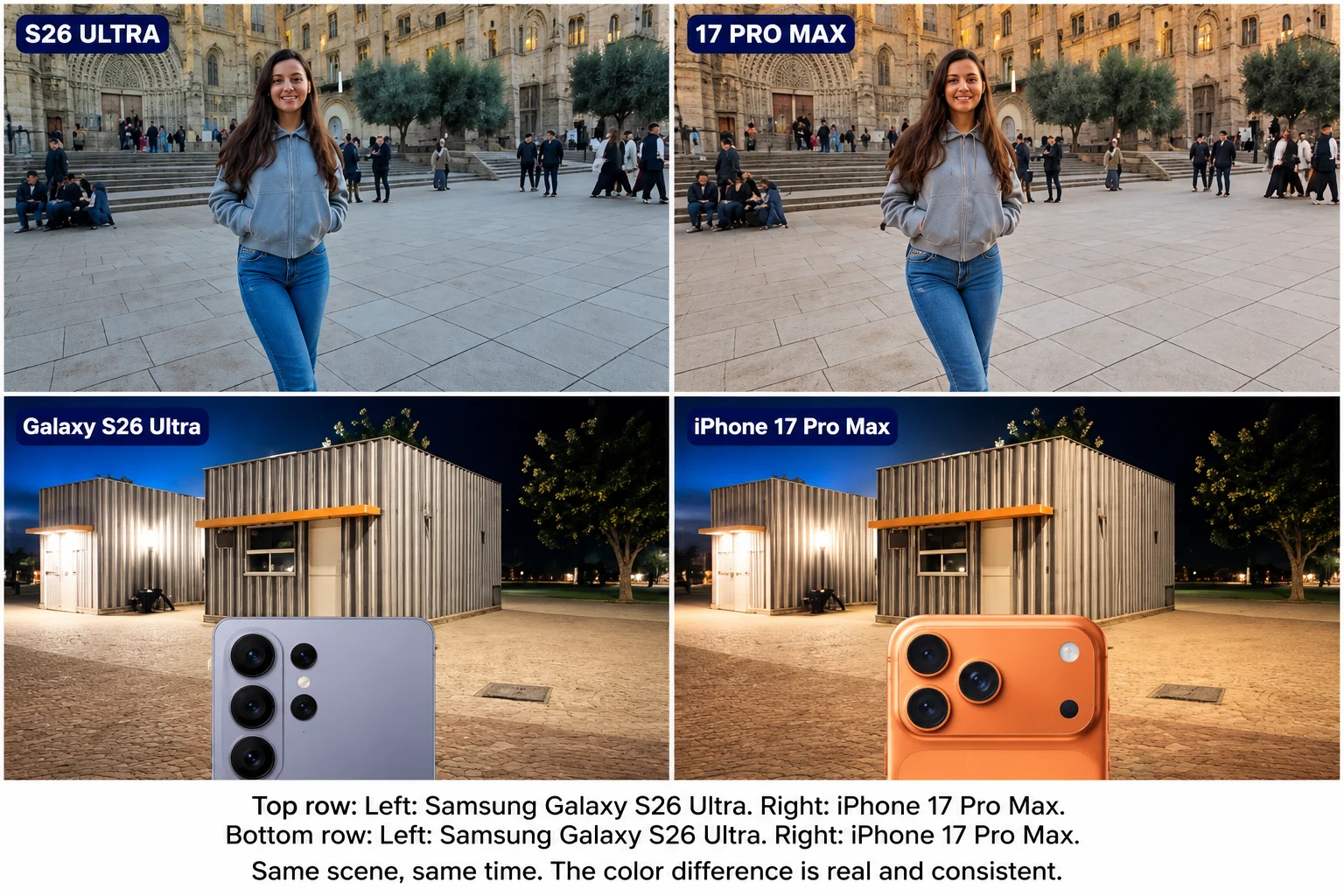
In daylight, both cameras produce photos that are hard to distinguish at normal viewing sizes. The S26 Ultra's processing tends toward cooler, slightly more saturated colors. The iPhone's output is warmer and more natural — closer to what the scene actually looked like.
In low light, the iPhone 17 Pro Max produces cleaner images with better noise handling. iPhones are far better for night photography and slightly better for video quality. After two weeks of shooting in mixed conditions, I'd agree with that assessment. Night shots from the iPhone were noticeably cleaner in complex lighting — a restaurant, a street at night, indoor events.
Zoom
The S26 Ultra has a quad camera system. The telephoto reach is longer than the iPhone's triple setup. If you regularly photograph subjects at a distance — sports, wildlife, concerts — the S26 Ultra's zoom system is genuinely better.
Video
The iPhone 17 Pro Max is the better video camera. Stabilization, color science, and the integration with professional video apps (Log format, ProRes) all favor Apple. For anyone creating video content — even just for social media — the iPhone's video output requires less work in post.
Selfie Camera
Both phones feature capable selfie cameras. The Galaxy's 2026 improvement comes in the form of a wider lens, while the latest iPhone Pro Max features a multi-aspect sensor that can take landscape photos when you're holding the phone vertically. That iPhone feature is genuinely useful for group shots.
Camera Verdict
iPhone 17 Pro Max: better for night photography, video, and natural color accuracy. S26 Ultra: better for zoom range and daylight versatility with four cameras.
Battery Life — Closer Than You'd Think
The S26 Ultra has a 5000 mAh battery. The iPhone 17 Pro Max has a 5088 mAh battery. The iPhone's battery is slightly larger, but Samsung's AMOLED efficiency and Snapdragon power management close the gap.
In my two weeks of daily use — a mix of browsing, emails, calls, photography, and occasional streaming — both phones comfortably made it through a full day. Heavy users, meaning six or more hours of screen time, will see the iPhone edge slightly ahead in endurance.
One clear advantage for Samsung: charging speed. The S26 Ultra supports 45W wired charging. The iPhone 17 Pro Max charges at 27W. If you need to top up quickly between meetings, the Samsung gets to 50% faster.
Wireless charging supports 15W on both. Neither phone comes with a charger in the box.
S Pen — Useful or Gimmick?
The S Pen is included with the S26 Ultra at no extra cost. Apple's equivalent stylus, the Apple Pencil, requires a compatible iPad and costs separately.
After two weeks with the S Pen, my honest assessment is: it's genuinely useful for specific things and irrelevant for everything else.
Taking handwritten notes in meetings is faster with the S Pen than typing on a phone keyboard. Signing PDFs without printing them. Annotating screenshots before sending to clients. Sketching quick diagrams.
If none of those tasks are part of your regular workflow, the S Pen will live in its slot and you'll occasionally show it to people as a conversation piece. That's fine — it adds value for those who use it and costs nothing extra for those who don't.
When you factor in the S Pen's value as a productivity tool, the $100 price premium over the iPhone 17 Pro Max shrinks in significance. That's a fair point. A standalone stylus for the iPad costs $129.
AI Features — Galaxy AI vs Apple Intelligence
Both phones ship with their own AI systems in 2026. Neither is as capable as using a dedicated AI app like Claude or ChatGPT — but both are genuinely useful for specific on-device tasks.
Galaxy AI on the S26 Ultra handles real-time translation during calls, note summarization with the S Pen, Circle to Search (draw a circle around anything on screen and search it), and generative photo editing. The Circle to Search feature alone earned it about three compliments from people watching me use it.
Apple Intelligence on the iPhone 17 Pro Max handles email summarization, notification prioritization, writing suggestions across apps, and improved Siri integration. The email summarization is the feature I used most — scanning a long email thread and getting a three-sentence summary saves real time.
Both AI systems are more useful than they were a year ago. Neither replaces a dedicated AI writing or productivity tool. See our full guide to AI tools on TechVaultAI for what pairs well with either phone.
Ecosystem — The Real Deciding Factor
For many people, this choice will come down to the ecosystem. If you already use Apple products like the Apple Watch, MacBook, and iPad, the iPhone 17 Pro Max has an obvious pull.
This is genuinely true and often undersold in comparison articles. If your laptop is a MacBook, your tablet is an iPad, and your watch is an Apple Watch — switching to an Android phone creates friction at dozens of small touchpoints every day. AirDrop, Handoff, iMessage, iCloud Photos, Universal Clipboard.
The same logic applies in reverse. If you use a Windows PC and a Galaxy Watch, the Android ecosystem is where things connect cleanly.
Neither ecosystem is objectively better. The right phone is the one that slots into the rest of your digital life with the least resistance.
Price — What You Actually Pay
The S26 Ultra starts at $1,299 for 256GB. The iPhone 17 Pro Max starts at $1,199 for 256GB. Samsung costs $100 more at the base level.
At the 512GB tier: S26 Ultra is $1,499. iPhone 17 Pro Max is $1,399. Still $100 apart.
At 1TB: S26 Ultra is $1,799 with 16GB RAM. The iPhone is $1,599 with 12GB RAM. The gap widens, but Samsung gives you more RAM at that tier.
The iPhone 17 Pro Max offers a 2TB option. There is no 2TB Galaxy S26 Ultra. If storage is a priority and you shoot a lot of 4K video, that iPhone-exclusive tier matters.
One thing worth knowing: the 2026 memory chip shortage has kept storage upgrade prices elevated across both brands. If 256GB is enough for your needs, sticking with the base model saves $120 to $360 regardless of which phone you choose.
Who Should Buy Which Phone
Buy the Samsung Galaxy S26 Ultra if:
You're already on Android and happy with the ecosystem
You take a lot of photos at zoom distances
You write or annotate regularly and the S Pen sounds useful to you
You want the sharpest display currently available
Fast charging between meetings matters to your day
Buy the iPhone 17 Pro Max if:
You're in the Apple ecosystem (MacBook, iPad, Apple Watch)
You shoot video and want the best mobile video quality available
Night photography is something you do regularly
You want the better outdoor display brightness
You prefer Face ID over in-display fingerprint
You need 2TB of storage
Wait if:
You are an iPhone user and don't urgently need an upgrade — iPhone 18 is expected in September 2026
Your current phone still works well — the average iPhone is now held 3.80 years before trade-in, a record high in 2025. There's real wisdom in that
Final Verdict
For most buyers in 2026, the choice comes down to ecosystem preference — raw spec differences alone no longer justify switching. That's the most honest sentence in any S26 Ultra vs iPhone 17 Pro Max comparison, and I'd stand behind it after two weeks with both.
The Samsung Galaxy S26 Ultra is the better phone on paper: sharper display, more cameras, included S Pen, faster charging, and lighter weight despite the larger feature set. If specs drove buying decisions, Samsung would win more market share than it does.
The iPhone 17 Pro Max is the better phone for how most people actually live: cleaner software, better video, superior ecosystem integration for Apple users, and the camera system that produces the most natural-looking results without editing.
Neither is a bad choice. The question is which one fits your life — not which one wins a benchmark.
If you're starting fresh with no ecosystem loyalty, the S26 Ultra at $1,299 gives you more hardware for the money. If you're embedded in Apple's world, the iPhone 17 Pro Max is the right call and worth the slight price discount.
Check S26 Ultra price at Samsung.com — Check iPhone 17 Pro Max at Apple.com
Full Specs — Side by Side
Category | Samsung Galaxy S26 Ultra | Apple iPhone 17 Pro Max |
Launch Date | March 11, 2026 | September 19, 2025 |
Starting Price | $1,299 | $1,199 |
OS | Android 16, One UI 8 | iOS 18 |
Processor | Snapdragon 8 Elite Gen 5 | Apple A19 Pro |
RAM | 12GB / 16GB (1TB) | 12GB |
Storage | 256GB / 512GB / 1TB | 256GB / 512GB / 1TB / 2TB |
Display Size | 6.9 inches | 6.9 inches |
Display Type | Dynamic AMOLED | OLED |
Resolution | 3120 x 1440 (498 PPI) | 2868 x 1320 (458 PPI) |
Refresh Rate | 1–120Hz adaptive | 1–120Hz adaptive |
Peak Brightness | 2600 nits | 3000 nits |
Main Camera | 200MP, f/1.7 | 48MP, f/1.8 |
Camera System | Quad (200MP + 50MP + 10MP + 50MP) | Triple (48MP + 48MP + 12MP) |
Front Camera | 12MP | 24MP |
Battery | 5000 mAh | 5088 mAh |
Wired Charging | 45W | 27W |
Wireless Charging | 15W | 15W |
Dimensions | 163.6 x 78.1 x 7.9mm | 163.4 x 78.0 x 8.75mm |
Weight | 214g | 233g |
Build | Gorilla Glass Armor 2 + Aluminum | Ceramic Shield + Aluminum |
Biometrics | Ultrasonic in-display fingerprint | Face ID |
S Pen | Included | No |
Water Resistance | IP68 | IP68 |
5G | Yes | Yes |
Satellite Connectivity | No | Yes (Emergency SOS) |
USB | USB-C 3.2 | USB-C 3.2 |
Colors | 6 options | 3 options |
Frequently Asked Questions
Is the Samsung Galaxy S26 Ultra worth the extra $100 over the iPhone 17 Pro Max?
For Android users — yes, if you use the S Pen or need longer zoom reach. For iPhone users — the ecosystem lock-in makes the $100 irrelevant. Switch for reasons beyond price.
Which phone has better battery life?
In real-world testing both last a full day comfortably. The iPhone 17 Pro Max has a marginally larger battery. The S26 Ultra charges faster at 45W. If battery longevity is your priority, iPhone edges ahead; if fast top-ups matter more, Samsung wins.
Is the iPhone 17 Pro Max camera better than the S26 Ultra?
For night photography and video — yes, the iPhone is better. For zoom and camera versatility — S26 Ultra wins with four lenses. For daylight stills, they're close enough that personal taste in color science matters more than specs.
Should I wait for the iPhone 18?
If you're on an iPhone and it still works reasonably, yes. iPhone 18 is expected September 2026. If you're on Android and considering switching, the iPhone 17 Pro Max is still a very current phone and won't feel outdated in 2026.
Which phone is better for content creators?
iPhone 17 Pro Max for video creators. S26 Ultra for photographers who need zoom and versatility. Both are capable enough that your skill and lighting matter more than which device you're using.
Can I see more phone and gadget comparisons?
Yes — visit our gadget and phone reviews section at TechVaultAI for hands-on comparisons of the latest devices.
Disclosure: Links to Samsung.com and Apple.com in this article are not affiliate links. TechVaultAI tested both devices independently. No phones were provided by manufacturers for this review.
Used either of these phones? Tell us what you actually think in the comments — especially if your experience differs from ours.