Samsung Galaxy Z Fold 8 & Z Flip 8 Review (2026)

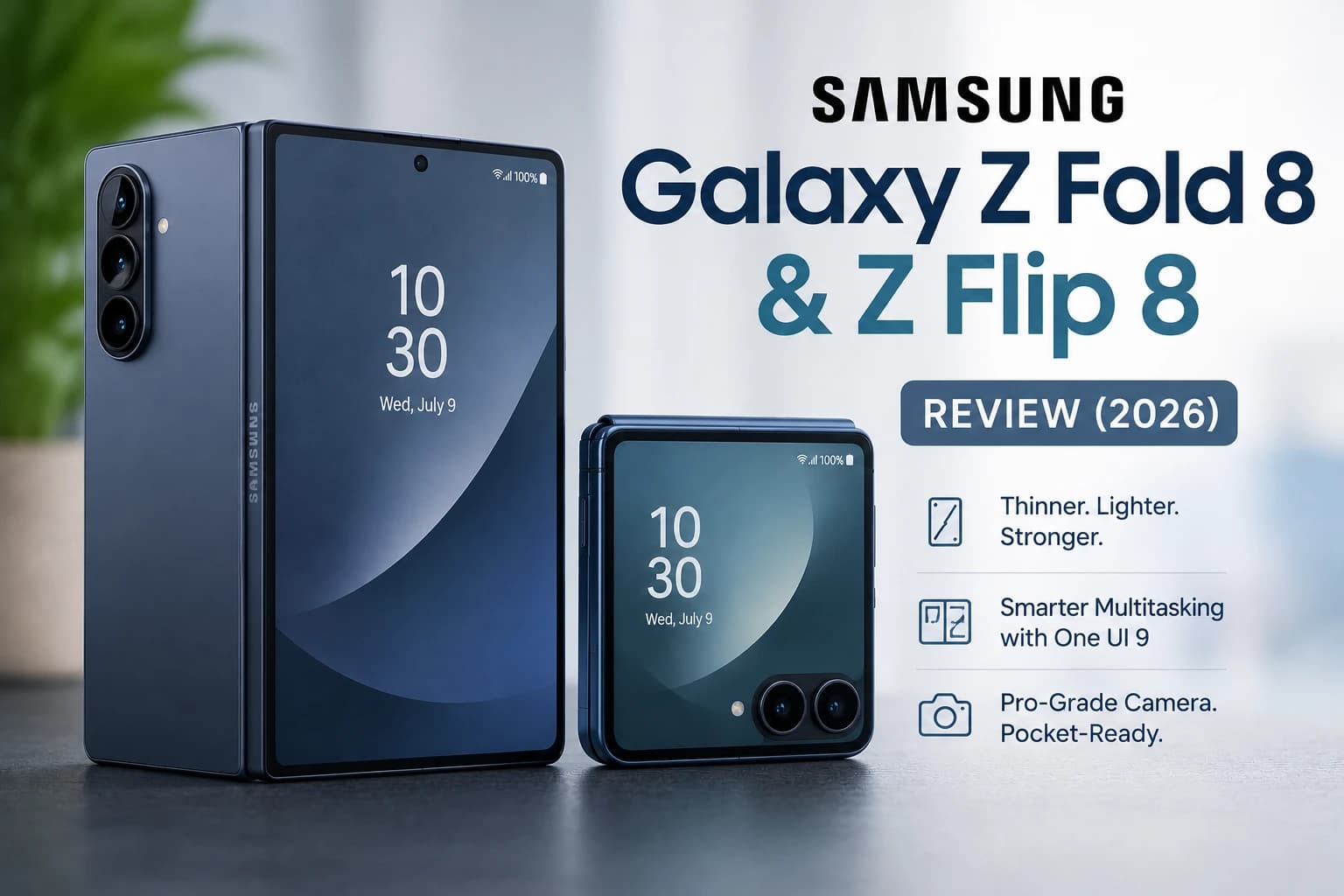
Samsung hasn't had a quiet year in a long time, but 2026 is different. Apple is coming — an iPhone Fold is expected later this year, a clamshell model reportedly in development behind it. Motorola's Razr lineup has been steadily eating into the Flip's price positioning. Google is updating its Pixel foldable. For the first time since Samsung more or less invented this category, they're building from a place of real competitive pressure rather than comfortable market leadership.
That pressure is visible in both phones. The Galaxy Z Fold 8 and Z Flip 8 — set to be announced at Galaxy Unpacked in London on July 22, 2026 — don't feel like the kind of updates a company makes when it knows nobody's catching up. They feel like the kind Samsung makes when it's looking in the rearview mirror.
Whether that's enough to justify the price is the question we'll answer here.
If You Only Have Two Minutes
The Z Fold 8 is the most meaningful Fold upgrade in several generations. A 200MP main camera, a 5,000mAh battery that finally breaks a five-year flatline, and 45W charging that honestly should have shown up three generations ago. It starts at $1,999. If you're coming from a Z Fold 5 or older, the upgrade makes sense. If you bought the Fold 7 last year, you'll feel the improvements but probably not enough to justify the cost of switching this soon.
The Z Flip 8 tells a different kind of story. The specs on paper don't look dramatic — same battery cells, same camera hardware as the Flip 7. But the Exynos 2600 chip on Samsung's 2nm process should deliver real battery gains through efficiency alone, and the physical design gets meaningfully thinner and lighter. It starts around $949. Right now, it's the best clamshell foldable money can buy — though that calculus may shift when Apple eventually shows its hand.
Samsung Galaxy Z Fold 8
Design and Display
The crease has been the defining complaint about Z Fold phones since the beginning. Every year there's some improvement, every year reviewers note that it's still there. The Z Fold 8 takes the most significant structural step yet — a dual-layer Ultra Thin Glass construction with a laser-drilled metal plate underneath — and reports suggest around 20% less visible crease than the Z Fold 7. Not gone, but genuinely better.
It's worth saying plainly: no foldable from any manufacturer has eliminated the crease. It's not a Samsung failure or a quality control issue — it's the physics of bending glass repeatedly. Anyone promising a crease-free foldable before this technology matures is selling you something. The Z Fold 8's 20% reduction is real progress.
Beyond the crease, the display specs land at 6.5 inches on the cover and 8 inches on the inner screen, both at 120Hz Dynamic AMOLED. Samsung is adding a Privacy Display mode that makes the screen harder to read from side angles — a small feature that will matter a lot to anyone who works on their phone in coffee shops or open offices. The weight comes down from 215g on the Z Fold 7 to around 201g, which is more noticeable in your hand than the number suggests.
Performance
The Snapdragon 8 Elite Gen 5 for Galaxy — built on Samsung's 2nm process — is the same chip in the Galaxy S26 Ultra. Paired with up to 16GB of RAM and storage up to 1TB, the multitasking experience on the inner screen should finally feel as fast as the hardware justifies. Previous Fold generations occasionally had the frustrating quality of looking like a productivity powerhouse while feeling slightly sluggish in split-screen. That should be resolved here.
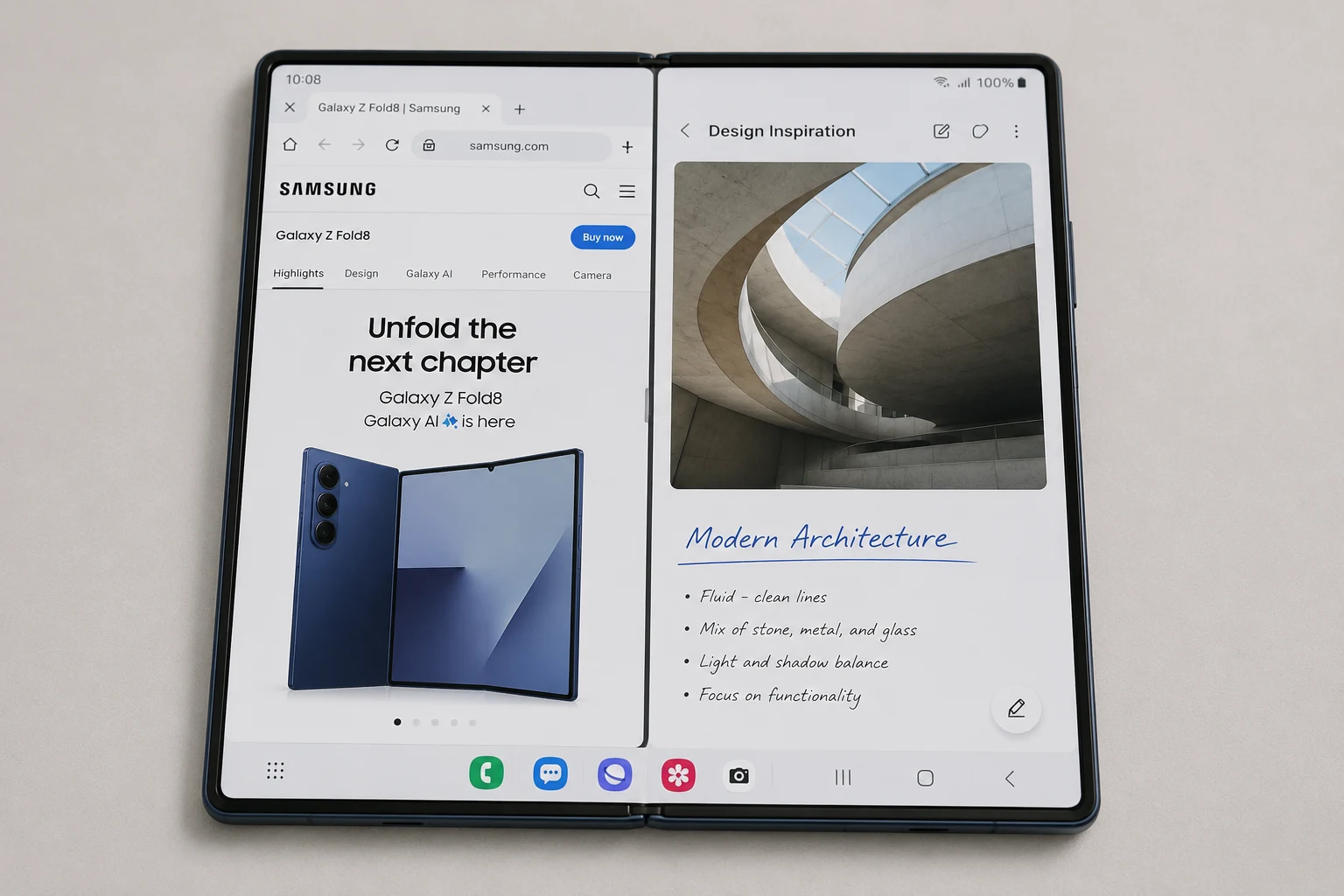
One UI 9 on Android 17 brings Gemini Intelligence system-wide, and for the first time this genuinely feels designed for a foldable rather than adapted for one. Multi-app AI automation — pulling information from one window while composing in another, summarizing a document while a meeting runs in the other half of the screen — makes more intuitive sense on an 8-inch display than on any slab phone.
Camera
This is where the Z Fold 8 makes its clearest argument.
The main camera goes to 200MP with a 1/1.3-inch sensor — the same physical sensor size as the Galaxy S26 Ultra. Samsung has been criticized fairly for years for selling a phone that costs as much as a small laptop while giving it camera hardware that trailed its own flagship S series. That criticism is now addressed, at least on the primary lens.
The ultrawide upgrade matters more than the headline number suggests. The Z Fold 7 shipped with a 12MP ultrawide while the S25 Ultra was at 50MP — a four-generation gap within Samsung's own lineup. The Z Fold 8 moves to 50MP with a 120-degree field of view and substantially better low-light performance. Fold owners have been asking for this since the Z Fold 4. It's here.
The telephoto holds at 10MP with 3x optical zoom, unchanged. That's a fair trade given everything else that moved this generation, though it'll remain a talking point.
Battery — Breaking Five Years of Stagnation
Samsung held the Z Fold battery at 4,400mAh across the Z Fold 3, 4, 5, 6, and 7. Five consecutive generations. All while adding features, brighter displays, and more processing power that drained that same capacity faster each year. Battery endurance became the most consistent complaint from long-term Fold owners, and it was a fair one.
The Z Fold 8 moves to 5,000mAh — up 600mAh, the first increase since the Z Fold 2 in 2020. Charging jumps from 25W to 45W wired, alongside 20W Qi2.2 wireless and 4.5W reverse wireless. That's a bigger tank and a faster fill, exactly the combination that should have arrived a generation or two ago.
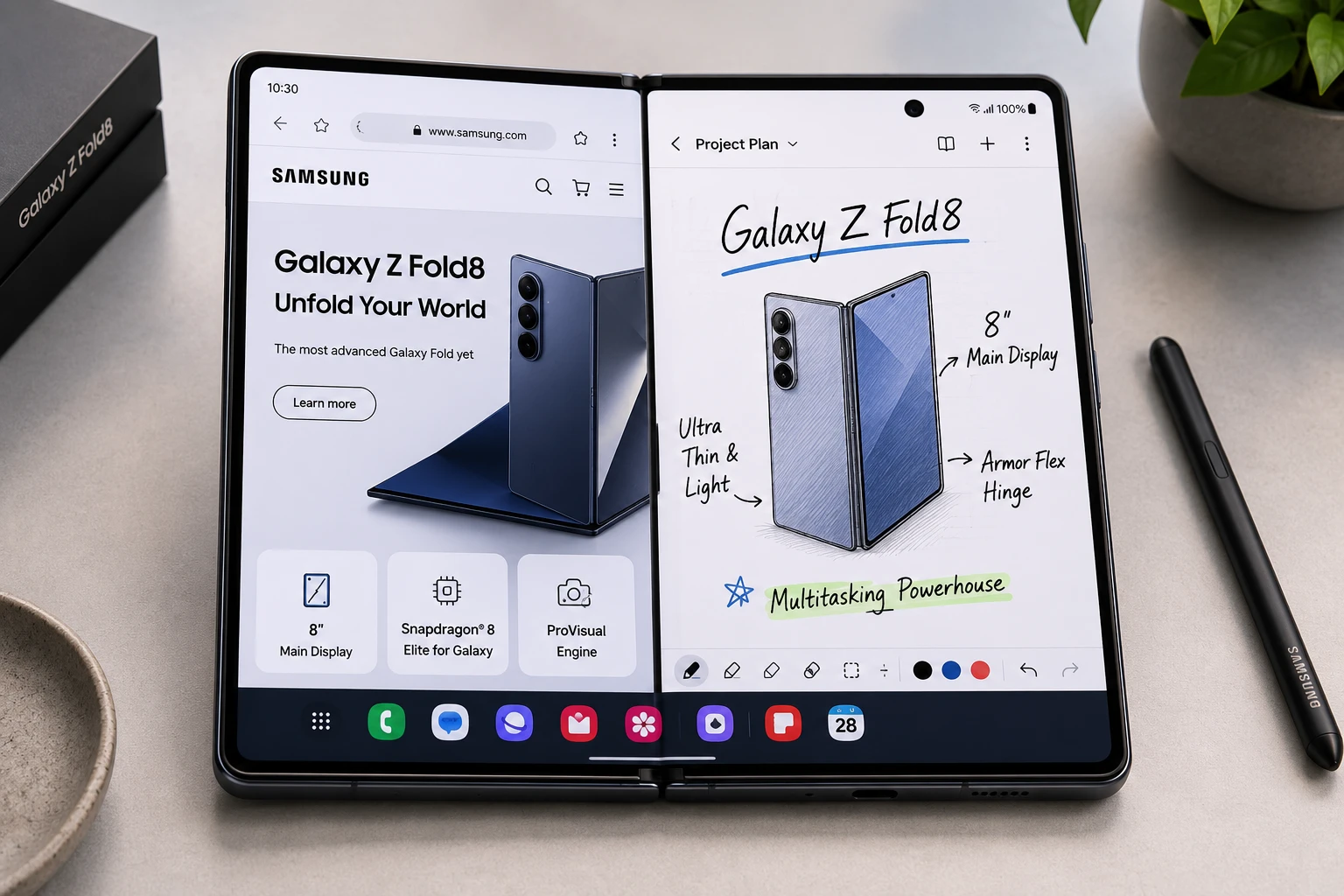
For moderate daily use — email, browsing, some video, occasional multitasking — a full day looks very achievable. Heavy inner-screen multitasking will still pull more power than a conventional slab phone, but the worst-case scenario improves meaningfully.
Visit Our Latest Comparison: S26 Ultra vs iPhone 17 Pro Max
Price
Configuration | Expected Price |
256GB | $1,999 |
512GB | $2,199 |
1TB | $2,499+ |
The entry price holds flat against the Z Fold 7. Given that component costs have been rising industry-wide due to the ongoing DRAM shortage, keeping the base model at $1,999 looks like a deliberate competitive decision with Apple's foldable positioning in mind.
If you're on a Z Fold 5 or older, the camera, battery, and AI package together make a genuine case for upgrading. If you bought the Fold 7 last year, the improvements are real — just probably not $1,999 worth of real on top of what you already have.
Best Android Phones of 2026: Full Rankings — internal link
Samsung Galaxy Z Flip 8
Design
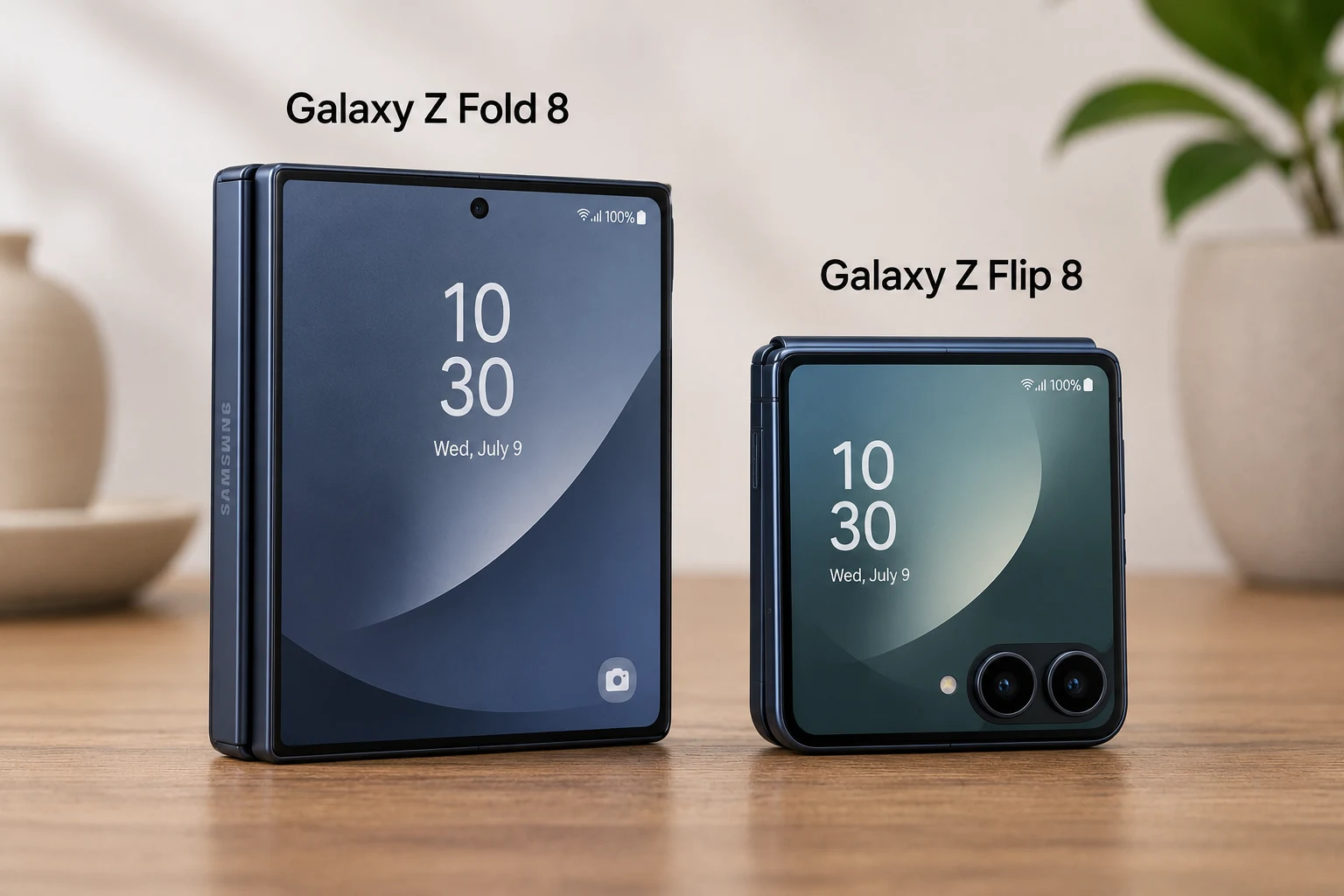
Samsung's internal target for the Z Flip 8 was a 10% thickness reduction versus the Z Flip 7, reportedly as a direct response to Apple's anticipated clamshell designs. Leaker Jukan flagged this in November 2025, and the CAD renders OnLeaks published in April 2026 support the direction. Weight reportedly lands around 180g, which is lighter than most conventional flagship smartphones.
The cover screen grows from 3.4 inches to 4.1 inches. That jump is more significant than it looks in a spec sheet. A larger cover screen changes how you actually use the phone day to day — reading full notifications without opening the device, replying to messages, checking calendar events. Samsung has been pushing this functionality further each generation, and 4.1 inches crosses a threshold where the cover display becomes a genuinely useful interface rather than a glanceable window.
Performance
The Z Flip 8 runs on the Exynos 2600 in most markets, with the same Snapdragon 8 Elite Gen 5 regional split for the US that Samsung used with the Galaxy S26. The Exynos 2600 is built on Samsung's 2nm process.
The efficiency story from the S26 is relevant here. The Galaxy S26 used identical battery cells to the S25 but delivered 30 to 60 minutes more screen-on time purely through chip efficiency gains. The Z Flip 8 carries the same battery hardware as the Flip 7 and is expected to benefit from the same dynamic. You're not getting more milliamp-hours — you're getting a chip that wastes less of them.
RAM sits at 12GB with 256GB or 512GB storage options. One UI 9 on Android 17 brings Galaxy AI features adapted for a single-screen layout — camera processing, writing tools, intelligent notifications — rather than the multi-window automation that makes more sense on the Fold.
Camera
The camera is where the Z Flip 8 shows its hand as a refinement year rather than a reinvention. The main sensor stays at 50MP, the ultrawide at 12MP — the same configuration as the Z Flip 7.
What improves is the processing behind those sensors. The Exynos 2600 handles more computational photography work, video stabilization improves, and Galaxy AI's scene recognition and portrait processing get updated. Real-world shots will look better than Flip 7 shots in controlled testing, but the improvement comes from software and processing rather than new glass or larger sensors.
If camera quality is your primary buying criterion, the Z Fold 8 or the Galaxy S26 will serve you better. The Flip's camera has always been about convenience — good enough for everyday use and social media, exceptional in the context of a flip phone, not trying to compete with dedicated camera phones.
Battery
GalaxyClub identified the Z Flip 8's battery components by part number through FCC filings in March 2026 — a dual-cell setup totaling 4,300mAh, identical to the Z Flip 7 cells. The hardware hasn't changed.
The expected improvement, as with the performance section, comes from the chip. Charging supports 25W wired and 15W Qi2.2 wireless — unchanged from the previous generation.
Price
Configuration | Expected Price |
256GB | ~$949–$999 |
512GB | ~$1,099 |
Samsung appears to be holding near the Z Flip 7's launch pricing, which is the right call given Motorola's competitive presence in the clamshell segment at lower price points.
If you're coming from a Z Flip 6 or earlier, the Flip 8 is an easy recommendation. If you bought the Flip 7 last year, the thinner design and efficiency gains are genuine — but the camera hardware and battery capacity being unchanged makes the upgrade a personal call rather than an obvious one.
Samsung Galaxy S26 Ultra Review: The Benchmark That Sets the Bar — internal link
Z Fold 8 vs Z Flip 8 — Which One Is Actually for You
These aren't competing products. They're for different people with different priorities, and the choice between them usually becomes obvious once you answer one question: do you want a phone that functions like a small tablet when you need it, or do you want a phone that disappears into your pocket?
Z Fold 8 | Z Flip 8 | |
Starting Price | $1,999 | ~$949 |
Form Factor | Book-style, tablet inner screen | Clamshell, pocketable |
Best For | Productivity, multitasking, power users | Everyday carry, design-conscious buyers |
Main Camera | 200MP, S Ultra-class sensor | 50MP, same as Flip 7 |
Battery | 5,000mAh, 45W charging | 4,300mAh, 25W charging |
AI Features | Multi-window Gemini Intelligence | Galaxy AI, single-screen |
Software Updates | 7 years | 7 years |
The Fold 8 is a productivity tool that happens to make calls. The Flip 8 is a stylish everyday phone that happens to fold. Neither choice is wrong — they're just different answers to different questions.
What's Still Unconfirmed Before July 22
A few things remain open that could change the final verdict on either device.
S Pen on the Z Fold 8 — the Z Fold 7 dropped it, which frustrated a lot of productivity users. The Fold 8's slightly increased thickness has sparked rumors that S Pen support returns, but Samsung hasn't said anything officially. If it comes back, it changes the value proposition for note-taking and sketching workflows.
The Z Flip 8 US chipset — regional Snapdragon versus Exynos matters for raw performance and thermal management. US buyers on Snapdragon would get the best possible outcome from this hardware generation. Still unconfirmed.
Camera samples — a 200MP sensor is only worth something if it delivers in practice. Pre-release spec sheets mean very little without real-world test shots across lighting conditions. We'll have those after hands-on time at Unpacked.
Learn Notion AI Worth It for Small Teams in 2026?
Final Verdict
The Z Fold 8 is the Fold that long-time fans have been waiting for. The camera closes the gap with Samsung's own S Ultra lineup, the battery finally grows to match what the hardware demands, and the AI features are genuinely built for the form factor rather than awkwardly adapted for it. At $1,999 it's still a lot of money, but it's easier to justify now than any previous Fold has been.
The Z Flip 8 is a refinement of something already working well. On paper it doesn't look like a big year, and for anyone upgrading from the Flip 7 it probably isn't. For everyone else — Flip 6 or older, or switching from a conventional phone — it's the most polished clamshell foldable available.
We'll update this with full hands-on impressions from Galaxy Unpacked on July 22, 2026.
Frequently Asked Questions
When do the Z Fold 8 and Z Flip 8 go on sale?
Both are announced July 22, 2026 at Galaxy Unpacked in London. Pre-orders open the same day. Units should be on shelves in the first or second week of August 2026.
What does the Z Fold 8 cost?
Leaked pricing puts the 256GB base at $1,999, 512GB at $2,199, and 1TB at $2,499 or higher. Entry price is flat versus the Z Fold 7.
What does the Z Flip 8 cost?
SamMobile reports a starting price around $949.99 for the 256GB configuration — a modest increase over the Z Flip 7's launch price.
Is the S Pen coming back to the Z Fold 8?
Samsung hasn't confirmed it. Rumors point to it possibly returning due to the phone's slightly increased thickness, but this stays in the rumor column until July 22.
Should Z Flip 7 owners upgrade to the Z Flip 8?
Honestly, probably not unless the thinner design is genuinely important to you. The camera hardware and battery capacity are unchanged. The chip efficiency gains are real but unlikely to transform the day-to-day experience dramatically enough to justify the cost of trading in a year-old phone.
How long will both phones receive software updates?
Seven years of OS and security updates — Samsung's flagship commitment, applied to both Z series devices.
Bottom Line
The best Fold Samsung has ever made — better camera, bigger battery, smarter AI. At $1,999 it's still a serious investment, but finally worth it. Upgrade from Fold 5 or older. Hold off if you bought the Fold 7 last year.

Written by
Asif IqbalSenior Writer
Asif Iqbal is the Founder & CEO of Tech Vault AI, leading the team's hands-on testing of AI tools and SaaS products & Tech reviews. He's focused on cutting through marketing hype to help readers find what actually works.
Samsung Galaxy Z Fold 8 & Z Flip 8 Review (2026) reviews
Loading reviews...
Questions & Answers
Loading questions...
📬 Get the Latest Reviews in Your Inbox
Once a week — AI tools, SaaS & gadget reviews delivered straight to your email.