Samsung Galaxy Glasses (2026): Everything You Need
Smart glasses have been "almost ready" for about a decade. Google Glass launched in 2013 and became a punchline within two years. Meta and Ray-Ban changed the conversation in 2023 by making glasses that people actually wanted to wear in public.
Now Samsung and Google are entering that market together — and based on everything officially confirmed so far, they are taking a different approach than anyone who tried before them.
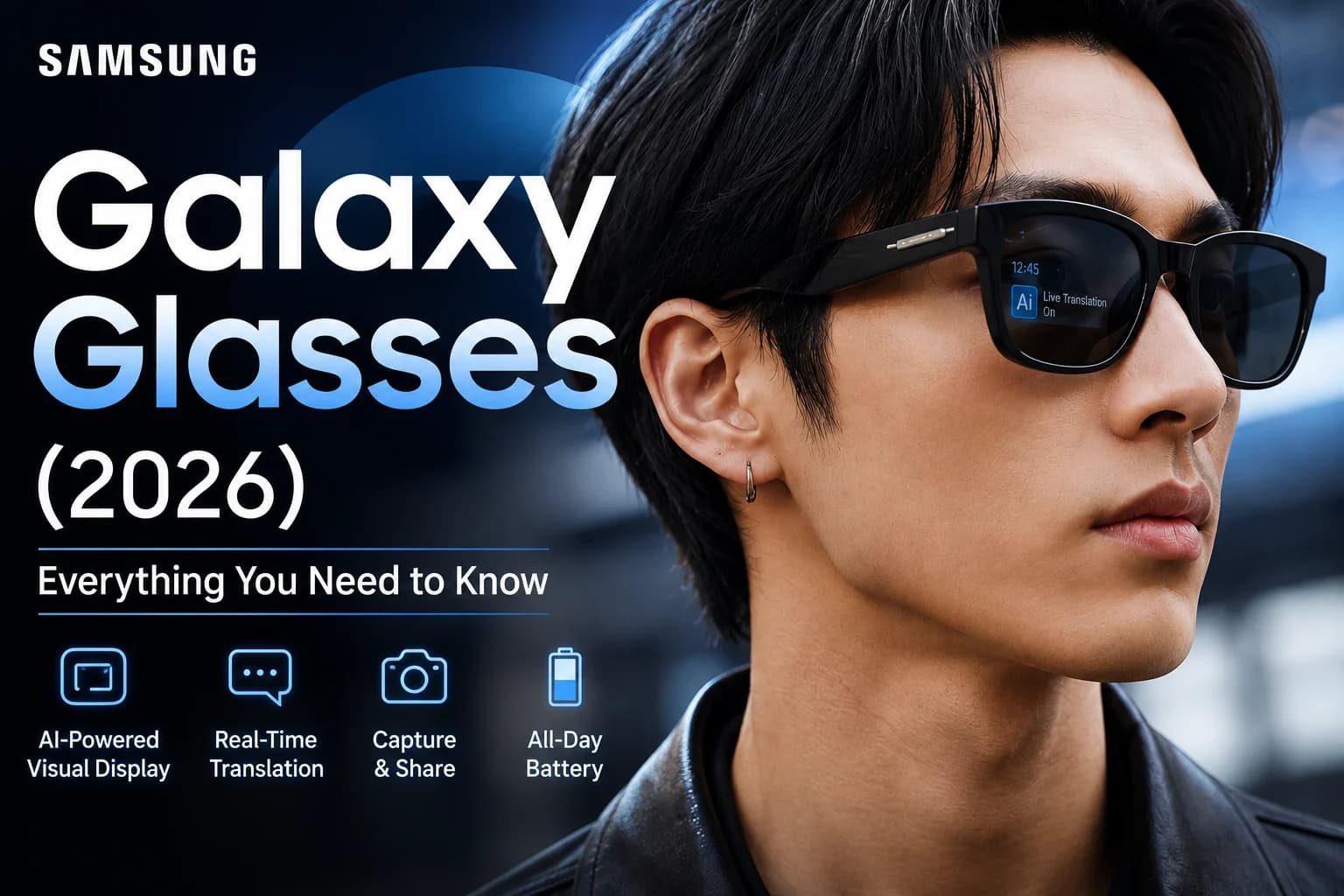
The Samsung Galaxy Glasses launch Fall 2026. They run Android XR, they are powered by Gemini AI, and they were built in collaboration with Gentle Monster and Warby Parker — two fashion-first eyewear brands with no history of making anything that looks remotely like a gadget.
Here is everything confirmed, everything credibly rumored, and one honest take on whether these glasses are worth waiting for.
Why This Launch Feels Different
Three things separate the Galaxy Glasses from every previous smart glasses attempt.
First, the timing. Meta's Ray-Ban glasses have already sold millions of units and trained consumers to accept cameras and AI assistants in everyday frames. The market exists in a way it simply did not when Google Glass launched. Samsung is not pioneering a category — it is competing in one that already has proven demand.
Second, the design partners. Samsung built the Galaxy Glasses with Gentle Monster for "disruptive yet refined aesthetics" and Warby Parker for "refined and timeless designs." That is not marketing language — it is a direct acknowledgment that smart glasses failed before because they looked like smart glasses. These are designed to look like glasses that happen to be smart.
Third, the AI layer. The Galaxy Glasses run Gemini AI and Android XR — the same platform powering Google Search, Samsung's device lineup, and the Galaxy XR headset already shipping in 2026. The integration is deeper than any previous smart glasses platform has managed.
Whether that translates into a product people actually use every day is the question Fall 2026 will answer.
Confirmed Specs and Features
Spec | Details | Source |
Launch | Fall 2026 | Google I/O 2026 — confirmed |
Design Partners | Gentle Monster, Warby Parker | Samsung press release |
OS | Android XR | Android.com/xr — confirmed |
AI | Gemini AI | Google I/O 2026 — confirmed |
Battery | 245 mAh | Geeky Gadgets — sourced |
Battery Life | 6–8 hours estimated | Geeky Gadgets — sourced |
Expected Price | $600–$900 | Multiple sources |
Display | Confirmed — at least one lens | Samsung demo footage |
Camera | Confirmed | Prototype demonstration |
Navigation | Holographic maps — confirmed | Samsung press release |
Translation | Real-time — confirmed | Google I/O demo |
Notifications | Caller ID, smart home — confirmed | Samsung press release |
Ecosystem | Galaxy Watch, Z Fold compatible | Samsung press release |
What Samsung Have Officially Confirmed
At Google I/O 2026, Samsung and Google confirmed the core capabilities. These are not rumors — they were demonstrated on stage or described in official press materials.
Real-Time Translation
Samsung's press materials confirm real-time translation as a primary use case. Based on the Google I/O demonstration, the translation appears as a visual overlay in the glasses' display — meaning you see translated text in your field of view rather than hearing it through a speaker.
This is the feature that most clearly separates the Galaxy Glasses from Meta's Ray-Ban. Ray-Bans handle translation through audio. A visual overlay changes the experience fundamentally — particularly for reading menus, signs, or text in a foreign language, where audio translation is clunky and a visual display makes immediate sense.
Navigation Assistance
Samsung confirmed holographic navigation maps as a primary use case. The official description: "holographic maps for intuitive navigation, offering a futuristic way to explore your surroundings."
What that means practically — based on similar features in other Android XR demos — is turn-by-turn directions appearing in your field of view while you walk. You look where you're going rather than down at your phone.
Caller ID and Smart Home Control
Samsung confirmed caller ID notifications and smart home control access through the glasses. These are quality-of-life features rather than showstoppers — but they reflect how the glasses are positioned: as a companion layer over your daily life, not a standalone computing device.
Gemini AI Integration
The Galaxy Glasses are powered by Gemini AI, enabling the glasses to answer questions, surface contextual information, and handle voice interactions. The Google I/O demo showed Gemini being used for navigation assistance and placing orders at restaurants — accessed through voice interaction rather than touching a phone.
The Real Competition: Meta Ray-Ban Glasses
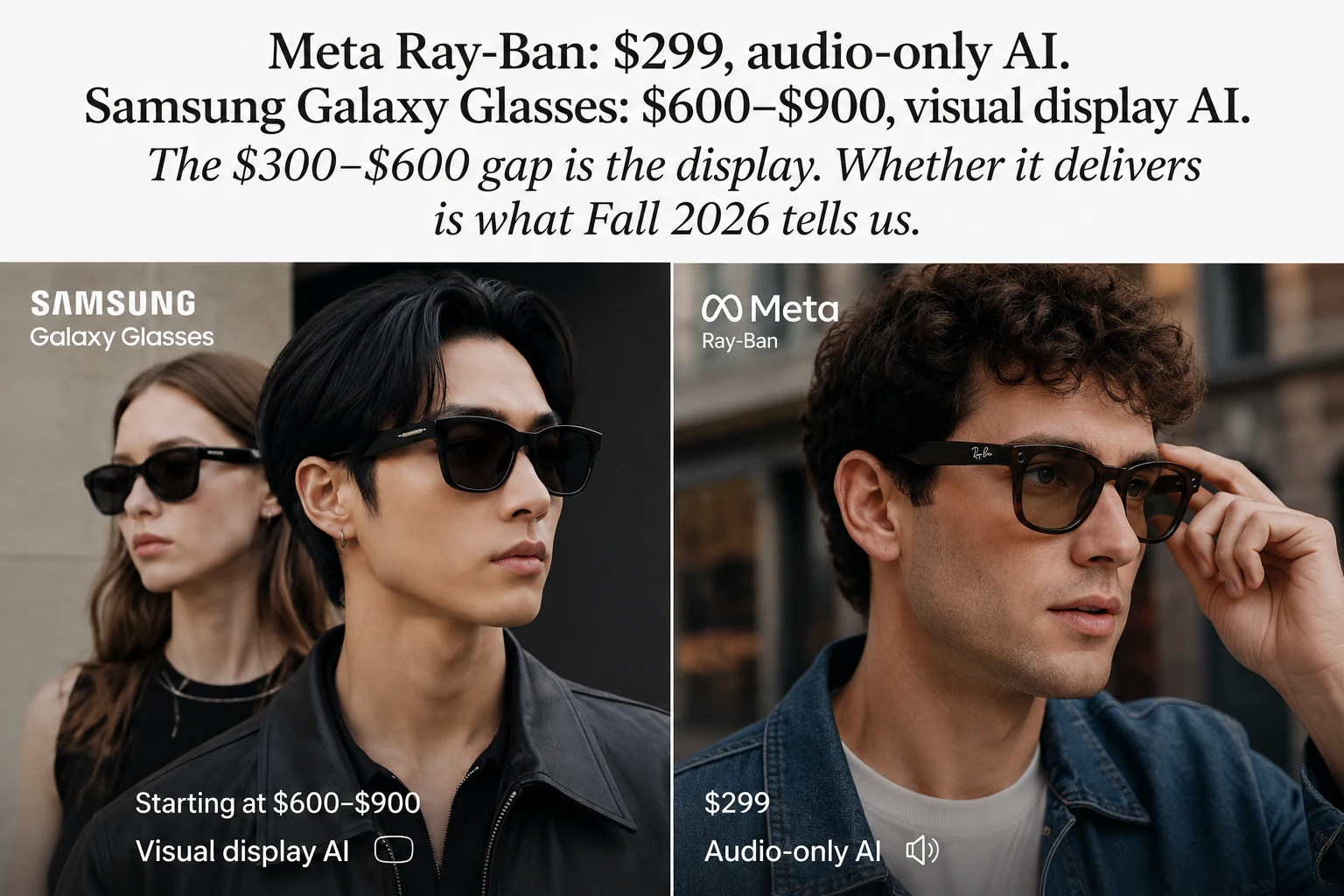
Any honest preview of the Galaxy Glasses has to address this directly. Meta's Ray-Ban glasses work. They sell. People wear them without embarrassment. The AI assistant is genuinely useful for quick questions and photo capture. Starting at $299, they are accessible enough that the average consumer can try them without a major financial commitment.
The Galaxy Glasses are expected to cost $600–$900. That is two to three times the price.
Samsung's answer to that gap has to be the display. That is the one confirmed feature Meta's glasses do not have, and it is the feature that changes what smart glasses can actually do for you. Audio-only AI glasses are a convenience. Glasses with a display that shows navigation, translation, and contextual information are a different category of device.
The honest caveat: we do not yet know how good that display is in real-world conditions. Field of view, visibility in direct sunlight, and whether the overlay feels natural or intrusive are all questions that press demos cannot answer. Those answers come when reviewers get the glasses in their hands — which has not happened yet.
That is the core risk of buying at launch.
Battery Life — The Honest Concern
245 mAh is a small battery. For context, the Apple Watch Ultra 2 has a 564 mAh battery and targets 36 hours of use. The Galaxy Glasses are targeting 6–8 hours from less than half that capacity.
That is technically feasible. Glasses are lighter than a watch, the display runs at low power for overlay use rather than full-screen video, and Gemini AI processing offloads to the companion phone rather than running entirely on-device. But 6–8 hours means most users will charge daily.
Whether the glasses come with a charging case — the kind that AirPods popularized, where the case itself holds multiple charges and the glasses charge passively when placed inside — has not been confirmed. If Samsung ships a charging case, daily charging becomes a non-issue for most users. If not, it is a real friction point for a $600–$900 device.
This is not a dealbreaker based on what we know. It is a detail worth watching when full product information arrives at Galaxy Unpacked on July 22.
Who These Glasses Make Sense For
Based on confirmed features and the price range, the Galaxy Glasses are clearly not targeting the same broad consumer that Meta targets at $299.
They make the most sense for frequent travelers who deal with language barriers regularly — visual translation overlays solve a real problem better than any audio alternative. They make sense for urban commuters and walkers who navigate on foot — glasses-based turn-by-turn directions remove a genuine daily friction point. They make sense for Samsung ecosystem users who already use Galaxy Watch, Galaxy phones, and Samsung's AI layer — the integration compounds the value across devices.
They make less sense for users who primarily want music and quick AI questions from their glasses. Meta's Ray-Ban covers that at $299 and does it well. The Galaxy Glasses charge a significant premium for the display and the deeper AI integration. If those features do not align with how you actually move through your day, the premium does not make sense.
For context on how these fit into the broader Samsung 2026 lineup — including the Z Fold 8 and Galaxy S26 Ultra — see our full Samsung device coverage at TechVaultAI.
How This Compares to Other Smart Glasses Launching in 2026
The smart glasses market in Fall 2026 is more competitive than it has ever been.
Meta's Ray-Ban Oakley AI glasses are already available with promotional pricing. The Asus ROG Xreal R1 targets gaming and productivity at $849 — a different use case but a similar price bracket. Apple's smart glasses remain unannounced with no confirmed launch date, though Apple's entry whenever it comes will reset expectations across the category.
Samsung launching Fall 2026 gives the Galaxy Glasses at minimum one full product cycle before Apple's version exists. That matters for early market positioning, accessory ecosystem development, and software maturity.
One factor Google and Samsung could leverage that competitors cannot easily match: Fitbit's health sensor technology. If the Galaxy Glasses incorporate heart rate or step tracking — which has not been confirmed but has been discussed by analysts — the value proposition changes significantly. A device that does navigation, translation, AI assistance, and health monitoring at $700 is a materially different product than audio glasses at $299.
For a broader look at AI-powered devices and tools launching in 2026, see our AI tools and gadgets review section.
What We Still Don't Know Before July 22
Samsung confirmed the glasses at Google I/O 2026 but held several details for the Galaxy Unpacked announcement on July 22 and the Fall launch.
Exact pricing within the $600–$900 range is unconfirmed. The display field of view — how much of your vision the overlay occupies and whether it feels natural — has not been published. Frame style options beyond Gentle Monster and Warby Parker collaborations have not been announced. The charging case situation is unconfirmed. Health tracking capabilities remain unconfirmed.
Most importantly: no independent reviewers have tested these glasses yet. Every feature described in this article reflects what Samsung and Google have demonstrated or officially stated. Real-world battery performance, display visibility in direct sunlight, translation accuracy in noisy environments, and whether the Gemini AI responses feel useful or frustrating in daily use — none of this is known.
We will update this article with hands-on coverage after the July 22 announcement and again at Fall launch. Bookmark our wearables and gadgets section for the latest.
Pros and Cons — Based on Confirmed Information Only
Pros:
Visual display separates them from every audio-only smart glasses competitor
Real-time visual translation is a confirmed feature that solves a real problem better than audio alternatives
Gemini AI integration is deeper than what Meta or any competitor currently offers in glasses form
Gentle Monster and Warby Parker design partnerships address the core reason smart glasses failed before
Deep Samsung ecosystem integration adds value for existing Galaxy users
Android XR platform means Google's full developer ecosystem from day one
Fall 2026 launch positions them ahead of Apple's entry into the category
Cons:
$600–$900 is two to three times the price of Meta Ray-Ban glasses
245 mAh battery means daily charging — charging case details unconfirmed
No independent hands-on reviews exist yet — display quality in real conditions is unproven
Companion device dependency — full value requires a Samsung Galaxy phone
Apple's smart glasses will likely arrive within 12–18 months and reset buyer expectations
Final Verdict — Before Launch
The Samsung Galaxy Glasses are the most capable smart glasses announced for 2026 based on confirmed features. The visual display, the Gemini AI integration, and the fashion-forward design approach each address a specific reason previous smart glasses attempts failed.
Whether they deliver on that potential is a question only hands-on reviews can answer. Display field of view, real-world translation accuracy, and battery life in actual daily use are all unknowns until Fall.
What the confirmed information makes clear: this is the first smart glasses announcement that meaningfully advances beyond what Meta's Ray-Bans do at the feature level. At $600–$900, the question is not whether Samsung has built something capable. The question is whether the visual display and AI integration justify paying $300–$600 more than glasses that already work well for millions of people.
For Samsung ecosystem users who navigate cities, travel internationally, and want the most forward-looking wearable on the market — the answer looks like yes, pending launch reviews.
For everyone else — the smart move is to wait for independent hands-on coverage before committing at this price.
We will cover the July 22 Galaxy Unpacked announcement in full and publish hands-on impressions as soon as review units are available. See all our gadget and wearables coverage at TechVaultAI.
Frequently Asked Questions
When do Samsung Galaxy Glasses launch?
Samsung confirmed a Fall 2026 launch at Google I/O 2026. More details are expected at Galaxy Unpacked on July 22, 2026 in London, with retail availability likely in September or October.
How much do Samsung Galaxy Glasses cost?
Multiple sources point to a $600 to $900 price range. Final pricing will be confirmed at Galaxy Unpacked on July 22.
Do Samsung Galaxy Glasses have a display?
Yes — Samsung confirmed a display in at least one lens. Unlike Meta's Ray-Ban glasses which are audio-only, the Galaxy Glasses show navigation, translations, and notifications visually in your field of view.
How long does the battery last?
The Galaxy Glasses have a 245 mAh battery with an estimated 6 to 8 hours of use depending on how intensively features like the display and AI are used. Whether Samsung includes a charging case has not been confirmed.
How do Samsung Galaxy Glasses compare to Meta Ray-Ban glasses?
Meta Ray-Bans start at $299 and offer audio-based AI assistance and photo capture without a visual display. Galaxy Glasses cost $600–$900 and add a confirmed visual display for navigation and AI overlays. The display is the core functional difference. Whether it justifies the price premium is something independent reviews will clarify.
📬 Get the Latest Reviews in Your Inbox
Once a week — AI tools, SaaS & gadget reviews delivered straight to your email.