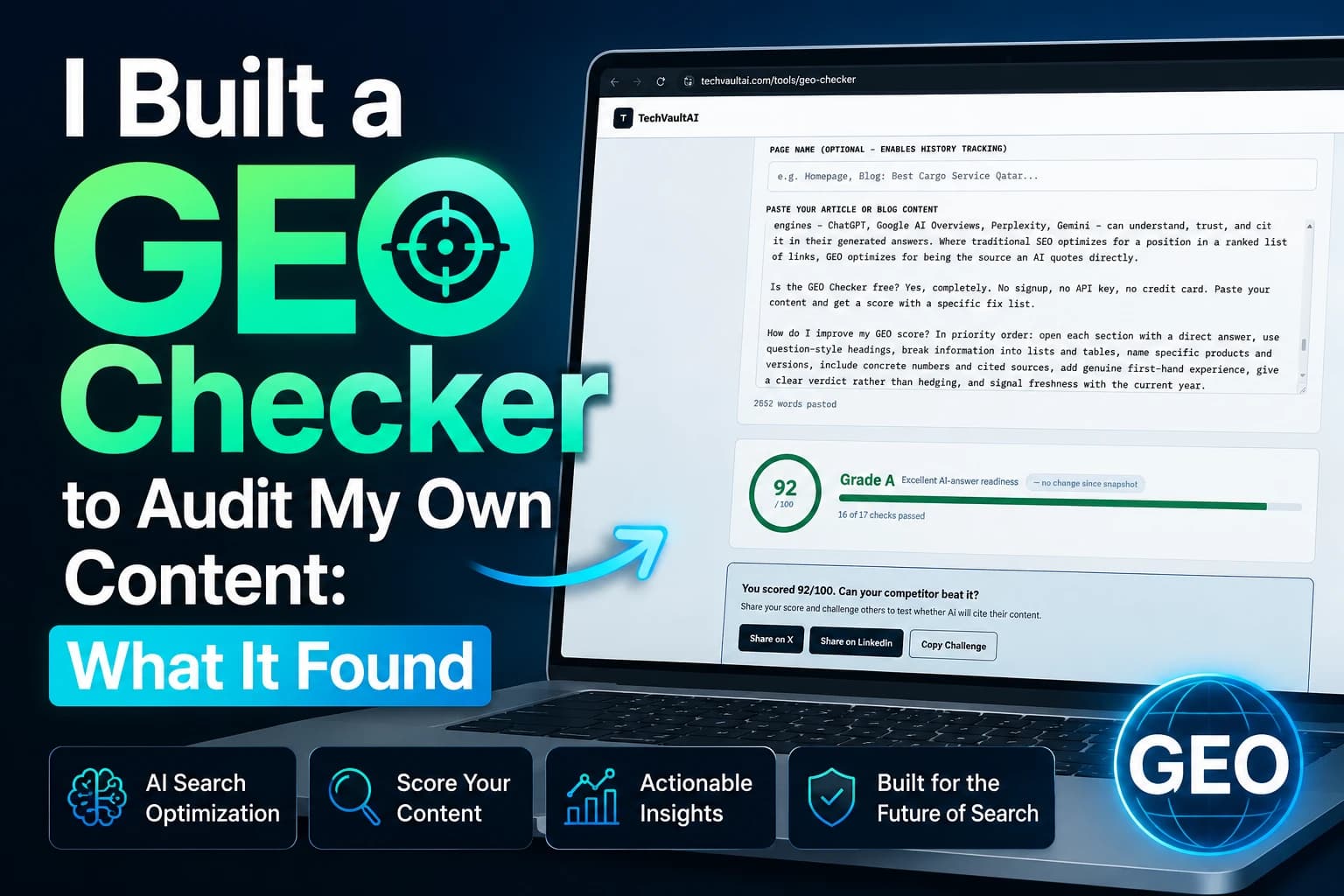
I Built a GEO Checker to Audit My Own Content: What It Found

Published: 13-7-2026 · Last updated: 13-7-2026 · Reading time: ~9 minutes
I built a free GEO Checker because I needed to answer one question about my own content: where are the gaps? Not a vague feeling that something could be better — I wanted a real breakdown of what was strong, what was weak, and exactly what to fix.
This is the full account of what I learned building it: what actually makes content citable by AI engines, what was harder than I expected, what the tool gets right, and — just as importantly — what it can't do.
If you just want to use it, it's free and needs no signup: GEO Checker.
Why I built it in the first place
The honest reason was a gap analysis on my own writing.
Search has fundamentally shifted. ChatGPT, Google's AI Overviews, Perplexity, and Gemini increasingly answer a question directly rather than sending someone to a page. When that happens, one of two things is true: either your content is the source the engine drew from and named — or it isn't, and you're invisible.
That's a binary outcome, and it's decided by things you can actually control. But I had no way to check which side of that line my content fell on. I could publish, wait months, and guess. That's not a system — that's hoping.
I looked for a tool that would tell me, before publishing, whether a piece was structured to be cited. What existed was either paid, or focused on classic SEO metrics (keywords, backlinks) that don't map to how AI engines pick sources. Nothing did the specific job I needed.
So I built one.
What the tool actually does
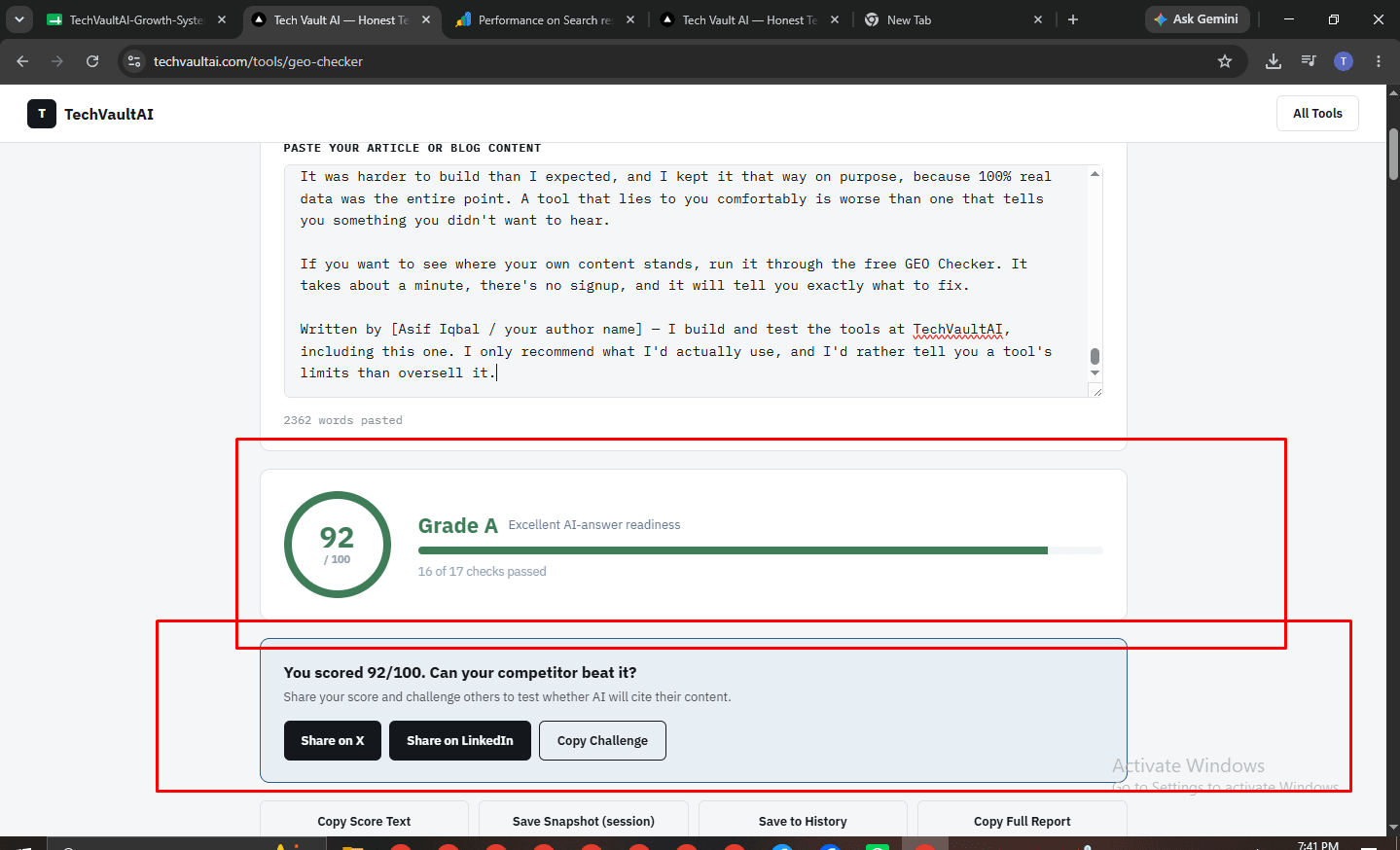
It scores any piece of content against 17 signals — the structural and credibility patterns AI answer engines tend to favor — and returns a score, a category breakdown, and a specific list of what's failing and how to fix it.
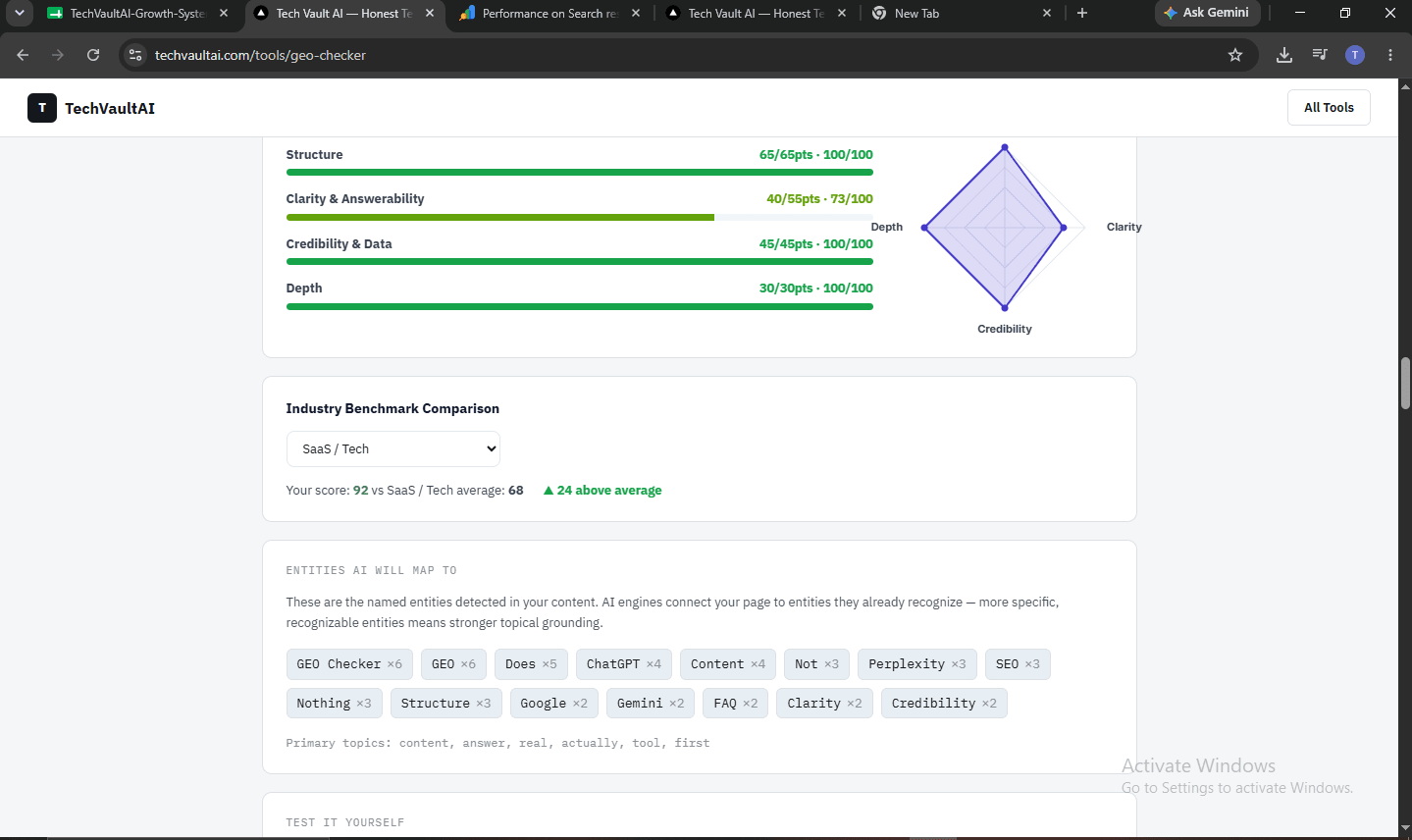
The 17 checks fall into four groups:
Structure — can an engine extract a clean answer from this?
- Does it open with a direct answer, not a wind-up?
- Are headings phrased as real questions people ask?
- Is information in lists and tables, or buried in dense prose?
- Are question headings actually followed by answers?
- Is there an FAQ section?
- Is there structural variety, or one wall of text?
Clarity — is the language quotable?
- Are sentences concise and scannable?
- Are there short, self-contained declarative statements an engine can lift?
- Are specific entities named — products, brands, versions?
- Are paragraphs short enough to parse?
Credibility — is this safe for an engine to repeat?
- Are there concrete numbers, data, or stats?
- Are sources cited or dated references given?
- Is there genuine first-hand experience?
- Does it signal freshness?
Depth — does it actually resolve the question?
- Is there sufficient depth, or is it thin?
- Does it cover the topic semantically — what, why, how, example?
- Does it give a comparison and a clear verdict?
You paste your content in, and it comes back with all of it: what passed, what failed, and what to change.
Building the scoring engine forced me to answer a question I'd been dodging: what specifically makes one piece of content better than another for AI search?
Not "write good content" — that's advice that helps nobody. I mean concretely: what do you change on the page?
Working through each signal, testing it, and watching what fired and what didn't, the picture got a lot clearer. Here's what actually matters, in the order I'd fix them.
1. Put the answer first
This is the highest-leverage change, and most content gets it wrong.
If your heading poses a question, the very next sentence should answer it — plainly, in one or two lines. Then elaborate. Most writers build up to the answer, saving it for the end like a reveal. AI engines don't wait for the reveal. They lift the opening block, and if the opening block is throat-clearing, you get skipped.
I found this pattern is nearly deterministic. Content that answers immediately gets pulled. Content that meanders does not.
2. Make it extractable
Lists. Tables. Short paragraphs. Clear sections.
A dense, beautifully-written paragraph might read wonderfully to a human and be nearly useless to an engine trying to pull a clean, quotable fact out of it. Structure isn't decoration — it's what makes extraction possible.
Any time you have a comparison, a set of steps, or a group of features, it belongs in a list or a table. Not prose.
3. Be specific — name real things
Vague content can't be connected to anything.
AI models understand the world through entities they already recognize: specific products, companies, versions, people, prices. When your content names them, the model can map your page onto its existing knowledge and treat you as a source about that thing. When your content says "this tool" and "the platform," there's nothing to grab onto.
Specificity isn't just better writing. It's what makes your content addressable.
4. Take a position
Content that resolves a decision gets surfaced. Content that ends in "it depends" does not.
This surprised me at first, but it makes sense: a person asking an AI engine which tool to pick wants an answer. An engine looking for a source to cite wants content that supplies one. If your article carefully lays out both sides and refuses to conclude, there's nothing for the engine to quote as a resolution.
Have an opinion. Defend it. Say who should pick what.
5. Show real first-hand experience
This is the one that stuck with me most, and it's the reason I keep coming back to it.
First-hand experience is the single thing an AI cannot fabricate about your content. A model can summarize specs from a dozen sources. It cannot report what actually happened when someone used a thing for three months, what broke, or what disappointed them. Google's E-E-A-T framework now leads with Experience for precisely this reason.
Everything else on this list is a structural technique — worth doing, but replicable by anyone. Real experience is the only genuine moat, and it's the thing that separates a source worth citing from a page worth summarizing and discarding.
6. Signal freshness
Reference the current year. Mention recent versions and updates. AI engines strongly prefer fresh sources for anything time-sensitive, and a page that gives no temporal signal reads as potentially stale.
How I'd actually use it (the workflow)
Here's the practical loop, which takes about five minutes per article:
- Write the draft naturally. Don't write to a checklist — you'll produce something robotic. Write like you're explaining it to someone.
- Paste it into the checker. Get the score and the failing signals.
- Fix the failures in order of weight. The tool weights them — a missing direct answer costs more than a slightly long paragraph. Fix the heavy ones first.
- Re-score. Most drafts move from a middling grade to an A in two or three passes.
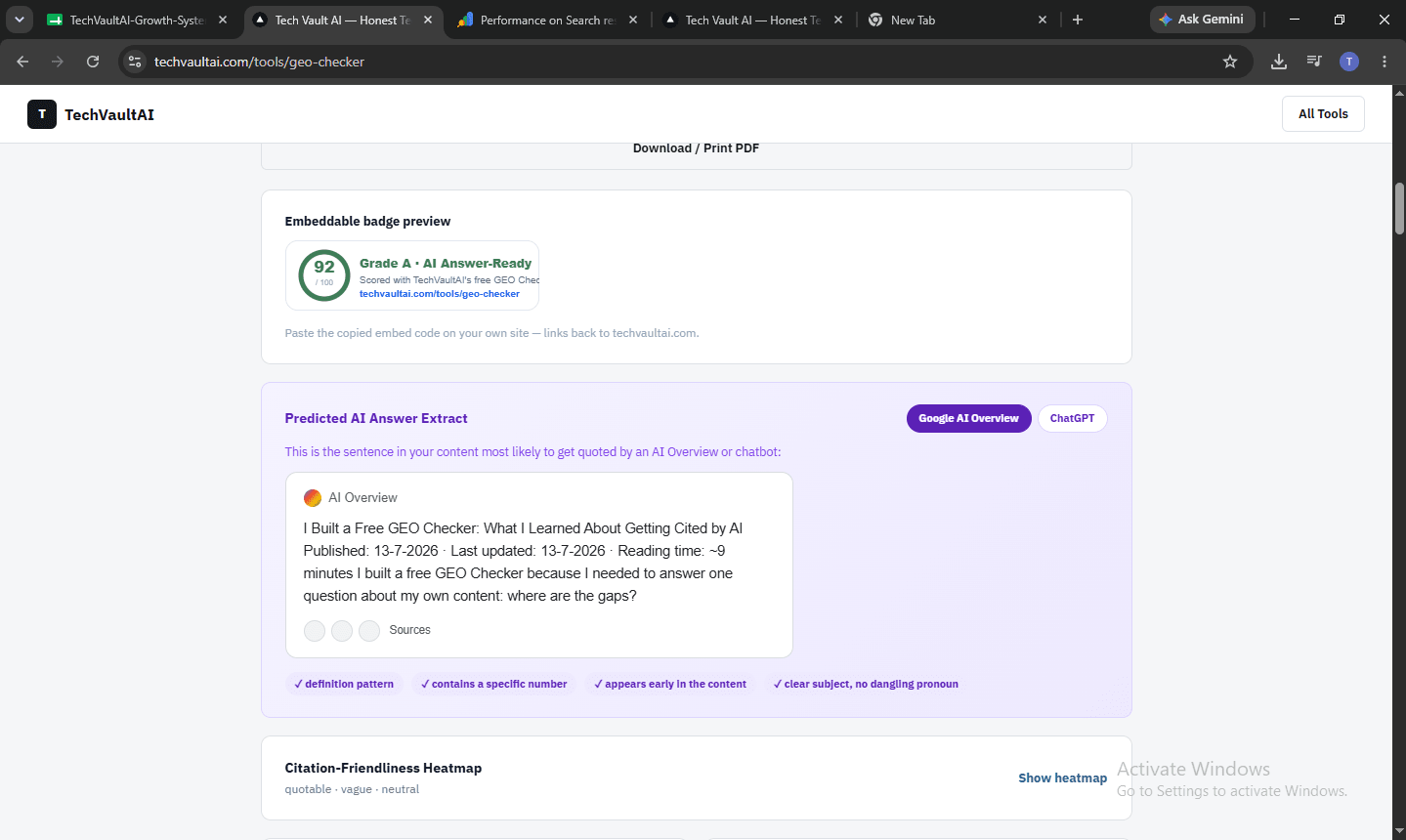
- Publish, then check reality. The tool includes ready-made prompts you can paste into ChatGPT and Perplexity to see whether your live page actually gets cited. That's the real test.
That last step matters. A score is a proxy. The ground truth is whether an engine names you.
What was harder than I expected
I'll be straight about this, because I think the difficulty is the most honest thing I can tell you about the tool: it was technically hard to build. Considerably harder than I planned for.
None of the scoring can be hand-wavy. Consider what each check actually requires:
- Detecting whether a question heading is genuinely followed by a direct answer — not just any text, but an actual answer — is a real parsing problem.
- Deciding whether a claim is backed by a nearby number means locating both the claim and the number and understanding they're related.
- Determining whether a sentence is quotable — self-contained, declarative, no dangling pronouns — requires real linguistic logic.
- Detecting genuine first-hand experience, as opposed to text that merely uses the word "I," is subtle.
Every one of those had to be built and tested until it fired correctly without throwing false positives. Getting the logic right took far longer than building the interface around it. There was no shortcut.
But here's the trade-off I made deliberately, and it's the thing I'd defend hardest: it gives 100% real data.
Nothing is estimated. Nothing is a guess dressed up as a metric. It parses your actual content and reports what's actually there. I could have shipped something faster by faking half the signals with rough heuristics and calling it a score — plenty of tools do exactly that.
But a checker that fudges its numbers is worse than no checker at all. It gives you false confidence, which is more expensive than uncertainty. If I'm telling you your content is ready, that has to mean something.
What happened when I ran my own content through it
I ran my own articles through it, and the results were fair: the scores matched the actual quality of what I'd written.
That sounds like a modest finding. It was, to me, the most important validation of the whole project.
The weaker pieces scored lower. The stronger ones scored higher. And critically, the failing checks pointed at real problems — things I looked at and immediately recognized as genuine weaknesses, not arbitrary rule violations.
If the tool had told me everything I'd written was excellent, I'd have known the scoring was broken. A gap analysis that flatters you is useless. Getting an honest, slightly uncomfortable score on your own work is the entire point.
Who this is for — and who should skip it
Use it if: you publish content and want to know, before or after publishing, whether AI engines will actually cite it — and specifically what to change so they do.
Skip it if: you're looking for backlink counts, keyword search volume, or competitor traffic estimates. It doesn't do those, and it never will. Those require large paid databases, and I'd rather give you honest data on what I can genuinely measure than invented numbers on what I can't.
That's a real limitation, and I'd rather state it plainly than let you discover it and feel misled.
The honest limitation of the score
The score is a readiness indicator, not a citation guarantee.
It measures whether your content follows the structural and credibility patterns that AI answer engines demonstrably favor. It's a strong proxy — but it cannot promise ChatGPT will cite you tomorrow. Nobody can promise that. Anyone who does is selling you something.
What it can do is find your gaps and tell you precisely what to fix. That's exactly what I built it for, and it's what it does well.
The bottom line
Building it taught me more about what makes content citable than anything I'd read on the subject. The lessons compress into six things: answer first, structure it so it can be extracted, name specific things, take a position, show real experience, and signal freshness. The first five are technique. The sixth — real experience — is the only one that's genuinely defensible against AI, and it's the one I'd protect above all others.
It was harder to build than I expected, and I kept it that way on purpose, because 100% real data was the entire point. A tool that lies to you comfortably is worse than one that tells you something you didn't want to hear.
If you want to see where your own content stands, run it through the free GEO Checker. It takes about a minute, there's no signup, and it will tell you exactly what to fix.

Written by
Asif IqbalSenior Writer
Asif Iqbal is the Founder & CEO of Tech Vault AI, leading the team's hands-on testing of AI tools and SaaS products & Tech reviews. He's focused on cutting through marketing hype to help readers find what actually works.
I Built a GEO Checker to Audit My Own Content: What It Found reviews
Loading reviews...
📬 Get the Latest Reviews in Your Inbox
Once a week — AI tools, SaaS & gadget reviews delivered straight to your email.