HeyGen vs Synthesia (2026): Which Best AI Avatar Video Tool?
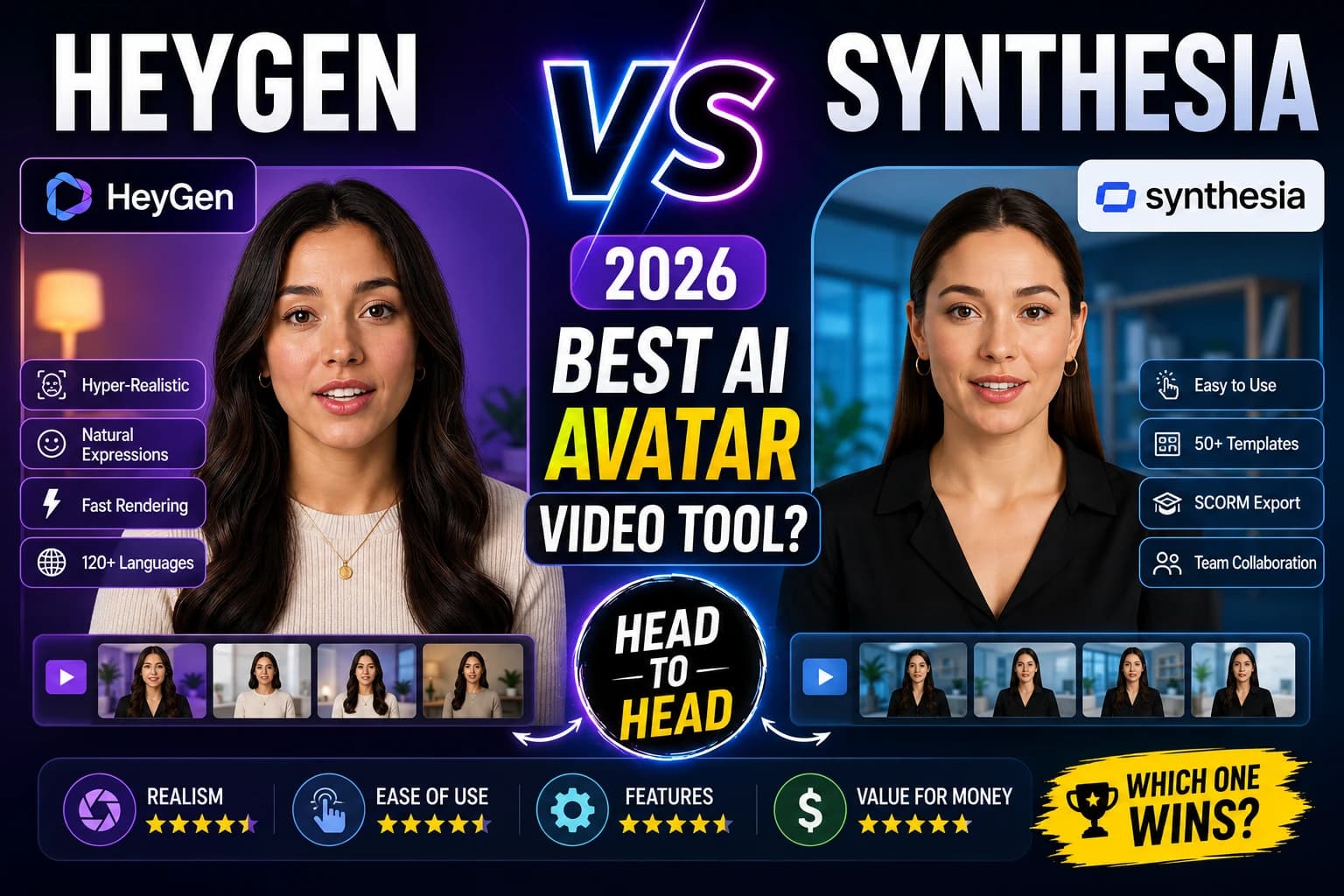
⚖️ Our Verdict
HeyGen for creators and marketers. Synthesia for enterprise L&D teams.
Overall Rating
HeyGen
PriceFree / $29/month (Creator) / $89/month (Team)
Synthesia
Free 3min / $18/month (Starter) / $64/month (Creator)
✅ Pros
HeyGen
Synthesia
❌ Cons
HeyGen
Synthesia
There is a version of this comparison that tells you HeyGen is for creators and Synthesia is for enterprise. That framing was thin in 2024. In 2026, it is incomplete enough to lead you to the wrong tool. Both platforms have changed substantially this year. Synthesia 3.0 added Video Agents for real-time two-way conversations, an AI Copilot that writes scripts and suggests visuals, and interactive Courses for workplace learning. HeyGen launched Avatar IV — the most photorealistic AI avatar rendering available at a non-enterprise price point — and integrated Sora 2 and Veo 3.1 for AI-generated B-roll. The gap between them has narrowed on features. The gap on pricing approach has not.
This comparison is based on what both platforms actually do in 2026, what they cost in practice, and who each one is genuinely built for.
Quick Comparison
| HeyGen | Synthesia | |
|---|---|---|
| Starting Price | $29/month (Creator) | $18/month (Starter) |
| Free Plan | 3 videos/month | 3 min/month |
| Avatars | 500+ | 240+ |
| Languages | 175+ | 160+ |
| Avatar Quality | Avatar IV — photorealistic | Professional-grade, consistent |
| Pricing Model | Premium Credits (complex) | Minutes/month (predictable) |
| Voice Cloning | Yes | Enterprise only |
| SCORM Export | No | Yes |
| Best For | Creators, marketers, social media | Enterprise training, L&D teams |
| Rating | 4.3/5 | 4.1/5 |
Pricing — The Part That Catches People Off Guard
Both platforms start at $29/month and target similar use cases, but their pricing structures work very differently. HeyGen sells Premium Credits where 1 minute of Avatar IV video costs 20 credits. Synthesia sells minutes per month directly.
That difference matters more than the headline numbers suggest.
HeyGen's "unlimited" framing on paid plans is real for standard videos, but Avatar IV burns credits faster than the marketing implies. If you are specifically using Avatar IV — which is the reason most people choose HeyGen over competitors — the credit math works out to significantly less output than the plan name suggests.
Mid-market teams often choose HeyGen based on the lower Creator plan pricing at $29/month, then discover the Business plan at $149/month is required for collaboration features. That tier-jump is a real cost surprise for teams that start solo and need to add collaborators.
Synthesia's pricing is more predictable. Synthesia uses minutes per month instead of credits, which most teams find easier to budget. The tradeoff: the Starter plan includes only 10 minutes per month — half of what HeyGen Creator's 200 credits cover in Avatar IV usage.
Practical pricing comparison:
| Plan | HeyGen | Synthesia |
|---|---|---|
| Free | 3 videos/month | 3 min/month |
| Entry Paid | $29/month (Creator) | $18/month (Starter) |
| Mid-tier | $89/month (Team) | $64/month (Creator) |
| Business | $149/month | Custom |
| Annual discount | Yes | Yes |
HeyGen starts at $24/month annually with superior avatar realism and custom avatar access from $99. Synthesia starts at $18/month with enterprise compliance and team workflows.
Avatar Quality — Where HeyGen Pulls Ahead
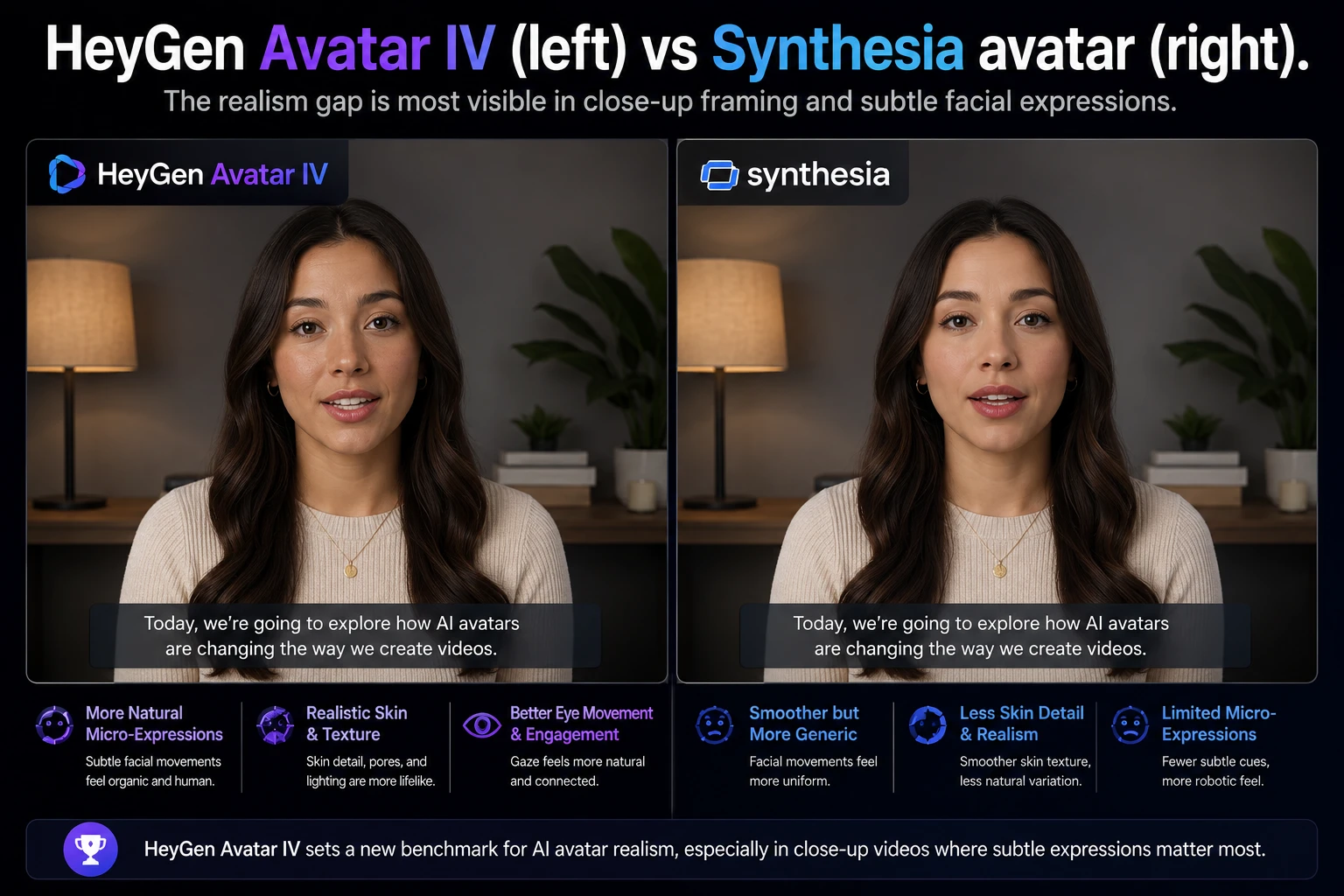
HeyGen's Avatar IV technology produces more photorealistic output than Synthesia at equivalent price tiers. The difference is most visible in close-up framing and emotional expressions. HeyGen's newer avatars handle subtle facial movement in a way that earlier AI avatars did not. Side-by-side comparisons on the same script show HeyGen looking more like a real person on camera, Synthesia looking more like a high-quality corporate spokesperson.
HeyGen has grown rapidly since its launch, becoming one of the most widely used AI video platforms in 2026, trusted by over 100,000 businesses and recognized as G2's #1 Fastest Growing Product.
That quality edge genuinely matters for specific use cases — a sales explainer video or social media clip where you want the viewer to feel a human connection. For those situations, Avatar IV is noticeably better than what Synthesia offers at the same price tier.
For an internal training video where the focus is the information rather than the presenter, Synthesia's quality is completely adequate and the enterprise features are more valuable than the avatar upgrade.
The honest summary: if you are producing content where avatar realism is the point, HeyGen wins. If the avatar is a delivery vehicle for information rather than the focus itself, the quality difference is not worth the pricing premium.
Features — What Each Platform Does That the Other Doesn't
HeyGen exclusive features
HeyGen's Avatar IV engine displays natural micro-expressions, subtle head tilts, hand gestures, and smooth lip movements that are difficult to distinguish from real video at first glance.
Voice cloning at the Creator tier — record a short sample and generate videos in your own voice. Record a short video and create a perfect AI clone of yourself. Your avatar can speak any language naturally with lip movements synced to the translation.
HeyGen integrates Sora 2 and Veo 3.1 for AI-generated B-roll in 2026 — a premium feature that adds cinematic footage to avatar videos without leaving the platform.
Talking Photos — turn a still image into a speaking avatar. Face swap. These are creator-focused features with no direct Synthesia equivalent.
Synthesia exclusive features
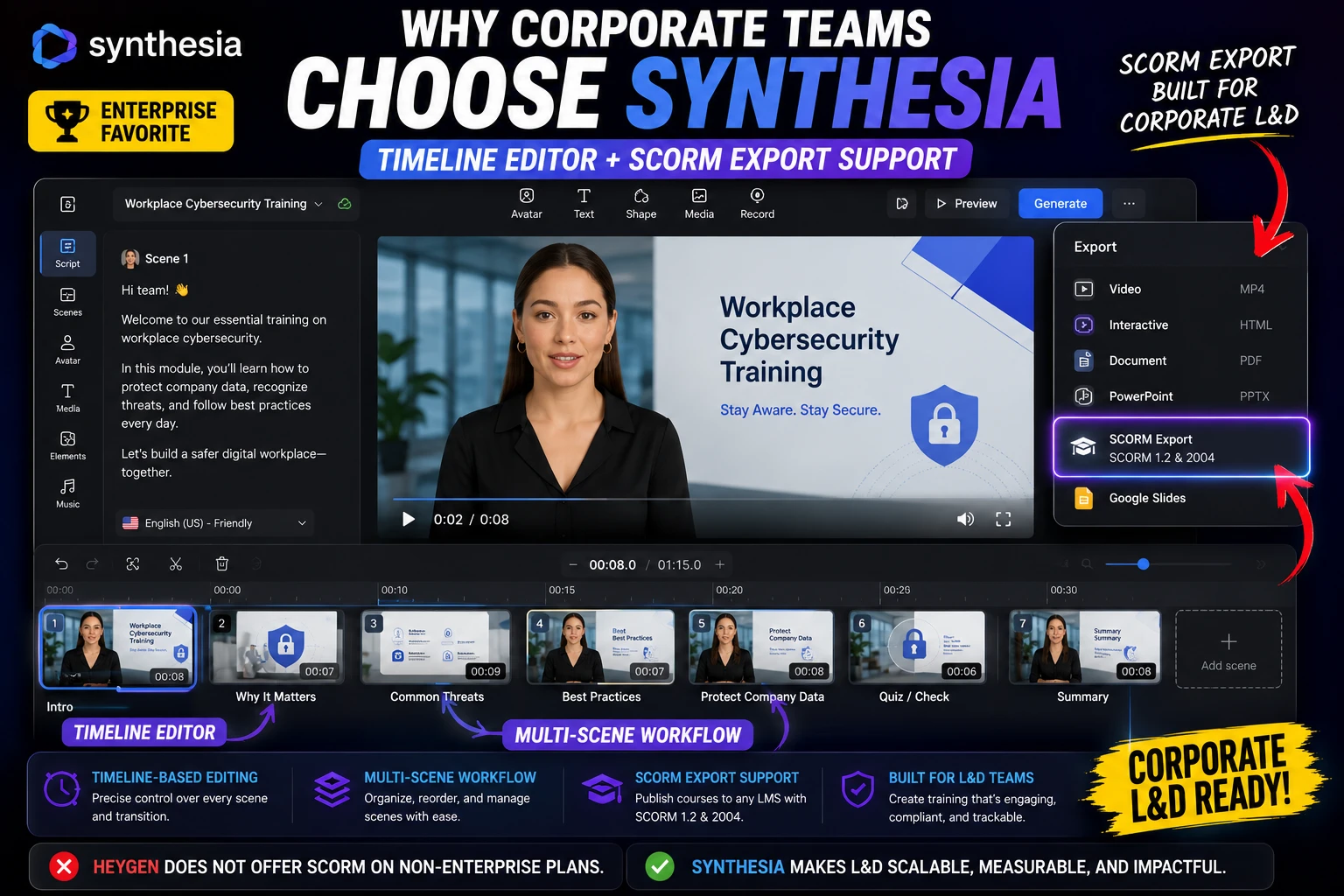
Synthesia 3.0 added Video Agents for real-time two-way conversations, an AI Copilot that writes scripts and suggests visuals, and interactive Courses for workplace learning. SOC 2 compliance, SSO, and SCORM export are built in — L&D teams use it for a reason.
Synthesia's clients include Amazon, Reuters, BBC, and Heineken. The platform prioritizes avatar quality, security compliance, and depth of features over breadth.
SCORM export means Synthesia videos can be uploaded directly to any LMS — a non-negotiable requirement for corporate training teams that HeyGen simply cannot meet on non-enterprise plans.
Synthesia provides more advanced editing capabilities with timeline-based editing, scene management, and detailed control over pacing and presentation — tools that appeal to professional producers who want pixel-perfect results.
Real Use Case Testing
Across reported testing from multiple sources in 2026, the pattern is consistent enough to draw clear conclusions.
Marketing video production: HeyGen produces better-looking output for external-facing marketing content. Avatar IV realism holds up in social media contexts where viewers expect human presenters. HeyGen wins on speed for Avatar III videos and wins on quality for Avatar IV.
Corporate training: Synthesia wins consistently for internal training content. The SCORM export, collaborative editing, and predictable minutes-based pricing align with how L&D teams actually operate. Synthesia wins for predictable monthly costs — annual video minutes mean teams know exact budget requirements.
Multilingual content: Both platforms handle translation well. HeyGen wins on avatar naturalness with 100+ avatars across 175+ languages. Synthesia wins on structured editing with 240+ avatars across 160+ languages. For large-scale multilingual campaigns, HeyGen's lip-sync translation quality is slightly stronger. For structured multilingual training libraries, Synthesia's workflow is more manageable.
Solo creators and freelancers: HeyGen's free plan (3 videos/month, no credit card) is the better starting point. HeyGen is generally the easier starting point for beginners. Its free plan gives you 3 complete videos per month with no credit card required, and the interface is intuitive enough to produce a polished AI presenter video in under 30 minutes.
The Credit System Problem
This deserves its own section because it affects real purchasing decisions.
HeyGen sells Premium Credits rather than minutes. The pricing units are: 1 minute of Avatar IV = 20 credits. On the Creator plan at $29/month, you receive 200 credits — which works out to 10 minutes of Avatar IV video per month. That is a meaningful constraint for active content producers.
Standard avatar videos use fewer credits and stretch further. But most people choosing HeyGen over competitors specifically want Avatar IV. If that is your use case, calculate your actual monthly video needs in Avatar IV minutes, not total credits, before selecting a plan.
Synthesia's minutes-based system is simpler and more predictable. Synthesia wins for cost predictability — annual video minutes mean you know exact budget requirements in advance. The Starter plan's 10 minutes per month is genuinely limited, but at least you know exactly what you are getting.
Who Should Use HeyGen
HeyGen is the stronger pick if you produce high volumes of content, need talking photos or face swap for social media and personalized outreach, or work with multilingual audiences. The unlimited video output on paid plans and Avatar IV realism make it a genuinely capable tool for creators and marketing teams.
Buy HeyGen if:
- You create marketing videos, social media content, or sales outreach where avatar realism matters
- Voice cloning — generating videos in your own voice without recording — is important to your workflow
- You work solo or in a small team and don't need SCORM export or enterprise compliance
- You want to try before buying — the free plan gives 3 full videos per month with no credit card
Skip HeyGen if:
- You need SCORM export for LMS integration — only available on Enterprise
- Your team has 5+ collaborators — the Business plan at $149/month is required for collaboration features
- Predictable, simple pricing matters more than avatar quality
Try HeyGen free — 3 videos/month, no credit card →
Who Should Use Synthesia
Synthesia is the better pick for enterprise training, internal communications, and L&D teams where the focus is information delivery rather than presenter realism. The compliance features, SCORM export, and team collaboration tools are built for this context.
Buy Synthesia if:
- You create corporate training, onboarding, or internal communications content
- SCORM export for LMS integration is a requirement
- You need SOC 2 compliance and enterprise security features
- Predictable minutes-based pricing is important for budget planning
- You are working with a team that needs collaborative editing
Skip Synthesia if:
- Avatar realism for external marketing content is your primary need — HeyGen's Avatar IV is better at equivalent price tiers
- Voice cloning is important — Synthesia restricts this to Enterprise
- You are an individual creator focused on social media content
Try Synthesia free — 3 min/month →
Alternatives Worth Knowing
Neither HeyGen nor Synthesia is the only option in 2026. If the pricing or feature gaps on either platform don't suit your needs, these are worth evaluating.
Colossyan specifically targets the mid-market gap that both HeyGen and Synthesia underserve. Mid-market companies between 50 and 5,000 employees are underserved by both platforms, which optimize for either solo creators or Fortune 500 procurement cycles. Colossyan's pricing and feature set sits between the two.
Vidnoz offers a free plan with more generous limits than either platform and is worth testing for basic avatar video creation before committing to a paid subscription.
Descript approaches video creation from an editing-first perspective — you edit the transcript and the video changes accordingly. For content creators who spend more time editing than scripting, the workflow difference is meaningful.
For a full comparison of AI video tools including free options, see our AI tools review section at TechVaultAI.
Final Verdict
HeyGen wins for realistic avatars and creative flexibility. Synthesia wins for enterprise teams and predictable costs. That summary is accurate — but the more useful version is:
If you are producing content where a human-looking presenter matters — marketing videos, sales outreach, social media — and you are working solo or in a small team, HeyGen is the correct choice. Avatar IV realism is genuinely better at this price point and the free plan is the lowest-friction way to start.
If you are building a corporate training library, need SCORM for your LMS, manage a team that collaborates on video production, or require enterprise compliance documentation, Synthesia is built for that workflow in a way HeyGen is not.
For most freelancers and individual content creators: start with HeyGen's free plan. Three videos per month is enough to evaluate whether AI avatar video fits your workflow before spending anything.
See all our AI video tool comparisons at TechVaultAI for more options in this category.
FAQ
Which is cheaper — HeyGen or Synthesia?
Synthesia starts at $18/month annually, making it cheaper at entry level. HeyGen starts at $24/month annually. However, HeyGen's credit system means Avatar IV video production on the entry plan is more limited than it appears. For straightforward minutes-based budgeting, Synthesia is more predictable.
Does HeyGen have a free plan?
Yes. HeyGen's free plan gives 3 complete videos per month with no credit card required. It is the more generous free tier compared to Synthesia's 3 minutes per month.
Can Synthesia export SCORM files for LMS?
Yes. Synthesia supports SCORM export for LMS integration. HeyGen does not offer SCORM export on non-Enterprise plans. For corporate training teams using an LMS, this makes Synthesia the practical choice.
Which has better avatar quality in 2026?
HeyGen's Avatar IV produces more photorealistic output than Synthesia at equivalent price tiers. The difference is most visible in close-up framing and facial expressions. For internal training content, Synthesia's quality is professional-grade and the difference is not meaningful. For external marketing content, HeyGen's realism advantage matters.
Can I clone my own voice on HeyGen or Synthesia?
HeyGen offers voice cloning starting at the Creator plan ($29/month). Synthesia restricts voice cloning to Enterprise plans. If voice cloning is important, HeyGen is the more accessible option.
Is HeyGen or Synthesia better for YouTube content?
HeyGen is the better fit for YouTube creators. The Avatar IV realism holds up in long-form video where viewer engagement depends on feeling a human connection. Talking photos, face swap, and the broader template library for creative formats are also more suited to YouTube production than Synthesia's enterprise-oriented toolkit.
Disclosure: Some links in this article are affiliate links. Tech Vaul tAI earns a small commission if you sign up through them at no extra cost to you. Both platforms were evaluated based on publicly available pricing, feature documentation, and third-party testing data from multiple independent sources.
Using HeyGen or Synthesia for your work? Share what you're creating in the comments.

Written by
Asif IqbalSenior Writer
Asif Iqbal is the Founder & CEO of Tech Vault AI, leading the team's hands-on testing of AI tools and SaaS products & Tech reviews. He's focused on cutting through marketing hype to help readers find what actually works.
HeyGen reviews
Loading reviews...
Synthesia reviews
Loading reviews...
Questions & Answers
Loading questions...
📬 Get the Latest Reviews in Your Inbox
Once a week — AI tools, SaaS & gadget reviews delivered straight to your email.