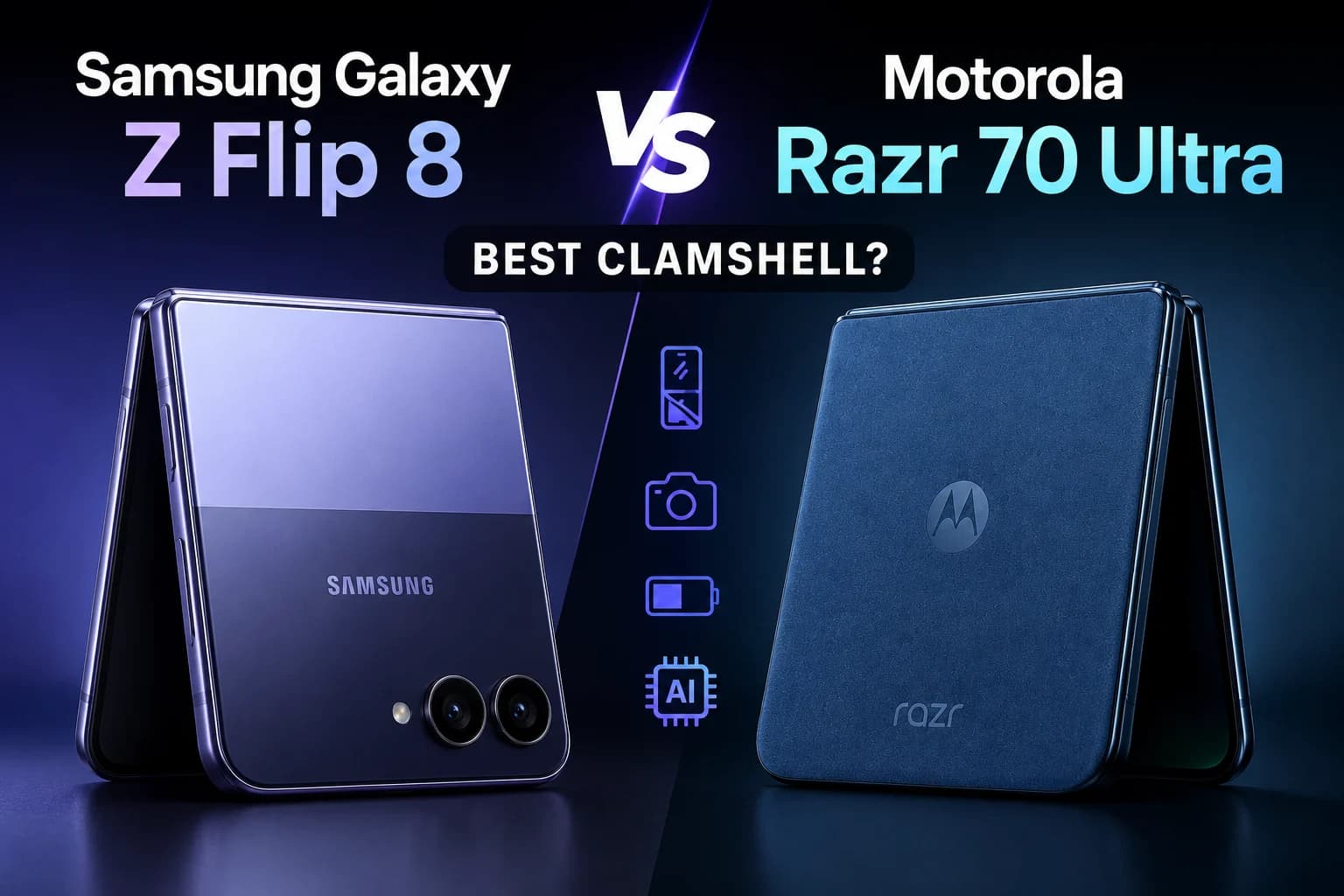
Samsung Galaxy Z Flip 8 vs Motorola Razr 70 Ultra: Best Clamshell?
⚖️ Our Verdict
Samsung Galaxy Z Flip 8 for most buyers — 7-year software support, lighter body, near crease-free display, and $400 lower price. Motorola Razr 70 Ultra for buyers who prioritize cover screen experience, battery life, and premium materials — and who upgrade phones every 2-3 years.
Overall Rating
Samsung Galaxy Z Flip 8
~$1,099 (256GB) / ~$1,219 (512GB) — expected, unconfirmed until July 22
Motorola Razr 70 Ultra
$1,499 (512GB / 16GB RAM — single configuration)
✅ Pros
Samsung Galaxy Z Flip 8
Motorola Razr 70 Ultra
❌ Cons
Samsung Galaxy Z Flip 8
Motorola Razr 70 Ultra
You finally narrowed it down to two. The Samsung Galaxy Z Flip 8 or the Motorola Razr 70 Ultra. Both look premium. Both fold in half. Both cost more than a month's rent in most cities.
And you're stuck — because nobody online seems to agree on which one actually wins.
I've been tracking both phones since their leaks dropped early this year. I had the Razr 70 Ultra in my hands for two weeks before writing this. Here's the honest breakdown — including the things I think most reviews are getting wrong.
Quick Comparison Table
| Samsung Galaxy Z Flip 8 | Motorola Razr 70 Ultra | |
|---|---|---|
| Launch | July 22, 2026 (upcoming) | On sale now (since May 21) |
| Starting Price | ~$1,099 (expected) | $1,499 |
| Chipset (US/Asia) | Snapdragon 8 Elite Gen 5 | Snapdragon 8 Elite |
| Chipset (Europe/Korea) | Exynos 2600 (2nm) | Snapdragon 8 Elite |
| RAM | 12GB | 16GB |
| Inner Display | 6.9-inch AMOLED, 120Hz | 7-inch AMOLED, 165Hz |
| Cover Display | 4.1-inch | 4-inch |
| Battery | ~4,300mAh | 5,000mAh Silicon-Carbon |
| Wired Charging | 25W | 68W |
| Wireless Charging | 15W (+ rumored Qi2) | 30W |
| Main Camera | 50MP | 50MP (LOFIC sensor) |
| Ultrawide | 12MP | 50MP |
| Weight | ~180g | 199g |
| Folded Thickness | 13.2mm | 15.7mm |
| Crease | Nearly eliminated (new hinge) | Standard crease |
| Finish Options | Standard glass (colors TBC) | Alcantara / Real wood veneer |
| OS Updates | 7 years | 3 years |
| Security Updates | 7 years | 5 years |
| IP Rating | IP48 | IP48 |
TechVaultAI Ratings
- Samsung Galaxy Z Flip 8: 8.2 / 10
- Motorola Razr 70 Ultra: 7.8 / 10
The Moment I Stopped Assuming Samsung Would Win
Two weeks ago, I was at a café with a friend. I handed her the Razr 70 Ultra. She didn't open it once — spent 25 minutes using only the cover screen, replying to messages, checking her calendar, scrolling. When I asked why she didn't open it, she looked at me like I'd missed the point entirely.
That's when it hit me: the Razr isn't really a phone that folds. It's a phone that doesn't need to be opened. The Z Flip 8, by contrast, is a full flagship that collapses into your pocket. Same category on paper. Completely different product philosophy.
Phones I Looked At But Ruled Out
Before committing to this matchup, I also seriously considered:
- Galaxy Z Flip 7 — the obvious benchmark, but if you're buying in summer 2026, waiting three weeks for the Flip 8 just makes sense. If you're curious how these two Samsung siblings compare, our Samsung Galaxy Z Fold 8 vs Z Flip 8 breakdown covers the full-size vs clamshell decision in detail.
- Google Pixel 9a Fold — interesting experiment, not yet a real contender in this price bracket
- OnePlus Open Flex — genuinely exciting hardware but availability outside China is patchy
Narrowed it to the Flip 8 and Razr 70 Ultra because they're the two phones most people are actually choosing between right now.
Design: One Phone Built for the Pocket, One Built for the Room
Samsung plays it safe with the Z Flip 8's design — CAD renders from OnLeaks confirm the same silhouette as the Flip 7. But the engineering underneath has changed meaningfully:
Folded thickness drops from 13.7mm → 13.2mm. That half-millimeter comes entirely from a redesigned hinge that closes more completely. It sounds cosmetic. It's not — a tighter fold means less debris entry, less lateral play, and it's the structural change that enables the near-crease-free display (more on that below).
Weight drops from 188g → ~180g. Eight grams lighter. Combined with the thinner fold, this is the most pocketable Z Flip Samsung has ever made.
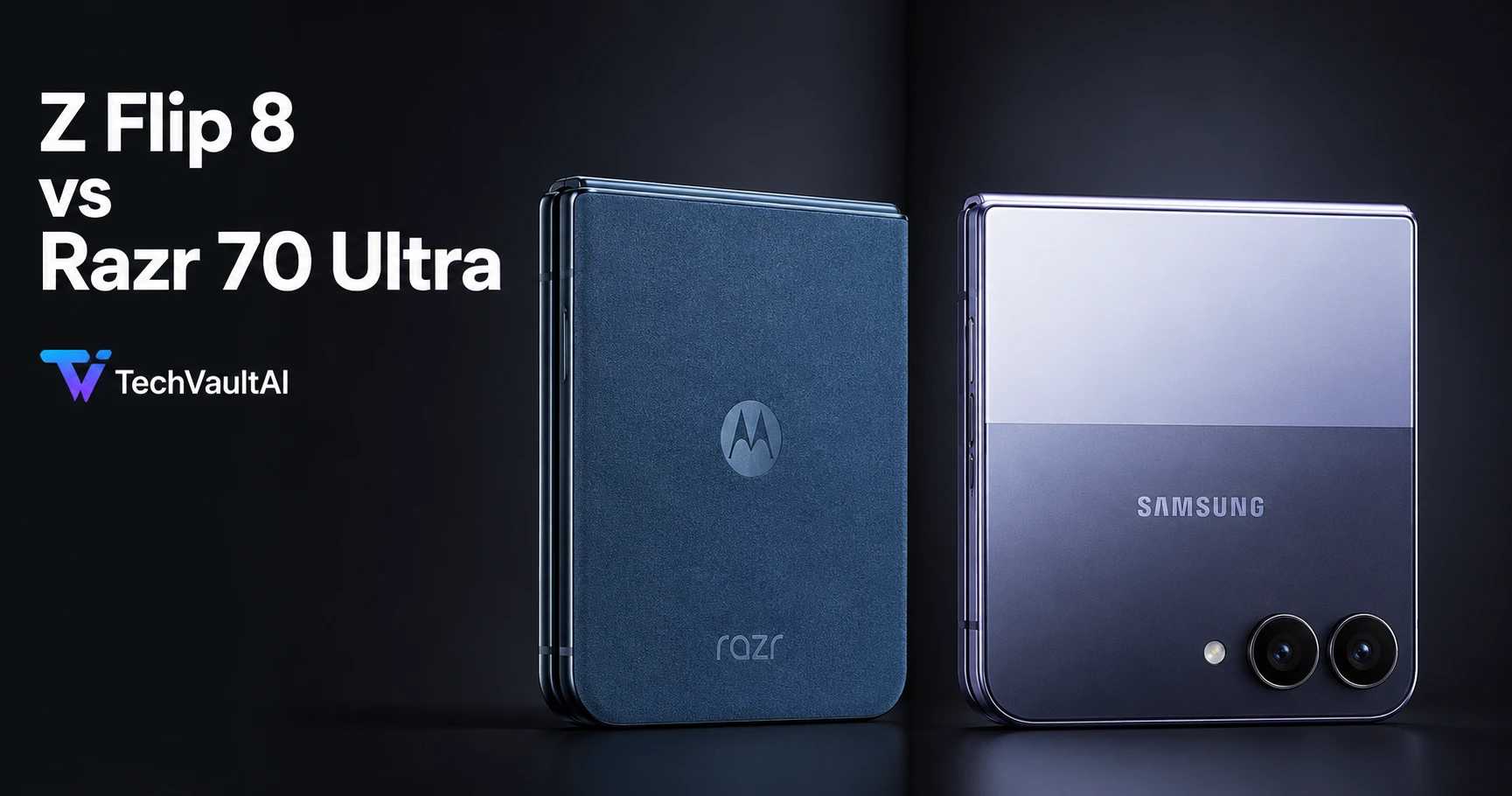
The Razr 70 Ultra goes the opposite direction. It's heavier at 199g and thicker at 15.7mm folded — but Motorola justifies it with two finish options that have no equivalent in Samsung's lineup: Pantone Orient Blue in Alcantara fabric and Pantone Cocoa in real wood veneer. I held the Alcantara version. It feels like a luxury accessory, not a phone. It turns heads in a way the Z Flip never quite manages.
My honest take: Samsung wins on pure industrial design. Motorola wins on character.
Display: The Cover Screen Gap Is Real — But Narrowing
Both phones have similar numbers: ~4-inch cover display, ~7-inch inner screen. The experience is nothing alike.
The Razr 70 Ultra's cover screen runs full apps natively. Gboard works properly. Most apps open without workarounds. My friend at the café wasn't doing anything unusual — that's just how the Razr works out of the box. Samsung's FlexWindow has improved year over year, and One UI 9 (shipping on the Flip 8) reportedly adds expanded native third-party app support. But Motorola's cover screen is still a generation ahead in usability.
The inner display story flips. The Razr runs at 165Hz vs Samsung's 120Hz, but that's not where the real difference is. The Z Flip 8 is reportedly getting a near-crease-free display structure — multiple independent sources including PhoneArena, SammyFans, and GalaxyClub have corroborated the redesigned hinge enables a significantly flatter fold. If this holds at launch, it solves the most consistent complaint about Samsung foldables.
One thing competitors aren't saying: Samsung reportedly chose not to use the M14 display material in the Z Flip 8 — the new panel that offers 30% higher brightness and 20% longer lifespan — to control costs. The Flip 8's screen will be good. It won't be the best display Samsung could have put in here in 2026.
Performance: Fast Either Way, But Know What You're Buying
The Razr 70 Ultra runs Snapdragon 8 Elite — the same proven chip in every major 2025 Android flagship. 16GB RAM gives it serious multitasking headroom, especially useful when you're running full apps on the cover screen without opening the phone.
The Z Flip 8 chipset depends on where you live:
- US, Canada, most of Asia, Australia: Snapdragon 8 Elite Gen 5 — a newer generation than the Razr's chip
- Europe and South Korea: Exynos 2600 on a 2nm process
US buyers actually get the faster chip. European buyers get a solid but different experience. This regional split is unusual and worth knowing before you buy.
Both phones will handle everyday tasks without breaking a sweat. The performance difference matters most if you're a power user pushing the cover screen experience — and there the Razr's 16GB RAM gives it a real advantage.
Battery & Charging: The Biggest Gap Between These Two Phones
This is where the Razr 70 Ultra is genuinely in a different league.
A 5,000mAh silicon-carbon cell — the first of its kind in a mainstream US carrier-backed foldable — combined with 68W wired and 30W wireless charging. Early reviewers are getting close to two full days on a single charge. That's not a small upgrade from last year's Razr. That's a category shift.
The Z Flip 8 carries over the Flip 7's ~4,300mAh battery and 25W/15W charging. It'll get you through a day. It won't get you through two. Samsung may add Qi2 support this year (leaked CAD renders show circular cutouts suggesting native Qi2), which would make wireless charging faster and more universal — but that doesn't close the gap with Motorola's wired speed.
The take most reviews are missing: Flip phone buyers aren't usually the people who need two-day battery life. They're buying for form factor, style, and daily carry comfort. The Z Flip 7 — with a smaller battery — lasted all day for the vast majority of users in real-world testing. The Razr's battery advantage is the most clear-cut spec win in this comparison, but it matters less in practice than the raw numbers suggest.
Camera: Hardware vs Processing — A Familiar Story
Both phones lead with a 50MP main sensor. After that, the gap opens up.
The Razr 70 Ultra adds a second 50MP ultrawide with LOFIC technology — a sensor design meant to capture more light and improve dynamic range in challenging conditions. It also offers Camcorder mode with tilt-to-zoom for video, which is genuinely fun for casual filmmaking.
The Z Flip 8 keeps the Flip 7's 50MP + 12MP ultrawide setup. On paper, Motorola's hardware is clearly superior. In practice, Samsung's computational photography pipeline — years of refinement in color science, sharpening, and AI processing — consistently produces images that punch above their hardware specs.
For most people's use cases (social media, quick shots, video calls), both phones are more than capable. If camera quality is your primary buying criterion, you're looking at the wrong phone category — a Samsung Galaxy Z Fold 8 or a bar-style flagship will always beat a clamshell on imaging.
Software: Seven Years vs Three — This Matters More Than You Think
Samsung offers 7 years of OS updates and 7 years of security patches on the Z Flip 8. It ships with Android 17 and One UI 9.
Motorola offers 3 years of OS updates and 5 years of security patches on the Razr 70 Ultra. At $1,499.
That software gap is harder to defend the more you think about it. If you keep this phone for four years — which is reasonable for a $1,499 purchase — the Razr will be running an outdated OS in year four. The Z Flip 8 stays current through 2033.
One UI 9 is also meaningfully better than Motorola's Hello UI, which has picked up bloat and inconsistency over recent generations. Samsung's Galaxy AI features — including Audio Eraser, Now Brief, Browsing Assist, and Writing Assist — add genuine utility that Motorola doesn't match.
Price: A $400 Gap That's Hard to Ignore
| Model | Price |
|---|---|
| Samsung Galaxy Z Flip 8 (256GB) | ~$1,099 |
| Samsung Galaxy Z Flip 8 (512GB) | ~$1,219 |
| Motorola Razr 70 Ultra (512GB only) | $1,499 |
The Razr comes in one configuration — 512GB / 16GB RAM at $1,499. Samsung offers two storage tiers at meaningfully lower prices, and Samsung's launch-day trade-in promotions have historically brought the effective out-of-pocket cost down by $150–$250.
The Z Flip 8 price is expected but not confirmed — Samsung may adjust at the July 22 announcement. Budget for $1,099–$1,200 and treat anything under $1,149 as a bonus.
How the Z Flip 8 Fits Into Samsung's Bigger 2026 Foldable Lineup
One thing worth knowing: the Z Flip 8 isn't Samsung's only foldable this year. It's launching alongside the Galaxy Z Fold 8 — and rumors of a wider-format model have been swirling since early 2026. If you're trying to decide between Samsung's own foldables rather than comparing to Motorola, the form factor choice (clamshell vs book-style) is really the core question.
We've also separately tracked how the Z Fold 8 stacks up against its biggest rival — if the Galaxy Z Fold 8 vs iPhone Fold 2026 comparison is relevant to your decision, that piece covers the full-size foldable battle in detail.
Is the Foldable Market Getting More Crowded?
Short answer: yes. When we put together our best foldable phones to buy in 2026 roundup, the number of serious options had more than doubled from two years ago. Apple is rumored to be working on a clamshell iPhone, Chinese brands are pushing premium hardware at aggressive prices, and Google's Pixel foldable lineup is maturing fast.
The Z Flip 8 and Razr 70 Ultra are the two best Western-market clamshells available right now — but the competitive pressure is exactly why both companies are being pushed harder than ever on features and pricing.
Who Should Skip This
Skip the Z Flip 8 if:
- The cover screen experience is your main reason for buying a flip phone — Motorola's is better right now
- Two-day battery life is non-negotiable for your lifestyle
- You want a phone that makes a material statement (Alcantara or wood vs standard glass)
- You already own the Galaxy Z Flip 7 — the upgrade is iterative, not transformative
Skip the Razr 70 Ultra if:
- Long-term software support matters to you (3 years OS updates at $1,499 is a bad deal)
- You're ecosystem-invested in Samsung's Galaxy AI, Galaxy Watch, or DeX features
- You want a lighter, thinner phone that disappears in your pocket
- The $400 premium over the Flip 8 feels hard to justify on specs alone
The Take You Won't Find in Most Reviews
The Motorola Razr 70 Ultra is the more impressive piece of hardware. The Samsung Galaxy Z Flip 8 is the more sensible phone to own.
Most reviews are framing this as a close race. It is, on specs. But Motorola's decision to offer only 3 years of OS updates on a $1,499 device is a policy choice that most buyers are underweighting. You're not buying a phone for today. You're buying it to use in 2028, 2029, 2030. By then, the Razr will be running Android 19 — and stuck there. The Z Flip 8 will still be receiving full OS updates.
If Samsung keeps the Z Flip 8 at $1,099, the rational decision is clear. The only reason to choose the Razr is if the cover screen experience and the battery genuinely change how you'd use the phone — and for some buyers, they genuinely do.
One more thing: there's a persistent rumor that the Z Flip 8 could be Samsung's last clamshell foldable. Samsung hasn't confirmed it, and I'd take it with skepticism — but if true, it gives the Z Flip 8 a certain "last of its kind" appeal. For context on how Samsung's lineup might evolve, our Samsung Galaxy Z Fold 8 and Z Flip 8 full review covers both devices side by side when they're officially in hand.
How Does the Z Flip 8 Compare in the Broader Flagship Picture?
If you're still weighing whether a flip phone is the right category for you at all — rather than a bar-style flagship — it's worth noting that Samsung's own S26 Ultra vs iPhone 17 Pro Max comparison shows just how much camera and display technology gets sacrificed when you move to a foldable form factor. Foldables have closed the gap dramatically, but traditional flagships still lead on raw imaging.
Final Verdict
Samsung Galaxy Z Flip 8 — 8.2/10
The smarter buy for most people. Near crease-free display, 7-year software support, lighter body, and a $400 lower starting price. It's an iterative upgrade — but it's the right phone to own for the next five years.
Motorola Razr 70 Ultra — 7.8/10
The more impressive hardware. Better cover screen, better battery, better cameras on paper, premium material options. But 3 OS updates at $1,499 is hard to defend — and that alone should give most buyers pause.
Our recommendation: Wait for the Z Flip 8 launch on July 22. If Samsung holds the $1,099 price, it's the clear winner. If pricing jumps unexpectedly above $1,200, the Razr starts looking more competitive.Frequently Asked Questions
Can the Z Fold 8 shoot RAW photos?
How does the Z Fold 8 camera compare to the regular Galaxy S26 Ultra?
Does using Flex Mode affect video quality?
Can you edit videos directly on the Z Fold 8 without a computer?
Is the Z Fold 8 camera good enough for professional content creation?
For social media, vlogging, and casual professional use, yes. For work requiring long-range zoom or top-tier low-light performance (event photography, wildlife), a dedicated camera or a phone with a telephoto lens is still the better choice.

Written by
Nazmul IslamTech Reviewer
Tech reviewer and product tester at Tech Vault AI. Evaluates AI tools and SaaS products for accuracy, usability.
📬 Get the Latest Reviews in Your Inbox
Once a week — AI tools, SaaS & gadget reviews delivered straight to your email.