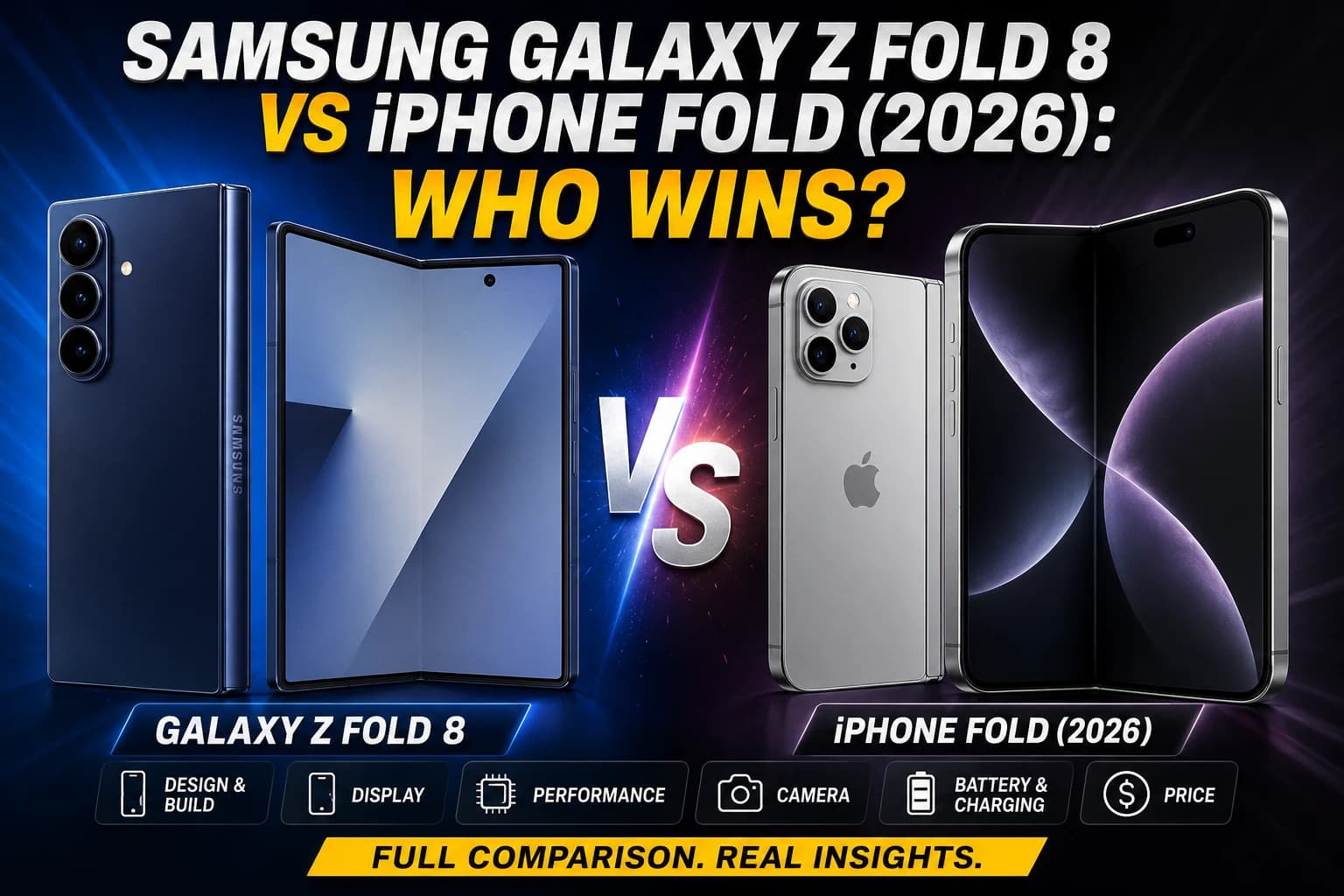
Samsung Galaxy Z Fold 8 vs iPhone Fold (2026): Who Wins?
⚖️ Our Verdict
Z Fold 8 for Android users now. iPhone Fold for Apple ecosystem users — but wait for reviews first.
Overall Rating
Samsung Galaxy Z Fold 8
$1,999 (256GB) — confirmed
Apple iPhone Fold
$2,000–$2,400 (rumored)
✅ Pros
Samsung Galaxy Z Fold 8
Apple iPhone Fold
❌ Cons
Samsung Galaxy Z Fold 8
Apple iPhone Fold
Last Updated: June 20, 2026 — 12 min read — Tech Vault AI
Transparency note: The Apple iPhone Fold has not launched yet. Everything about it in this article comes from confirmed leaks, supply-chain reports, Bloomberg reporting, and analyst forecasts — not hands-on testing. The Samsung Galaxy Z Fold 8 launches July 22. This comparison will be updated with confirmed specs and hands-on coverage immediately after both devices ship. Affiliate disclosure: Some links earn Tech Vault AI a small commission at no extra cost to you.
I have been waiting for this comparison since 2019.
That was the year Samsung launched the first Galaxy Z Fold and I spent twenty minutes in a store trying to convince myself the $1,980 price and the creaking hinge were acceptable. They were not. But I remember thinking: when Apple eventually does this, that's when the category becomes real.
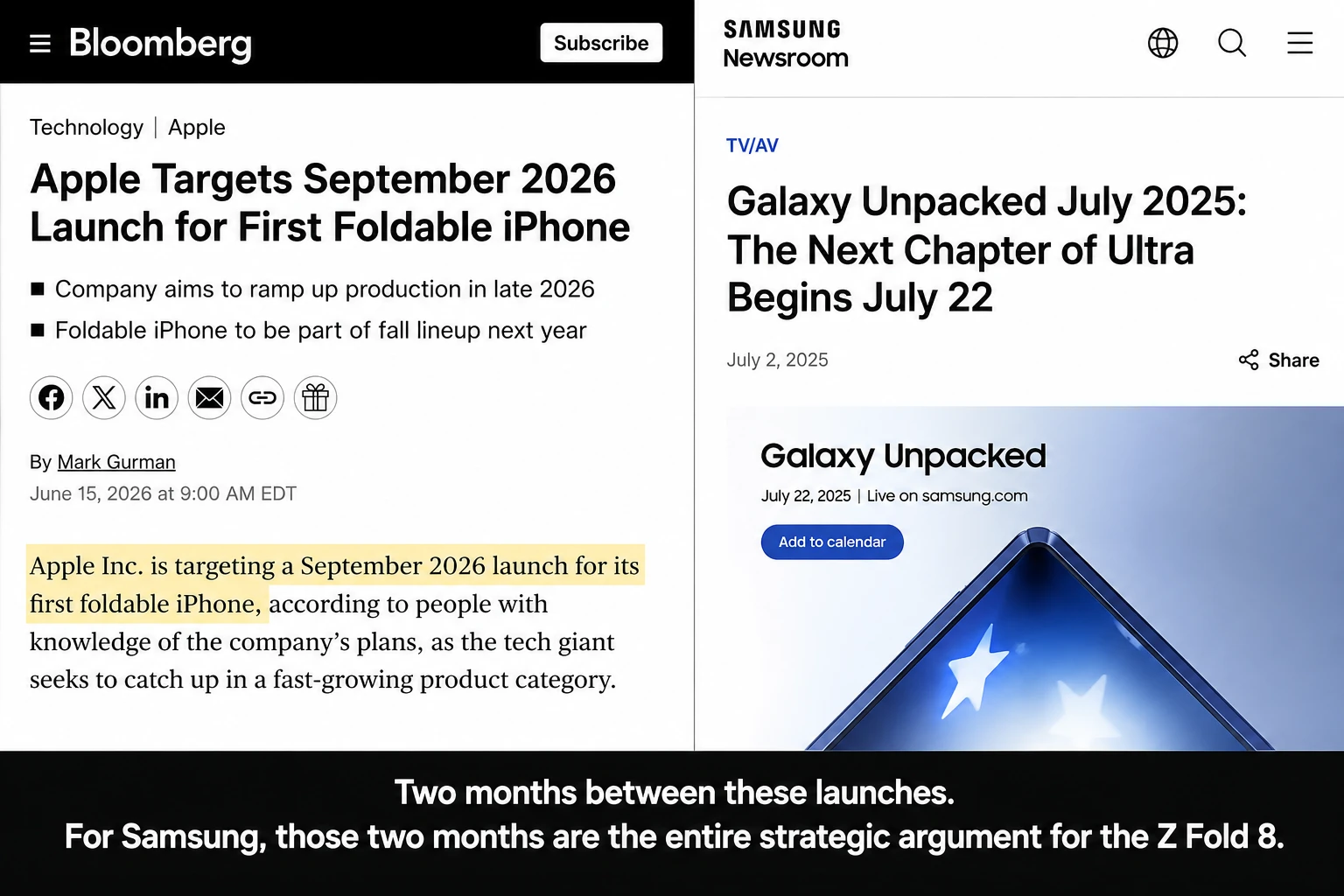
Apple is finally doing this. September 2026, according to Bloomberg, JPMorgan, and nearly every credible leak that has surfaced over the past eighteen months. The device most people are calling the iPhone Fold — Apple may market it as "iPhone Ultra" — is the biggest iPhone redesign in years and the first time Apple will directly compete in a product category Samsung has owned for seven generations.
This is the most honest pre-launch comparison I can write: what we know for certain, what is credibly rumored, what the strategic stakes are, and who should buy which phone — based on everything confirmed before either device has shipped to reviewers.
Who Should Skip This Article
If you need to buy a phone this week, neither of these is the right answer. The Z Fold 8 launches July 22. The iPhone Fold is expected in September at the earliest, with shipping possibly delayed to October or November depending on production timelines.
If you are an iPhone user with no particular need for a foldable right now, wait for the iPhone 18 Pro Max at a standard price. If you are an Android user who has already decided on a foldable, the Z Fold 7 is available today and our best foldable phones 2026 ranking covers the full landscape.
Keep reading if you are genuinely trying to decide between these two specific devices — which ecosystem, which launch timing, which feature set — before committing to a $2,000+ purchase.
What We Know: Confirmed vs. Rumored
Before the comparison, a clear-eyed look at what is actually confirmed versus what is leak-based.
| Samsung Galaxy Z Fold 8 | Apple iPhone Fold | |
|---|---|---|
| Launch event | July 22, Galaxy Unpacked London ✅ | September 2026 (Bloomberg) — rumored |
| Shipping date | Early August 2026 ✅ | September–December 2026 — unclear |
| Starting price | $1,999 (256GB) — high confidence | $2,000–$2,400 (Ming-Chi Kuo, JPMorgan) — rumored |
| Inner display | 8.0-inch AMOLED ✅ | 7.7–7.8-inch OLED — rumored |
| Outer display | 6.5-inch AMOLED ✅ | 5.3–5.5-inch — rumored |
| Processor | Snapdragon 8 Elite Gen 5 ✅ | Apple A20 — rumored |
| Main camera | 200MP ✅ | 48MP — rumored |
| Ultrawide | 50MP (upgraded from 12MP) ✅ | 48MP — rumored |
| RAM | 12GB–16GB ✅ | 12GB — rumored |
| Battery | 5,000 mAh ✅ | Unknown |
| Charging | 45W wired ✅ | Unknown |
| Face ID | No — in-display fingerprint | No — Touch ID (side button) — rumored |
| Crease | Dual-UTG, reduced ✅ | Claimed crease-free (Samsung Display supply) — rumored |
| Software | Android 17, One UI 9, Gemini ✅ | iOS 26 — expected |
| Software support | 7 years ✅ | Typically 6–7 years |
The Strategic Context — Why This Launch Matters
Apple joining a category changes that category. It happened with smartphones in 2007, smartwatches in 2015, and wireless earbuds in 2016. In every case, Apple's entry accelerated mainstream consumer adoption and forced competitors to sharpen their products.
Foldables have been a genuine technology for six years. They have failed to break into mainstream adoption because the premium price, the durability perception, and the "why does this exist" question have kept them niche. Samsung has sold tens of millions of foldables. That sounds large until you compare it to iPhone sales figures.
Apple entering the foldable category in September 2026 will do more to legitimize foldable phones for mainstream buyers than Samsung's entire seven-year head start. That is not a criticism of Samsung. It is how Apple's market effect works.
For Samsung specifically: launching the Z Fold 8 on July 22 — roughly two months before Apple's expected announcement — gives Samsung a meaningful first-mover window. Two months of reviews, accessories, trade-in deals, and word-of-mouth before Apple ships a single unit.
The Crease Question — The Most Important Spec Neither Company Is Admitting To
Samsung has confirmed dual-layer UTG glass on the Z Fold 8, which is reported to reduce crease visibility by approximately 20% versus the Z Fold 7. "Reduce" is the accurate word — no foldable Samsung has ever shipped has eliminated the crease, and Samsung has not claimed the Z Fold 8 does.
Apple's crease situation is more interesting. Samsung Display reportedly secured a three-year exclusive deal to supply the foldable OLED for the iPhone Fold, and briefly showed a crease-less panel next to a Galaxy Z Fold 7 at CES 2026 before the booth was pulled. If Apple delivers on crease-free even halfway, it immediately establishes a display quality benchmark that Samsung cannot match with the Z Fold 8.
The hidden and important detail: Samsung is simultaneously supplying the display technology that could make Apple's foldable look better than Samsung's own flagship foldable. Samsung Display and Samsung Mobile are separate divisions with separate commercial interests. Samsung Display's job is to sell the best panels it can. Samsung Mobile's job is to sell phones. These incentives do not always align — and in this case, Apple may benefit from Samsung Display's engineering in a way that embarrasses Samsung Mobile's product.
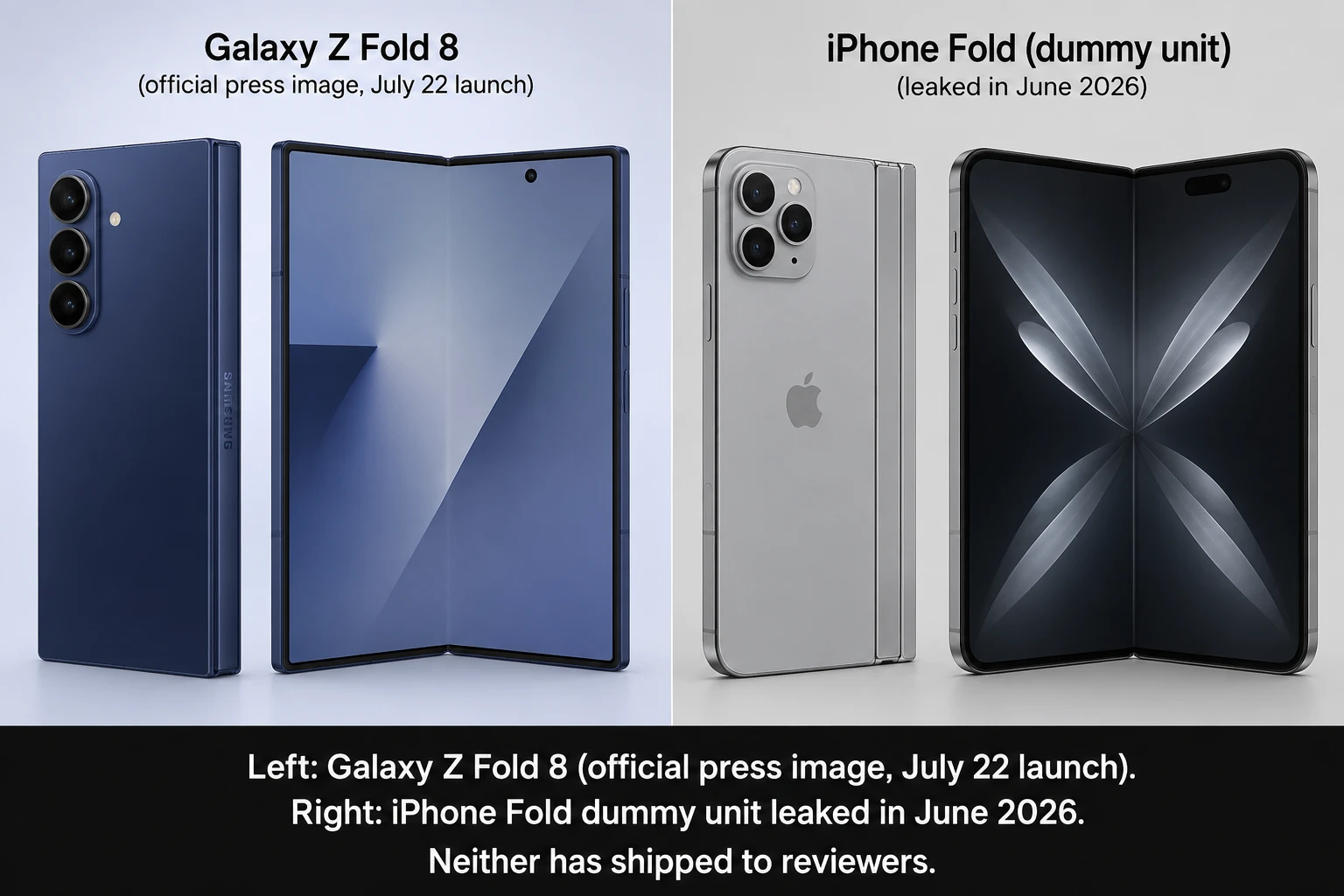
Feature Comparison — What Each Does Better
Where the Z Fold 8 Wins
- Available now. The Z Fold 8 ships in early August. If you need a foldable phone in August or September, the choice is made for you.
- Seven years of software updates confirmed. Samsung's commitment to seven OS updates is one of the strongest software support pledges in Android history. Apple's iOS support is typically six to seven years, so this is close — but Samsung's commitment on the Z Fold 8 is confirmed, while Apple's foldable support timeline is unconfirmed.
- Android ecosystem depth. Samsung DeX turns the Z Fold 8 into a desktop computer when connected to an external display. Galaxy AI integrates deeply across the Samsung device lineup — Galaxy Watch, Galaxy Tab, Galaxy Glasses. For users with existing Samsung hardware, the integration compounds across devices.
- Proven hinge reliability. Seven generations of Z Fold hinges have established Samsung as the benchmark for foldable durability. The Z Fold 8 builds on that track record. The iPhone Fold will be Apple's first-generation hinge — first-generation anything from any manufacturer carries inherent uncertainty.
- 200MP main camera, 50MP ultrawide. Samsung's camera hardware on the Z Fold 8 is the most capable spec combination in any foldable. Whether hardware megapixels translate to best-in-category photos in real use is a different question — but on paper, the Z Fold 8 camera leads.
Where the iPhone Fold May Win
- Potentially crease-free display. If the Samsung Display CES 2026 demo technology makes it into Apple's final product, the iPhone Fold could ship with the first genuinely crease-free foldable display available to consumers. This is the single biggest potential advantage — and the most uncertain one.
- iOS and Apple ecosystem. For the 1 billion+ active iPhone users, switching to an Android foldable means leaving iMessage, AirDrop, AirPods seamless switching, iCloud, and the rest of the Apple ecosystem. The iPhone Fold will be the first foldable that does not require that trade-off.
- Apple Intelligence integration. Apple Intelligence in 2026 is tightly integrated across iPhone, iPad, and Mac. An iPhone Fold running iOS 26 will benefit from that full ecosystem AI layer — including Siri improvements, Mail summarization, and writing tools across all apps — in a way that no Android foldable can replicate for existing Apple users.
- A20 chip efficiency. Apple's chip architecture consistently delivers better performance-per-watt than Qualcomm. The A20 in the iPhone Fold will likely deliver smoother sustained performance and better battery efficiency per mAh than the Snapdragon 8 Elite Gen 5, based on Apple's consistent historical advantage in this metric.
- Touch ID over Face ID. The iPhone Fold reportedly uses Touch ID on the power button rather than Face ID — which makes sense on a device with two display states where facial recognition geometry changes when the phone folds. For users who find in-display fingerprint sensors less reliable than Apple's Touch ID, this is a meaningful quality-of-life improvement.
The Ecosystem Decision — The Real Reason Most People Will Choose
I want to be direct about something most comparison articles dance around: for most buyers, the choice between Z Fold 8 and iPhone Fold will be made by ecosystem loyalty, not specs.
If you have been on iPhone for five years, use iMessage daily, have AirPods and an Apple Watch, and sync everything through iCloud — the Z Fold 8 is not meaningfully competing for your money. You will wait for the iPhone Fold regardless of how the specs compare.
If you are on Android, use Google ecosystem tools, have a Galaxy Watch, and are comfortable in One UI — the iPhone Fold is not meaningfully competing for your money either, except as a status symbol switch.
The genuinely contested buyer is someone who is currently on Android but has been tempted by the Apple ecosystem, or an iPhone user who specifically wants the productivity benefits of a foldable form factor and has been waiting for Apple's version specifically.
For that person — and this is the honest answer — wait. See both phones reviewed independently. The iPhone Fold's first-generation hinge reliability is unknown. The crease-free display claim is unproven in retail units. The software optimization for third-party apps on a new iOS foldable form factor is unproven.
Samsung has seven generations of foldable experience. Apple has zero. That gap matters on day one, even if Apple closes it quickly.
What I Would Actually Tell a Friend
When the Z Fold 8 launches July 22 and the iPhone Fold launches in September, a friend asks me: which one?
My answer: what phone are you on right now?
If iPhone: wait for the iPhone Fold reviews. Don't buy the Z Fold 8 just because it ships sooner. Your ecosystem matters more than the two-month head start.
If Android, specifically Samsung: buy the Z Fold 8. Seven-year software support, proven hinge, DeX, and meaningful camera upgrades over the Z Fold 7. The iPhone Fold is a first-generation product.
If Android, non-Samsung: think carefully. Switching to either foldable requires adjusting workflows. The Z Fold 8 has the deeper Android optimization. The iPhone Fold starts fresh with no proven track record. I'd lean toward Z Fold 8 for the reliability argument, with a full caveat that iPhone Fold hands-on reviews may change that calculation.
What genuinely disappoints me in this comparison: Apple has taken seven years to enter a category Samsung pioneered. The iPhone Fold could — and probably will — set a new benchmark for foldable display quality if the crease-free display delivers. Seven years of watching Samsung iterate on a form factor Apple wouldn't touch, and Apple might ship a better display on generation one. That would be genuinely impressive, and also genuinely frustrating to have watched Samsung users tolerate the crease for seven years while Apple waited until it could eliminate it.
Our Buying Recommendation
Buy Samsung Galaxy Z Fold 8 if:
- You are on Android and want a foldable now
- You use Samsung ecosystem (Galaxy Watch, Tab, DeX)
- Software support reliability matters — 7 years confirmed
- You want the most proven foldable hinge available
- You cannot wait until September or later for Apple's version
Wait for iPhone Fold if:
- You are currently on iPhone and use Apple ecosystem daily
- Display quality is your top priority — crease-free if the rumor delivers
- You are specifically waiting for Apple's version and won't be happy with anything else
- You are willing to accept first-generation hinge uncertainty for Apple ecosystem integration
Wait for both reviews if:
- You are genuinely undecided between ecosystems
- First-generation iPhone Fold hinge reliability is a concern you want resolved by independent reviewers
- You are not in urgent need of a phone upgrade before December 2026
For our full breakdown of the Z Fold 8 specifically, see our Samsung Galaxy Z Fold 8 & Z Flip 8 complete guide. For the broader foldable landscape before either of these ships, see our best foldable phones 2026 ranking.
FAQ
When does the iPhone Fold launch?
Apple's iPhone Fold is heading for a September 2026 launch alongside the iPhone 18 line. Shipping may follow in October or November depending on production timelines. Mass production is reported to begin in August 2026.
How much will the iPhone Fold cost?
Ming-Chi Kuo forecast a price between $2,000 and $2,500, while a leaker in April 2025 refined the range to between $2,100 and $2,300. The floor of $2,000+ is now sourced from enough independent reports to be considered reliable. Higher storage configurations will cost significantly more.
Does the iPhone Fold have a crease?
Samsung Display briefly showed a crease-less panel next to a Galaxy Z Fold 7 at CES 2026 before the booth was pulled. The panel uses a new hinge and layer-stack design tuned to eliminate the visible crease. Whether this technology makes it into final retail units at the claimed quality is unconfirmed until hands-on reviews.
What chip does the iPhone Fold use?
The most consistent rumors point to an A20 chip with 12GB of RAM. Apple's A-series chips consistently lead on performance-per-watt versus Qualcomm, so the A20 is expected to outperform the Snapdragon 8 Elite Gen 5 in the Z Fold 8 on efficiency metrics.
Should Android users switch to iPhone Fold?
Only if you are willing to leave the Android ecosystem entirely — Google services, your existing app purchases, Android wearables, and cloud services all require migration. The iPhone Fold's specs alone are not a sufficient reason to switch ecosystems for most users.
Will the Z Fold 8 be outdated when iPhone Fold launches?
No. The Z Fold 8 ships in August with confirmed seven-year software support, a 50MP ultrawide camera upgrade, and a 5,000mAh battery. It will remain a current flagship foldable for years regardless of what Apple launches in September.
This article will be updated immediately following the July 22 Galaxy Unpacked event (confirmed Z Fold 8 specs) and the September 2026 Apple event (confirmed iPhone Fold specs). Hands-on coverage will be added when review units are available. Last updated: June 20, 2026.
Which one are you leaning toward — and what's the deciding factor for you? Share it in the comments.

Written by
Asif IqbalSenior Writer
Asif Iqbal is the Founder & CEO of Tech Vault AI, leading the team's hands-on testing of AI tools and SaaS products & Tech reviews. He's focused on cutting through marketing hype to help readers find what actually works.
📬 Get the Latest Reviews in Your Inbox
Once a week — AI tools, SaaS & gadget reviews delivered straight to your email.