Samsung Galaxy Z Fold 8 vs Z Flip 8 (2026): Which Is Worth Your Money?
⚖️ Our Verdict
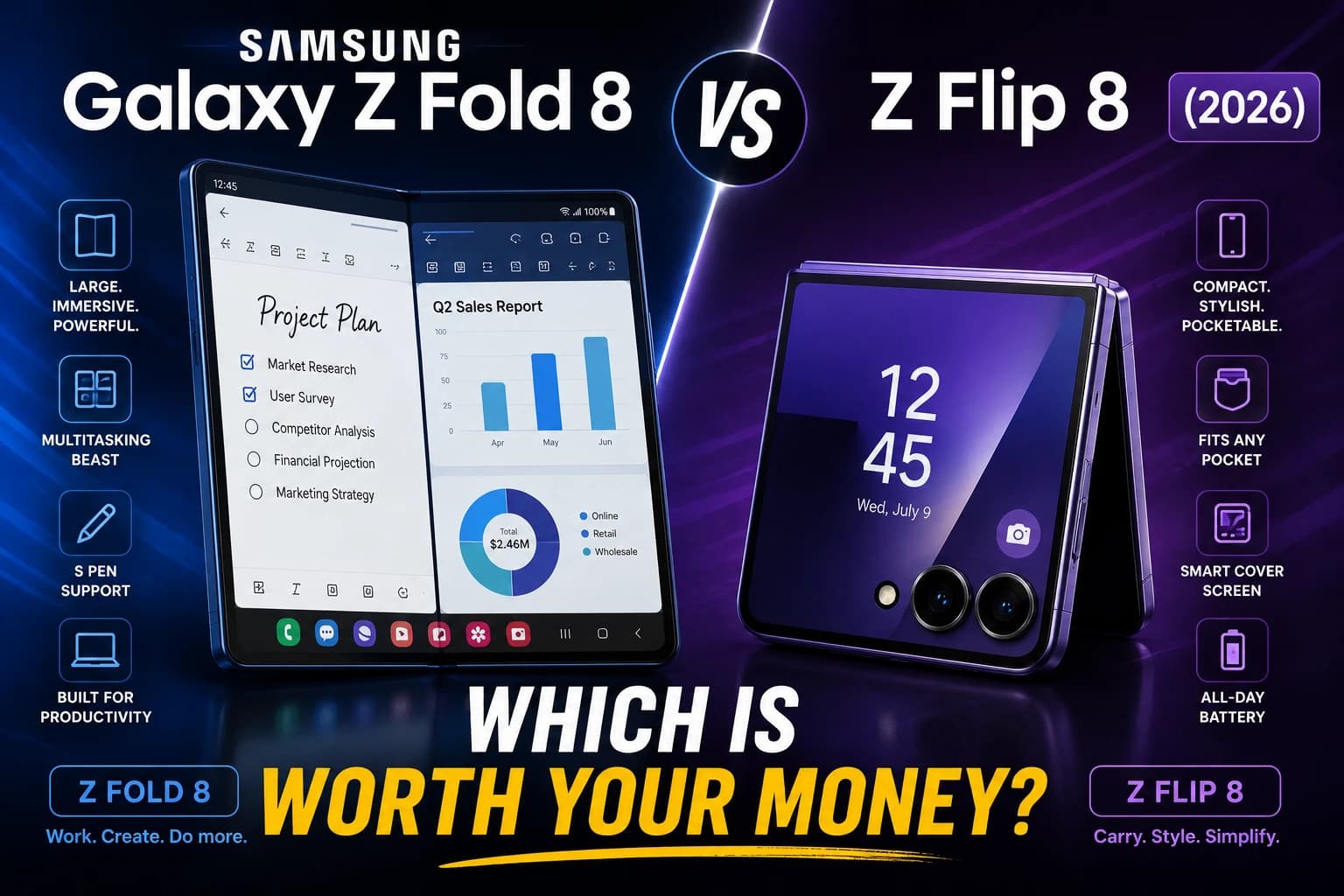
Depends entirely on your use case. Z Fold 8 wins on hardware, display, and productivity. Z Flip 8 wins on price, portability, and everyday practicality. If you genuinely use split-screen and multitasking — Z Fold 8.
Overall Rating
Samsung Galaxy Z Fold 8
$1,999 (256GB) / $2,199 (512GB) / $2,499 (1TB)
Samsung Galaxy Z Flip 8
~$1,099 (256GB) / ~$1,299 (512GB)
✅ Pros
Samsung Galaxy Z Fold 8
Samsung Galaxy Z Flip 8
❌ Cons
Samsung Galaxy Z Fold 8
Samsung Galaxy Z Flip 8
Both phones launch on the same day. Both fold. Both carry Samsung's best software. The price gap between them is $900.
That gap is the whole story.
The Galaxy Z Fold 8 and Z Flip 8 share a launch date — July 22, 2026 in London — but they solve completely different problems. Buying the wrong one is an expensive mistake. This breakdown exists so you don't make it.
We've tracked every confirmed spec, credible leak, and hands-on report leading into the launch. Here is the clearest answer we can give you before July 22.
The Core Difference in One Sentence
The Z Fold 8 is a phone that becomes a tablet. The Z Flip 8 is a phone that becomes smaller.
Everything else flows from that.
Quick Comparison
Galaxy Z Fold 8 | Galaxy Z Flip 8 | |
Starting Price | $1,999 | ~$1,099 |
Inner Display | 8.0-inch AMOLED | 6.9-inch AMOLED |
Outer Display | 6.5-inch AMOLED | 4.1-inch cover screen |
Processor | Snapdragon 8 Elite Gen 5 | Exynos 2600 (2nm) |
Battery | 5,000 mAh | 4,300 mAh |
Wired Charging | 45W | 25W |
Main Camera | 200MP | 50MP |
Ultrawide | 50MP (upgraded) | 12MP (unchanged) |
S Pen | Possibly returning | No |
Weight | ~253g (estimated) | ~175g (estimated) |
Best for | Productivity, multitasking, replacing a tablet | Compact carry, style, everyday use |
Who the Z Fold 8 Is Actually For
Let's be direct. The Z Fold 8 is a $2,000 phone. At that price, it has to earn its place in your life in a way that a $1,200 Samsung Galaxy S26 Ultra or a $1,199 iPhone 17 Pro Max does not.
The argument for the Z Fold 8 is simple: the 8-inch inner display changes what you can do on a phone. Not slightly — meaningfully.
Split-screen multitasking with two full-size apps running simultaneously. Reading long documents without scrolling every three seconds. Sketching and annotating with the S Pen (if it returns as rumored). Watching video on a display closer to a small tablet than a phone. Using DeX to connect to a monitor and run a near-desktop Android experience.
If any of those use cases are a real part of your daily workflow — not something you imagine you might do someday — the Z Fold 8 justifies its price.
The upgraded 5,000 mAh battery (up from 4,400 mAh on the Z Fold 7) and 45W charging address the biggest practical complaint about previous Folds. The 50MP ultrawide upgrade fixes the embarrassing camera imbalance of last year's model. The Snapdragon 8 Elite Gen 5 means this phone will handle everything you throw at it for years.
The Z Fold 8 is for you if:
You currently carry both a phone and a tablet and want to consolidate
Your work involves reviewing documents, spreadsheets, or creative apps on the go
You're a power user who genuinely uses split-screen multitasking
You've used a previous Z Fold and know the format fits your life
$2,000 is within your budget and you want the most capable Android device available
The Z Fold 8 is not for you if:
You're buying it because it looks impressive — that feeling fades after a week
You mostly use your phone for social media, calls, and messaging
You're comparing it to a slab flagship and trying to justify the $700 premium — if you have to convince yourself, buy the S26 Ultra instead
For a full look at how the Z Fold 8 compares to Samsung's other 2026 flagship, see our Samsung Galaxy S26 Ultra vs iPhone 17 Pro Max comparison.
Who the Z Flip 8 Is Actually For
The Z Flip 8 is easier to understand and harder to justify on specs alone.
It does not do anything a regular slab phone cannot do. The 6.9-inch inner display, when unfolded, is comparable to any standard flagship. The 50MP camera is good but not exceptional — and critically, it is the same camera hardware the Z Flip has used since 2024. Three consecutive years without a camera upgrade on a $1,099 phone is the Z Flip 8's most honest weakness.
What the Z Flip 8 offers is form. Folded, it is roughly 5.9mm thick and 12.3mm when closed — meaningfully smaller than any slab phone. It fits in a front jeans pocket where an iPhone 17 Pro Max physically cannot. It sits flat on a table without a case adding bulk. It looks different from every other phone in the room.
That sounds superficial. For a lot of buyers, it genuinely isn't. Compact carry is a real quality-of-life improvement for people who move through the world in ways that make phone size a daily friction point.
The Exynos 2600 chip is a real upgrade — the 2nm process delivers better efficiency and AI performance than last year's model. The tighter hinge closure improves the everyday feel of the phone. Android 17 with One UI 9 and Gemini Intelligence brings the same software experience as Samsung's most expensive devices.
Head over to this page to see the full specs and breakdown for the iPhone 18 Pro and 18 Pro Max.
The Z Flip 8 is for you if:
Compact carry is genuinely important to how you live — not just nice-to-have
You want a foldable phone without the weight, bulk, and cost of the Fold
You're upgrading from a Z Flip 5 or older (meaningful improvement across the board)
The design sets it apart from everything else and that matters to you
You're in the Samsung ecosystem and want the best compact option in it
The Z Flip 8 is not for you if:
You own a Z Flip 7 — the camera is unchanged and thinner design alone does not justify $1,099
Camera quality is your top priority — the Motorola Razr 70 Ultra has a better ultrawide and 68W charging at a competitive price
You're hoping the foldable format adds new capabilities — it doesn't, it just changes the shape
The $900 Question
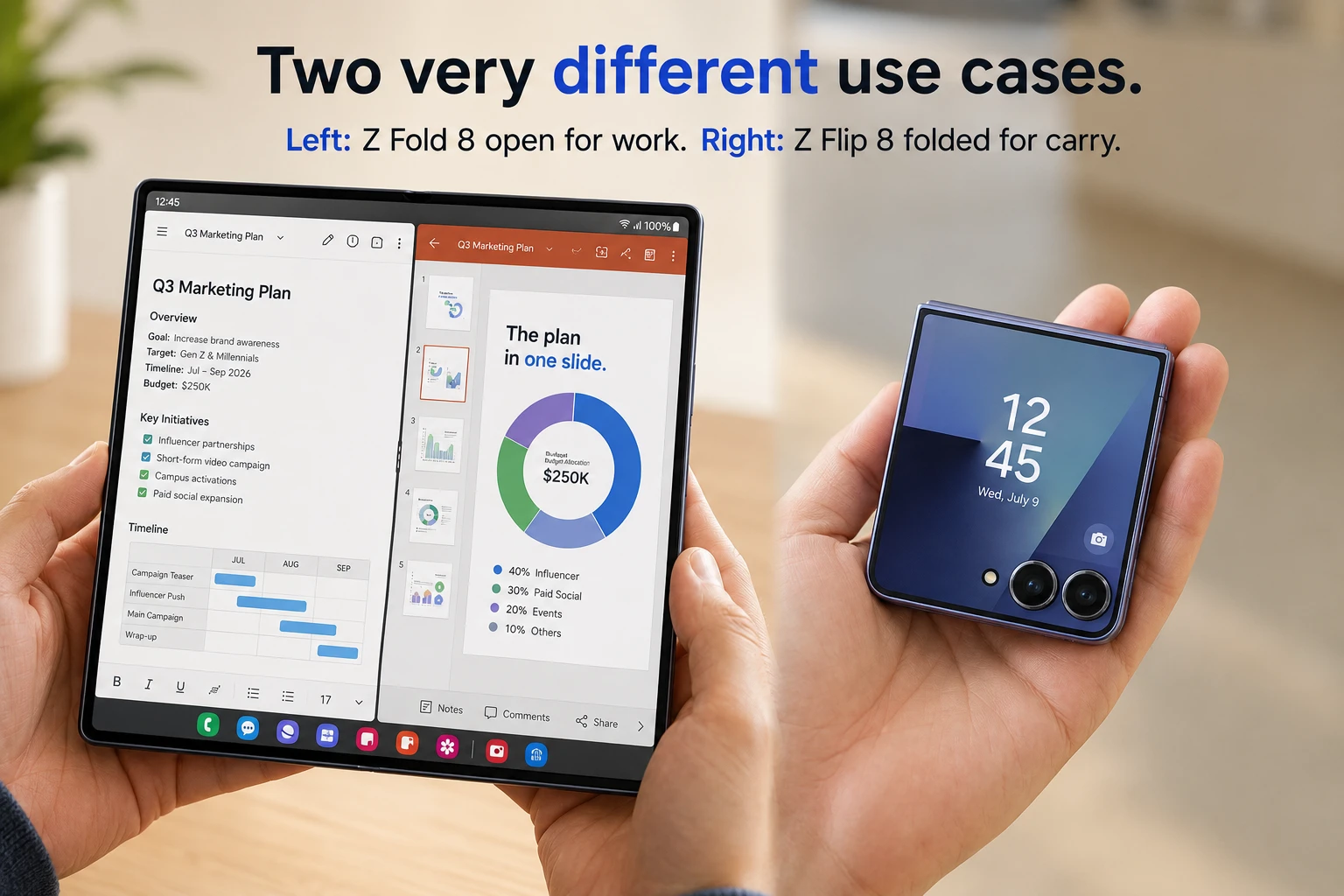
The gap between $1,099 and $1,999 is not just money. It represents a fundamental difference in what these phones are for.
Spending $900 more for the Z Fold 8 makes sense when the larger display genuinely changes how you work and consume content daily. It does not make sense when you're buying the format for novelty, status, or because you think you might use split-screen someday.
Spending $1,099 on the Z Flip 8 makes sense when compact carry is a real priority and you value the design distinction. It does not make sense when you're paying a $400 to $500 premium over comparable slab phones primarily for a folding mechanism that doesn't add new capabilities.
Both phones face the same underlying question: does the foldable format change how you actually use your phone?
If yes — Z Fold 8 for productivity and multitasking, Z Flip 8 for compact carry and design.
If not — the Samsung Galaxy S26 Ultra at $1,299 gives you more camera hardware, a faster charge, and a lighter form factor than either foldable. Our full review of the best Samsung phones in 2026 covers all the options side by side.
What About Waiting for the iPhone Fold?
Apple's foldable iPhone is expected later in 2026. If you're an iPhone user considering switching ecosystems for a foldable, waiting makes sense. Apple's first foldable will likely prioritize thinness, camera quality, and iOS integration over multitasking depth.
If you're already on Android and Samsung's ecosystem, waiting for Apple's foldable doesn't make sense. The Galaxy Z Fold 8 ships in August. Apple's device arrives at best in September, more likely Q4.
If you're genuinely undecided between Android and iOS, our SaaS and AI tools comparison can help you think through which ecosystem better fits your software needs beyond the hardware.
Both Phones — What They Share
Before the decision, it's worth knowing what you get regardless of which one you choose.
Both phones ship with Android 17 and One UI 9. Both get Gemini Intelligence — Google's system-wide AI layer — arriving on foldables before any other Android device. Both carry Samsung's seven-year software update commitment, which is the best in Android and competitive with Apple. Both have IPX8 water resistance. Both support Samsung DeX, Galaxy Watch integration, and the full Samsung ecosystem.
You are not choosing between a good phone and a lesser one. You are choosing between two excellent phones designed for different lives.
Final Verdict
Buy the Z Fold 8 ($1,999) if the large inner display, split-screen multitasking, upgraded ultrawide camera, and the potential S Pen return align with real things you do every day. It is the most capable Android device launching in 2026.
Buy the Z Flip 8 (~$1,099) if compact carry genuinely matters to your daily life and you want the best compact foldable in Samsung's lineup. Skip it if you own a Z Flip 7 — the camera hasn't changed.
Buy neither if you're not sure the foldable format improves your daily life. The Galaxy S26 Ultra at $1,299 gives you more traditional flagship value than either foldable at its respective price point.
Both phones go on sale in early August 2026 following the July 22 Galaxy Unpacked announcement. Pre-orders are expected to open on launch day with Samsung's usual trade-in and accessories bonuses.
Bookmark our phones and gadgets section — we'll have updated coverage immediately after the July 22 announcement.
This article will be updated immediately after the July 22 Galaxy Unpacked announcement with confirmed pricing, full specs, and any surprises Samsung reveals.
Frequently Asked Questions
What is the price difference between Z Fold 8 and Z Flip 8?
The Z Fold 8 starts at $1,999. The Z Flip 8 is expected around $1,099. That is a $900 gap at the base level.
Which is better for everyday use — Z Fold 8 or Z Flip 8?
For most people's everyday use — social media, calls, messaging, browsing — the Z Flip 8 is the more practical choice. The Z Fold 8's advantages are most felt in productivity and multitasking scenarios.
Is the Z Fold 8 worth $900 more than the Z Flip 8?
Only if the 8-inch inner display and multitasking capabilities are things you will genuinely use daily. If you're a light phone user, the Z Flip 8 covers everything you need at $900 less.
Should I wait for the iPhone Fold instead?
If you're currently on an iPhone and the ecosystem matters to you, waiting for Apple's foldable later in 2026 makes sense. If you're on Android, the Z Fold 8 ships months before Apple's device.
Is the Z Flip 8 worth upgrading from Z Flip 7?
Probably not if you bought the Z Flip 7 last year. The camera hardware is unchanged. The thinner design is genuinely nicer but not a compelling upgrade reason on its own.

Written by
Asif IqbalSenior Writer
Asif Iqbal is the Founder & CEO of Tech Vault AI, leading the team's hands-on testing of AI tools and SaaS products & Tech reviews. He's focused on cutting through marketing hype to help readers find what actually works.
Samsung Galaxy Z Fold 8 reviews
Loading reviews...
Samsung Galaxy Z Flip 8 reviews
Loading reviews...
Questions & Answers
Loading questions...
📬 Get the Latest Reviews in Your Inbox
Once a week — AI tools, SaaS & gadget reviews delivered straight to your email.