Samsung Galaxy Z Fold 8: Should Z Fold 7 Owners Upgrade?
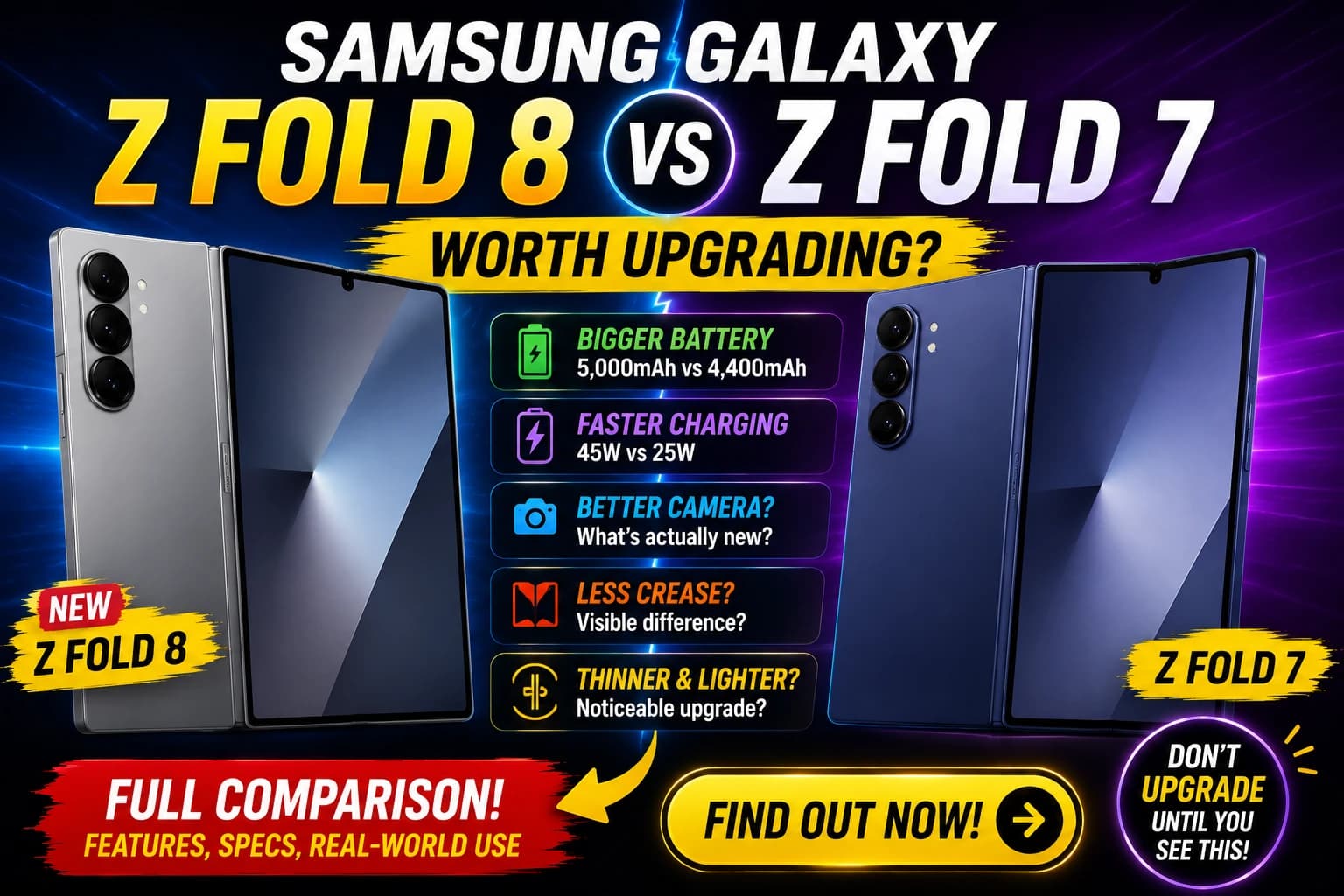
⚖️ Our Verdict
Z Fold 8 if your Z Fold 7 has a specific frustration — crease, camera, or battery. Otherwise, wait. Eleven months is not long enough to justify $2,000 just because a newer model exists.
Overall Rating
Samsung Galaxy Z Fold 7
$1,999 (256GB) — current model, launched July 2025
Samsung Galaxy Z Fold 8
$1,999 (256GB) — 512GB/1TB expected +$80 per tier due to memory shortage
✅ Pros
Samsung Galaxy Z Fold 7
Samsung Galaxy Z Fold 8
❌ Cons
Samsung Galaxy Z Fold 7
Samsung Galaxy Z Fold 8
I have been folding and unfolding my Z Fold 7 for eleven months now. The crease down the middle of the inner screen still catches the light a certain way when I'm reading in bed, and I notice it every single time. Small thing. Never stopped bothering me.
That crease is apparently going away on the Z Fold 8. So is the camera embarrassment — my Z Fold 7's ultrawide lens has been the weakest part of an otherwise excellent phone since the day I bought it. When Samsung's leak schedule started filling up with Z Fold 8 details in May, I found myself doing something I do not usually do: actually considering an upgrade after less than a year.
This is the honest version of that decision — not a spec sheet dump, but the actual reasoning a current Z Fold 7 owner needs before deciding whether $1,999 (or more, depending on which configuration Samsung settles on) is worth spending eleven months into ownership of the previous model.
Who Should Read This vs. Who Should Skip It
This article is written specifically for people who already own a Z Fold 7. If you're coming from an older Fold or a different foldable entirely, the calculation is different and more favorable toward upgrading — see our Z Fold 8 vs Z Flip 8 buying guide for that broader decision.
Skip this if: Your Z Fold 7 works fine and you have no specific complaint about it. Nothing here will convince you to spend $2,000 just because a newer model exists.
Keep reading if: You own a Z Fold 7 and have at least one genuine frustration with it — the crease, the camera, the battery life — and want to know if the Z Fold 8 actually fixes it or just claims to.
Quick Comparison
| Galaxy Z Fold 7 (current) | Galaxy Z Fold 8 (2026) | |
|---|---|---|
| Starting Price | $1,999 (at launch, July 2025) | $1,999 (256GB) |
| Inner Display | 8.0-inch AMOLED, visible crease | 8.0-inch AMOLED, dual-layer UTG — reduced crease |
| Outer Display | 6.5-inch AMOLED | 6.5-inch AMOLED |
| Processor | Snapdragon 8 Elite | Snapdragon 8 Elite Gen 5 |
| Battery | 4,400 mAh | 5,000 mAh (+13.6%) |
| Charging | 25W | 45W |
| Ultrawide Camera | 12MP | 50MP (upgraded) |
| Main Camera | 200MP | 200MP |
| S Pen | Not supported | Possibly returning (rumored) |
| Thickness (unfolded) | 4.2mm | ~4.5mm (rumored) |
The Crease — What's Actually Changing
This is the complaint I hear most from other Z Fold 7 owners, and it is the one I have personally lived with longest.
Samsung Galaxy Z Fold 8 Leaks: Dual-UTG Glass and the End of the Screen Crease? — that headline alone tells you how much attention this specific issue gets in foldable phone coverage. The new dual LED ultra-thin glass structure significantly reduces the crease along the fold, improving both the screen's visual appeal and its long-term durability.
Here is the honest caveat: "reduces" is not "eliminates." Every foldable Samsung has shipped to date has some visible crease under certain lighting angles. The dual-UTG approach is a genuine engineering improvement, not a marketing reframe — but I would not upgrade purely on the promise of a crease-free experience until independent reviewers confirm it in person after July 22.
If the crease is your single biggest frustration with the Z Fold 7, this is the most legitimate reason to consider the Z Fold 8. If it has never bothered you, this upgrade reason does not apply to you at all.
The Camera Gap — Three Years Overdue, Finally Closing
My Z Fold 7's ultrawide camera has been the one spec I actively avoid using. 12 megapixels next to a 200-megapixel main sensor on a $1,999 phone always felt like an afterthought Samsung never got around to fixing.
The Z Fold 8 finally addresses this directly. What's new for Z Fold 8 is an updated ultra-wide camera — unlike the Z Fold 7 which had a fairly lackluster 12MP ultra-wide camera for such an expensive device, the Fold 8 could be packing a much improved 50MP equivalent.
That is not an incremental bump. Going from 12MP to 50MP on the ultrawide lens is the single most meaningful camera upgrade in the Z Fold lineup's recent history. If you take a lot of group shots, architecture photos, or wide landscape images on your Fold — situations where the ultrawide actually gets used — this upgrade alone closes a gap that has existed since the Z Fold 7's launch.
The hidden detail most coverage misses: this upgrade specifically targets the camera that previous Fold owners complained about loudest. Samsung clearly read the reviews.
Battery and Charging — The Upgrade I'd Actually Notice Daily
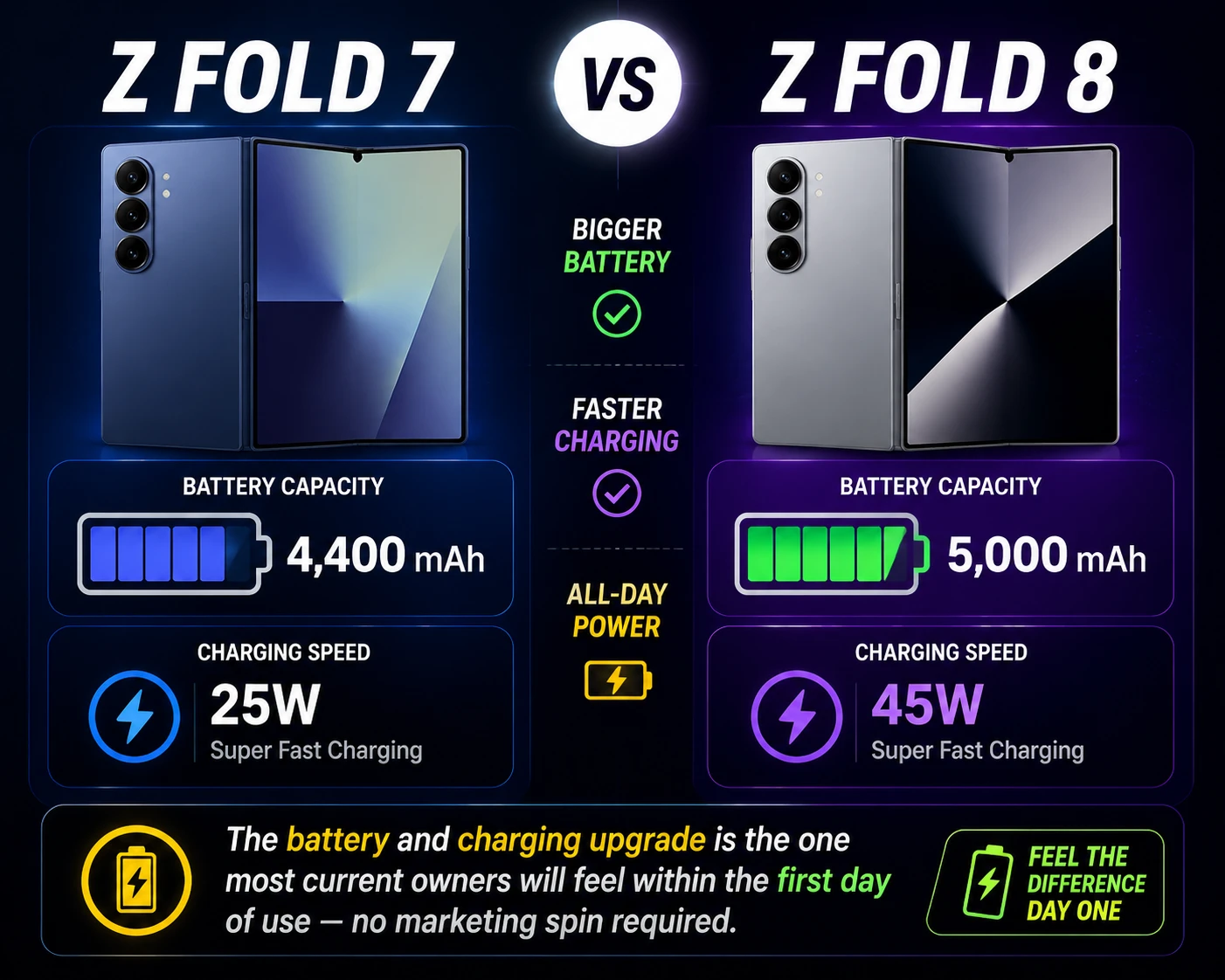
Major hardware upgrades include a 5,000mAh battery (up from 4,400mAh), 45W wired charging, a 50MP ultrawide camera upgrade, and the Snapdragon 8 Elite Gen 5 processor.
A 13.6% battery capacity increase combined with charging speed nearly doubling (25W to 45W) is the upgrade I would personally feel every single day, more than the camera or even the crease reduction. My Z Fold 7 needs a midday top-up on heavy days — split-screen multitasking on an 8-inch display drains faster than any slab phone I've owned. An extra 600mAh plus faster charging genuinely changes that daily rhythm.
This is the upgrade category where "better on paper" most reliably translates into "better in actual use" — battery life is not a feature you have to learn to appreciate, you notice it the first day you don't reach for a charger by 3pm.
The Price Problem Nobody Is Talking About Enough
Here's the part of this decision that deserves more attention than most coverage gives it.
The base model starts at $1,999, but the 512GB and 1TB configurations are getting price hikes of around $80 each, with the top-tier model potentially exceeding $2,700. Rising memory chip costs are the main driver behind the price increases, with the global DRAM shortage expected to persist into 2027.
If you bought your Z Fold 7 at a storage tier above the base 256GB, replacing it with the equivalent Z Fold 8 configuration in 2026 will cost more than what you paid in 2025 — not because Samsung padded margins, but because of a global memory shortage outside anyone's control. That is worth knowing before you assume the upgrade math is identical to last year's launch.
My honest take: if you're considering the 512GB or 1TB Z Fold 8, price-check the exact configuration before deciding. The headline $1,999 number applies only to the base 256GB model.
The Confusing Part: Z Fold 8, Z Fold 8 Ultra, and Z Fold 8 Wide
This is where Samsung's 2026 foldable strategy gets genuinely hard to follow, and it matters directly for anyone trying to decide whether to upgrade.
A new leak reveals alleged screen protectors for Samsung's Galaxy Z Flip 8, Z Fold 8 and Z Fold 8 Ultra, suggesting a wider, shorter Fold 8 design and clearer differentiation across the foldable lineup. Samsung now appears to be launching three distinct foldable form factors in the same event — a standard Z Fold 8, a Z Fold 8 Ultra, and reportedly a Z Fold 8 Wide as well, a purported rival to the wider rumored foldable iPhone.
This is about as confusing a strategy as one can achieve, not just because it muddies the work Samsung has put into separating the Z Fold range from the Z Flip, but because it doesn't clearly communicate what each phone actually offers.
For a current Z Fold 7 owner, this matters practically: do not assume "the new Z Fold" refers to one phone. Wait for July 22 to confirm exactly which model has which camera configuration and display size before comparing prices, because Samsung itself appears to still be finalizing how it differentiates these three devices. We cover the Ultra variant specifically in our Z Fold 8 Ultra vs Z Fold 8 breakdown.
Performance — A Real Upgrade, But Not the Reason to Buy
The Z Fold 7 runs the standard Snapdragon 8 Elite. The Z Fold 8 steps up to the Snapdragon 8 Elite Gen 5 — the same chip Samsung is putting in the Galaxy S26 Ultra.
In day-to-day use, my Z Fold 7 has never once felt slow. Split-screen multitasking, switching between a dozen open apps, even moderately demanding games — the current chip handles all of it without visible strain. The Gen 5 upgrade will show up in benchmark charts and in sustained performance under heavy thermal load over longer sessions, but it is not a reason to upgrade on its own if your Z Fold 7 already feels fast to you.
Gemini Intelligence arrives on foldables first, bringing multi-app AI automation through One UI 9 and Android 17. This software layer is the more interesting performance-adjacent upgrade — it's available across the new foldable lineup and represents a genuine step beyond what current Z Fold 7 software offers, though the chip itself is a smaller factor in daily experience than Samsung's marketing suggests.
What I'd Actually Do (My Honest Recommendation)
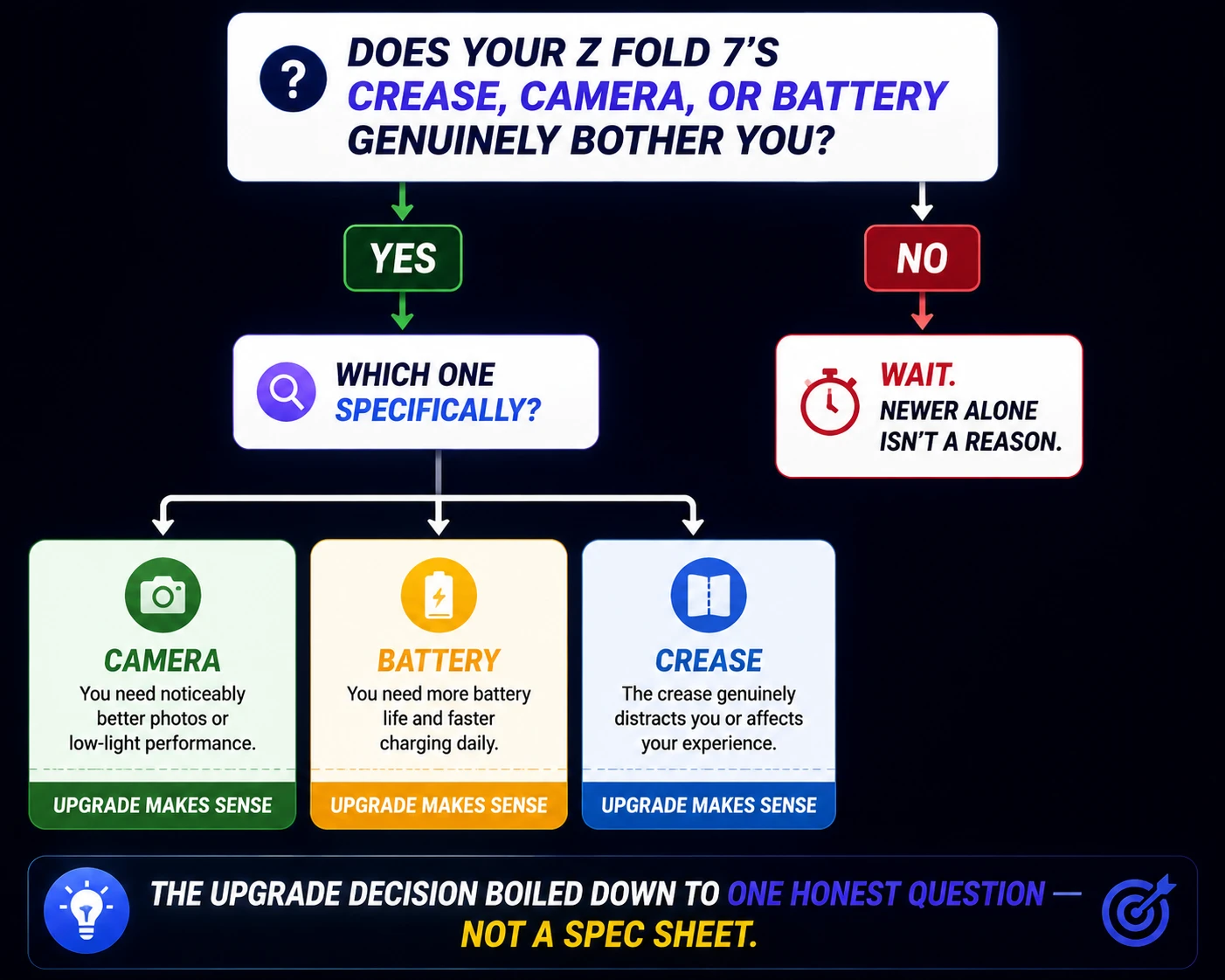
If you own a Z Fold 7 and the crease, camera, or battery life genuinely bother you in daily use — not theoretically, but as something you've actually complained about to a friend at least once — the Z Fold 8 addresses all three legitimately. That is not nothing. Three real complaints fixed in one generation is better than most annual phone refreshes manage.
If your Z Fold 7 has none of these specific frustrations and you're considering the upgrade because a new model exists, I would wait. Eleven months is not long. The resale value gap between an 11-month-old Z Fold 7 and a new Z Fold 8 is significant, and "newer" alone has never been a good enough reason to spend $2,000.
My personal plan: I'm waiting for July 22, reading the confirmed specs on whichever model ends up being the direct Z Fold 7 successor, and specifically checking whether the crease reduction holds up in hands-on coverage before deciding. The camera and battery upgrades alone are tempting. I am disappointed in myself for how tempted I already am, honestly — which is exactly the kind of impulse this article exists to slow down.
What We Still Don't Know
- Exact final pricing for 512GB and 1TB configurations beyond the rumored $80 increase per tier.
- Whether the crease reduction is noticeable in person or primarily a manufacturing/durability improvement.
- Whether S Pen support is actually returning — this remains a credible rumor, not a confirmation.
- How Samsung will market and differentiate the standard Z Fold 8 against the Ultra and Wide variants.
We will update this article immediately after the July 22 Galaxy Unpacked event with confirmed details. For the full pillar coverage of both new foldables, see our Samsung Galaxy Z Fold 8 & Z Flip 8 complete guide.
Is the Samsung Galaxy Z Fold 8 worth upgrading from the Z Fold 7?
How much will the Samsung Galaxy Z Fold 8 cost?
Does the Z Fold 8 actually fix the screen crease?
What is the difference between the Z Fold 8, Z Fold 8 Ultra, and Z Fold 8 Wide?
Should I sell my Z Fold 7 now or wait?

Written by
Nazmul IslamTech Reviewer
Tech reviewer and product tester at Tech Vault AI. Evaluates smartphones, AI tools, and SaaS products through real hands-on daily use — not spec sheets alone.
Samsung Galaxy Z Fold 7 reviews
Loading reviews...
Samsung Galaxy Z Fold 8 reviews
Loading reviews...
Questions & Answers
Loading questions...
📬 Get the Latest Reviews in Your Inbox
Once a week — AI tools, SaaS & gadget reviews delivered straight to your email.