Galaxy S26 Ultra vs iPhone 18 Pro Max: I Own One, I Borrowed the Other
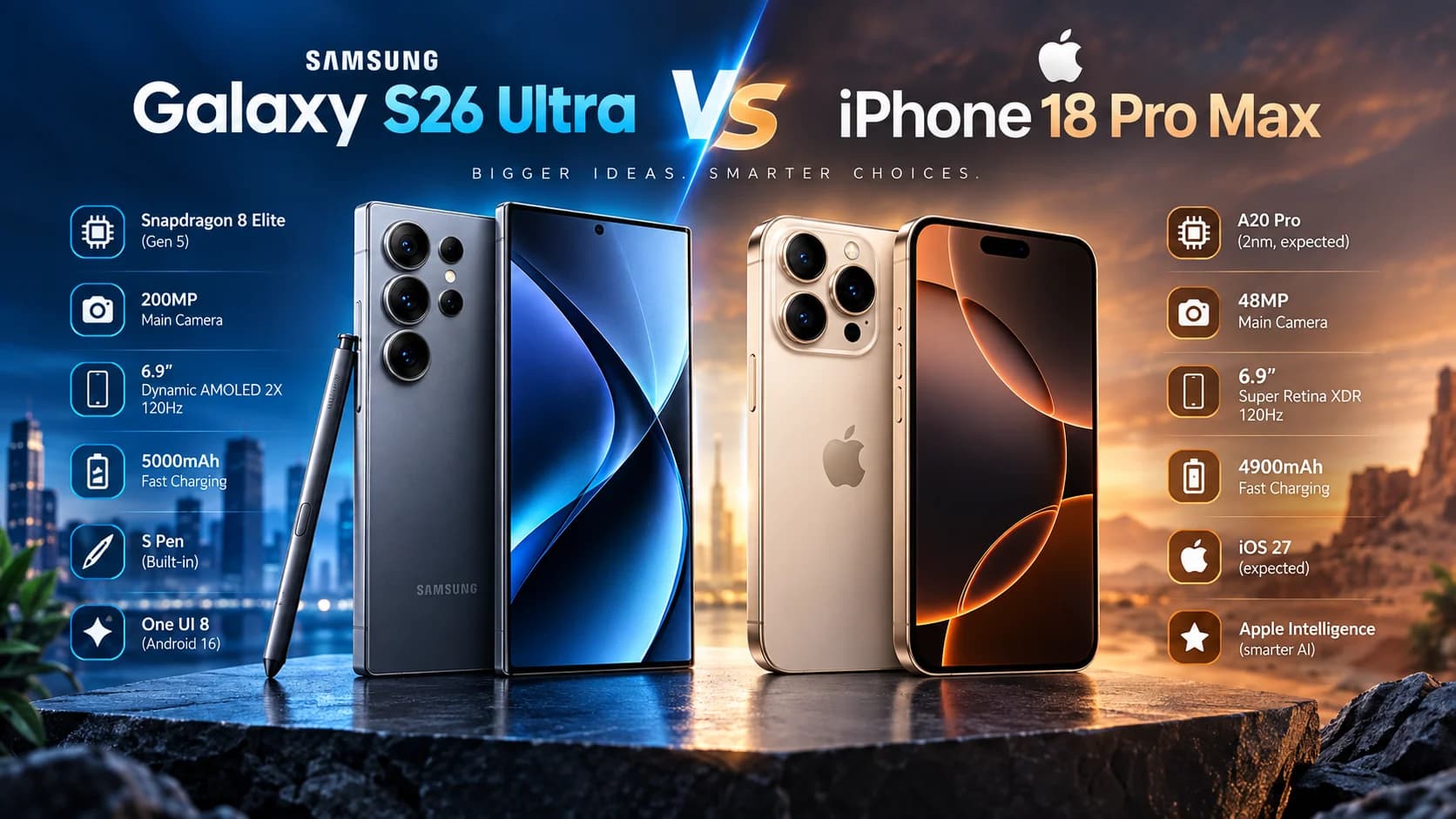
⚖️ Our Verdict
Galaxy S26 Ultra — best value today; iPhone 18 Pro Max — best hardware
Overall Rating
Samsung Galaxy S26 Ultra
$1,049 (256GB, was $1,299)
Apple iPhone 18 Pro Max
$1,299 (256GB)
✅ Pros
Samsung Galaxy S26 Ultra
Apple iPhone 18 Pro Max
❌ Cons
Samsung Galaxy S26 Ultra
Apple iPhone 18 Pro Max
Short answer: if you're buying this month, the Galaxy S26 Ultra is the better deal by a wide margin — not because it's the better phone, but because it's six months old and now sells for around $1,049, while the iPhone 18 Pro Max ships September 18 at a full $1,299. That $250 gap is the biggest single factor in this comparison, and almost nobody is talking about it.
Here's where I'm writing from, because it changes how you should read everything below. My own daily phone is an iPhone 17 Pro Max — three months of ownership, not a loaner. Last week I borrowed a friend's Galaxy S26 Ultra and used it as my only phone for seven days. Nobody has used an iPhone 18 Pro Max yet; Apple announced it yesterday and retail units don't land until September 18.
So one side of this is lived experience on both platforms, and the other side is Apple's spec sheet. I'll keep telling you which is which.
The Moment That Sold Me on the S26 Ultra Wasn't in Any Review
Day three. Crowded bus, phone in my hand, replying to messages. My friend sitting next to me leaned over and asked something I've been thinking about since:
"Why are you swiping on a dead screen?"
He wasn't joking. From his angle — maybe fifteen degrees off-axis — the display looked switched off. From mine it was perfectly bright. I'd enabled Privacy Display the night before and forgotten about it.
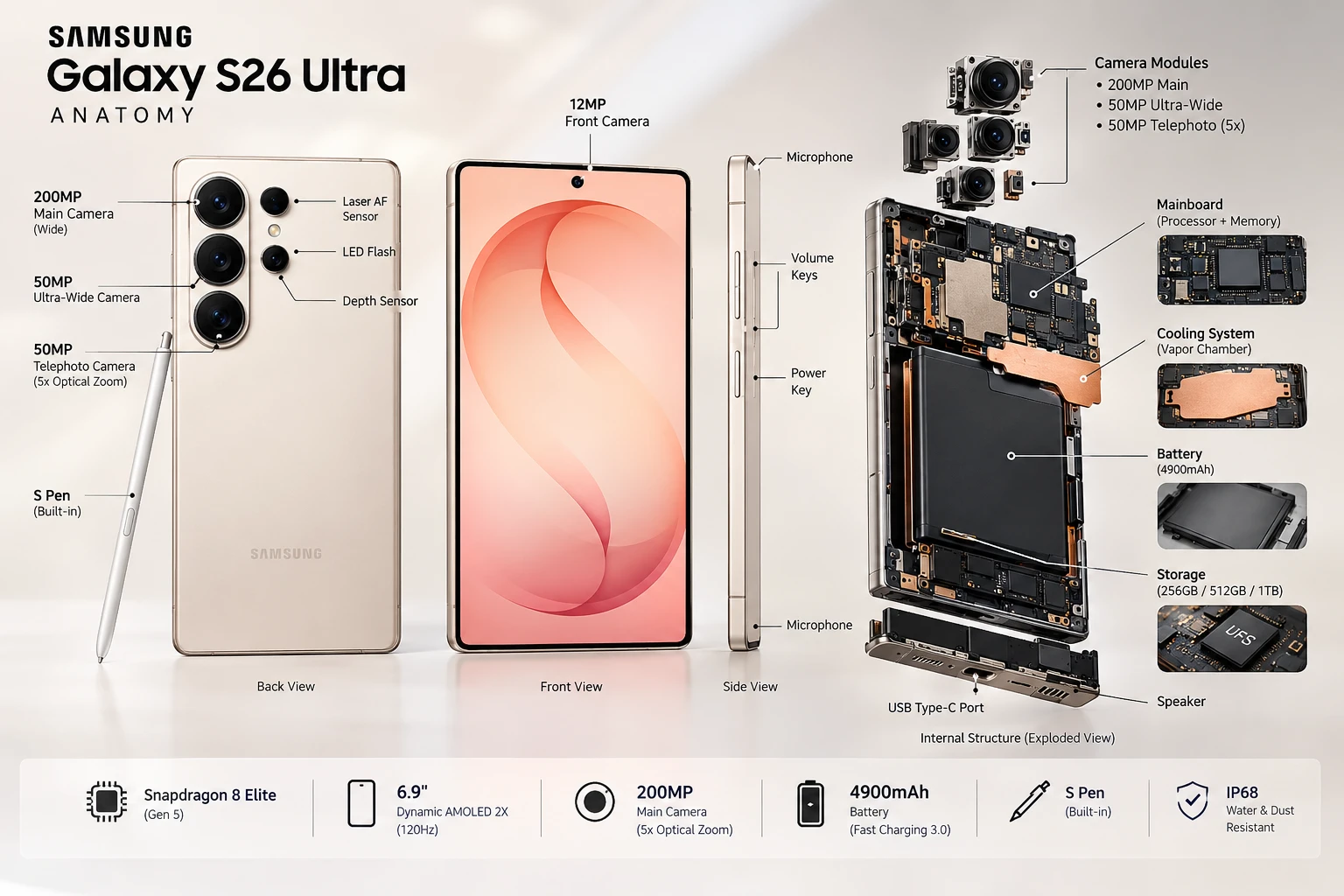
This isn't software dimming. Samsung built a panel called Flex Magic Pixel OLED with narrow and wide subpixels that can be controlled individually. Switch Privacy Display on and the wide pixels shut down, so light stops travelling sideways. Samsung calls it a world first on mobile, and it's exclusive to the Ultra — the S26 and S26+ don't have it.
You can toggle it from the Quick Panel, assign it to a double-press of the side button, or set it per-app so it only activates for banking apps or PIN entry.
The part most reviews skip: there's a third setting called Maximum privacy protection, buried under Settings → Display → Privacy display. It makes the screen almost unreadable off-axis, but it drops a metallic grey haze over everything — colours wash out even head-on. Independent testing by LTT Labs found it works by turning some wide pixels back on in dark areas to push the panel toward middle grey. It's clever engineering and it looks terrible. I switched it off after ten minutes.
And the Thing That Genuinely Annoyed Me
Day one, before any of the good stuff.
I'd read the S26 Ultra finally got a 24MP default photo mode — the middle ground between fast 12MP shots and slow 200MP files, roughly what iPhones have shot at for years. It was the feature I most wanted to try.
Opened the camera. Not there. Checked the resolution toggle. Not there. Went through the settings twice, convinced I was being stupid.
I wasn't. On a phone that launched at $1,299, the 24MP mode isn't in the camera app at all. To use it you have to:
- Leave the camera and open the Galaxy Store
- Download a separate app called Camera Assistant — a Good Lock module, version 4.5.19 or newer
- Open it, find Advanced Resolution, and enable 24MP manually
Only then does it appear in the stock camera. Samsung apparently hid it because a third resolution option might confuse mainstream buyers, which is a fair worry and a terrible solution. The result is a headline camera feature that's invisible to almost everyone who bought the phone.
Seven days in, that's still the thing I'd complain about first. Not the hardware — the decision. If you want more on how Samsung handles camera software across its 2026 lineup, our Galaxy Z Fold 8 camera review covers the foldable side.
I'm Not Neutral Here, and It's Worth Explaining Why
My own phone is an iPhone 17 Pro Max, three months old. So this isn't a reviewer picking up two loaners for a week — it's someone who lives on one side of this comparison and borrowed the other.
That matters because the iPhone 18 Pro Max keeps almost everything I've been living with. Same aluminum frame, same 6.9-inch panel size, same camera plateau. Apple changed the chip, the cooling and the aperture — the body and the material carried over. So the problems I've hit in three months are the ones I'd expect again, unless Apple specifically fixed them. And I can tell you exactly which ones it claims to have.
Three months in, here's what my 17 Pro Max actually does
The aluminum scratches. Confirmed, on my own unit. Not from drops or carelessness — normal pocket and desk use. The rails picked up visible marks and I don't like it. My blunt advice to anyone buying an 18 Pro Max: buy the case with the phone, not later. Apple didn't go back to titanium this year, so you'd be buying the same material that scratched on mine.
Battery health dropped about 5% in three months. Faster than I'd like at this price. iPhones have never led flagships on battery, and it's an area where Samsung has been ahead for years — a full charge on the S26 Ultra simply lasted me longer during my week with it, despite a smaller cell on paper.
Heat is the real problem, and it shows up three specific ways. Read this part carefully if you're considering the 18 Pro Max, because it's exactly what Apple says it fixed.
- Gaming: 20 to 30 minutes of something heavy like Genshin Impact and the phone is noticeably hot.
- 4K video outdoors: four or five minutes is all it takes.
- Charging while doing anything else: plug into a fast charger and game, or watch video, or shoot — that combination heats it fastest and hardest.
The knock-on effects are what actually ruin the experience:
- The screen auto-dims and you can't override it. Brightness drops to roughly half the moment it warms up, with no manual way to force it back. In sunlight you're squinting at a screen you paid $1,199 for.
- Charging stalls at 80%. Warm phone on a fast charger and the speed collapses. It sits at 80% and refuses to move until the phone cools.
- The camera app gives up. Long 4K takes have closed the app outright, and before that the preview stutters and drops frames.
Why this makes Apple's biggest claim testable
Apple's answer to all of the above is a vapor chamber with three times the surface area of the one in my phone, claiming up to 40% better sustained performance. That is a direct response to exactly the three failures above.
I'm not going to write that the 18 Pro Max runs cool — I haven't touched one. What I'll say is that I know precisely what to point it at on September 18: half an hour of Genshin, then five minutes of 4K in the sun, then a fast charger while it's still warm. If the screen holds brightness and charging doesn't stall, Apple genuinely fixed something. If it doesn't, the new chamber is marketing.
That test is coming to this page. Nobody else can run it with three months of the previous generation as a baseline.
What Actually Separates These Two Phones
| Galaxy S26 Ultra | iPhone 18 Pro Max | |
|---|---|---|
| Street price (256GB) | ~$1,049 (launched $1,299) | $1,299 |
| Released | March 2026 | September 18, 2026 |
| Display | 6.9", 1440×3120, 2,600 nits, Privacy Display | 6.9", 1320×2868, 3,000 nits |
| Chip | Snapdragon 8 Elite Gen 5, 3nm | Apple A20 Pro, 2nm |
| Main camera | 200MP, fixed ƒ/1.4 | 48MP, variable ƒ/1.48–ƒ/4.0 |
| Telephoto | 50MP periscope + 10MP (100x digital) | 48MP, 4x/8x optical |
| Ultrawide | 50MP ƒ/1.9 | 48MP ƒ/2.2 |
| Front camera | 12MP | 18MP |
| Battery | 5,000mAh | 5,567mAh (eSIM) / 5,391mAh (SIM) |
| Charging | 60W wired, 75% in 30 min | 60W wired, 50% in ~15 min |
| Weight | 214g | 249g |
| Thickness | 7.9mm | 8.75mm |
| Stylus | S Pen included | None |
| SIM | Nano + eSIM | eSIM only in the US |
| Software support | 7 major Android updates | ~6–7 years of iOS |
Two rows decide most purchases, and neither is the chip.
Price. Samsung's own store currently lists the 256GB unlocked S26 Ultra around $1,049, down from $1,299.99 at launch. Walmart has gone as low as $893. Apple is charging $1,299 for a phone you can't hold until September 18. You are comparing a discounted flagship against a full-price one, and most articles are still quoting Samsung's March price as if nothing changed.
The S Pen. It's inside the Samsung. Apple has never shipped a stylus with an iPhone and shows no sign of starting. If you write, sketch or annotate, no other row in that table matters.
One Thing I Won't Complain About: Weight
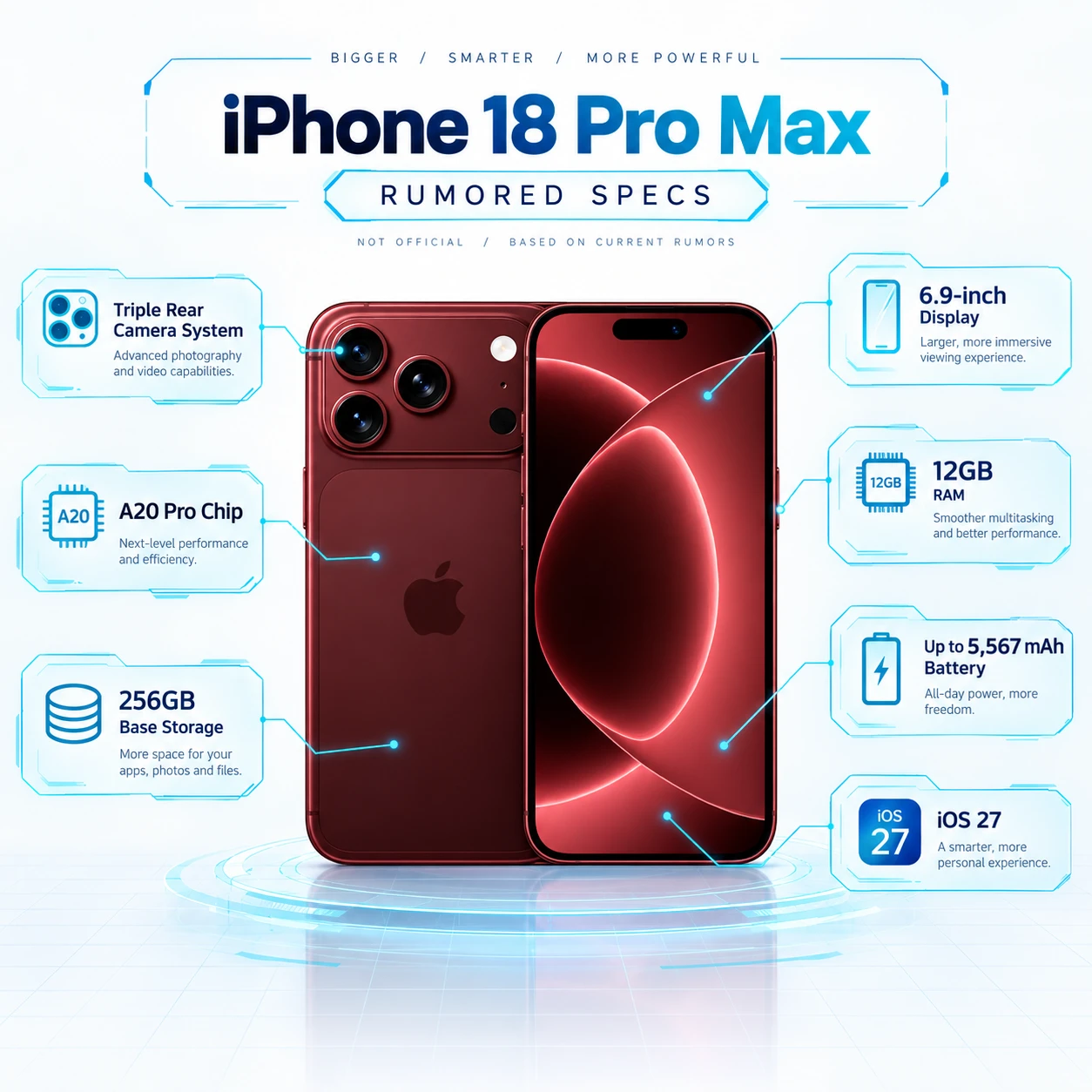
The 18 Pro Max is 249g, up from 233g on mine, and reviewers are already making it a talking point. I don't think it is one.
Flagships are heavy. That's the deal you accept for a 6.9-inch screen, a large battery and three lenses. My phone is heavy, the S26 Ultra at 214g is heavy, and 16 grams isn't going to change anyone's day. If weight genuinely matters to you, you don't want a Max-class phone at all — you want the iPhone 18 Pro at 211g, which is the same phone in a smaller shell this year, with the same chip, cameras and variable aperture for $100 less.
Which Camera Wins? It Depends What You Mean by "Wins"
Let me be specific about what I can and can't tell you.
On the S26 Ultra, after seven days: the 200MP sensor at ƒ/1.4 produces enormous, detailed files in good light. The 50MP periscope is genuinely useful — 100x digital zoom is a party trick, but the optical range is real. Night shots are strong. Samsung's processing still leans warm and slightly over-sharpened for my taste, which is a preference, not a flaw.
On the iPhone 18 Pro Max, from Apple's specs only: the headline is a variable aperture on the main camera, ƒ/1.48 to ƒ/4.0, driven by six laser-cut blades on a rotor. A first for any iPhone. It should mean better low-light capture wide open and more of the frame in focus at ƒ/4 — the group-photo problem where the person at the back goes soft. All three rear lenses are 48MP and the telephoto reaches 8x at 200mm.
My contrarian read, and I'll happily be wrong on September 18: the megapixel gap will matter less than everyone assumes, and the aperture control will matter more. 200MP against 48MP is a difference you see when you crop hard. Being able to stop down to ƒ/4 changes what kind of photo you can take at all. One is resolution; the other is control.
But that's a prediction, not a test result. For how we actually test cameras, our S26 Ultra vs iPhone 17 Pro Max comparison covers last year's pair with real photos from both phones.
Phones We Considered and Left Out
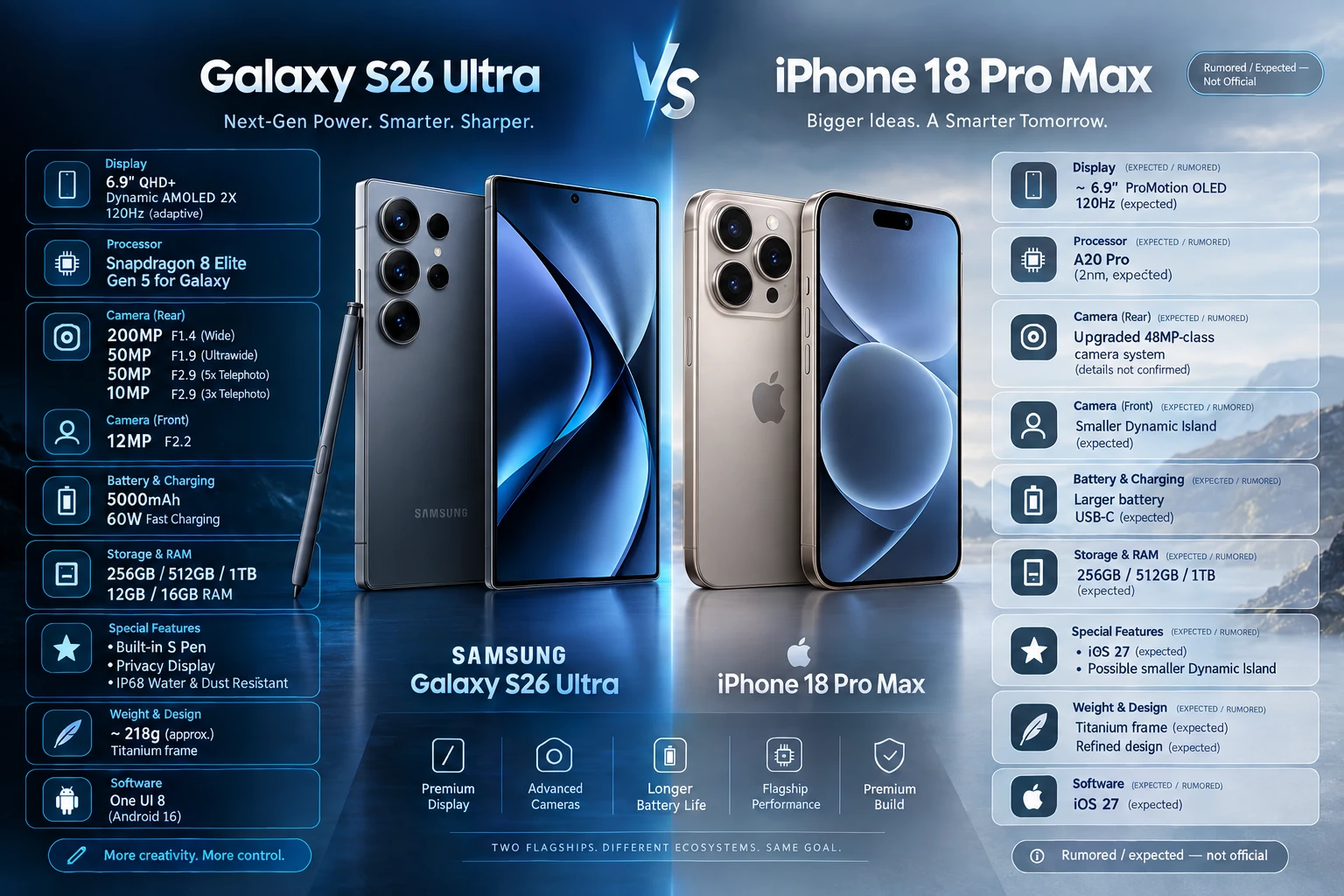
A straight two-phone comparison hides the fact that neither might be right for you. Here's what else was on the table.
iPhone 18 Pro — same A20 Pro, same three 48MP cameras, same variable aperture, same 2TB ceiling, at $1,199 and 211g. Left out because it's a near-identical phone. Honestly the better value of Apple's two this year.
Galaxy Z Fold 8 and Z Fold 8 Ultra — left out because a foldable is a different decision, not a competing one. If you want more screen rather than a better slab, our best foldable phones of 2026 roundup is the more useful page.
Apple iPhone Duo — Apple's first foldable, announced at the same event at $1,999. Left out because pre-orders don't open until October 16, so it isn't buyable this month. We cover it in our iPhone Duo vs Galaxy Z Fold 8 comparison.
iPhone 17 Pro Max — the phone in my pocket, now discounted. Left out of the head-to-head because it's a generation behind, but it's the smart buy for anyone who doesn't care about aperture control and can live with the heat behaviour I described above. Our iPhone 17 series hands-on test has the details.
Galaxy Z Flip 8 and Razr 70 Ultra — clamshells, different category, covered in our Z Flip 8 vs Razr 70 Ultra comparison.
Should You Wait for the iPhone 18 Pro Max or Buy the S26 Ultra Now?
Find yourself in this list.
You mostly photograph people and want the least fuss. Wait for the iPhone. Variable aperture is aimed squarely at portraits and group shots, and Apple's processing is more consistent out of the box. You'll pay full price on day one.
You write, sketch or annotate on your phone. Buy the S26 Ultra. The S Pen is in the phone and Apple has no answer.
Your phone gets hot doing real work — long recording, long gaming, charging while using it. Wait, and watch our thermal test on the 18th. Apple's tripled vapor chamber is aimed at exactly this, and it's the single biggest open question about the phone. If it works, it fixes the most annoying thing about owning a Pro Max.
$250 is real money to you. Buy the S26 Ultra. A six-month-old flagship at a genuine discount with 7 major Android updates ahead of it. The iPhone's advantages are real, but they are not $250 of real for most people.
You travel and rely on local SIM cards. Buy the S26 Ultra. US iPhone 18 Pro Max units are eSIM only — Apple's tech specs say plainly they don't accept physical SIM cards. The S26 Ultra keeps a nano-SIM slot alongside eSIM. This is the detail that catches people out after the box is open.
You're deep in the Apple ecosystem. This was never a comparison for you and we both know it. Read our iPhone 18 Pro Max full specs breakdown instead.
Who Should Skip Both
If you're on an S25 Ultra or an iPhone 17 Pro Max, skip this generation. Neither phone does something yours can't. Privacy Display is clever and variable aperture is genuinely new, but clever and new are not the same as worth a thousand dollars twelve months later. The one exception is the heat problem — if that's ruining your daily use, the 18 Pro Max's cooling might be worth the upgrade on its own. Wait for the test.
If your phone is mostly messaging, maps, video and photos of your family, both of these are overpriced for what you'll use. A mid-range phone at half the money won't meaningfully disappoint you, and I'd rather say that than sell you a flagship.
Which is better, the iPhone 18 Pro Max or the Galaxy S26 Ultra?
How much is the Galaxy S26 Ultra in 2026?
When does the iPhone 18 Pro Max come out?
Does the iPhone 18 Pro Max overheat like the 17 Pro Max?
Does the Galaxy S26 Ultra have a 24MP camera mode?
What is Privacy Display on the S26 Ultra?
The Bottom Line
The Galaxy S26 Ultra is the phone I'd tell a friend to buy this month, and the reason is unglamorous: it's very good, and it's $250 cheaper than the alternative because it's been on sale since March. Privacy Display is the most genuinely new thing on either spec sheet, and the S Pen still has no answer from Apple.
The iPhone 18 Pro Max will probably be the better phone. Variable aperture is a real capability, not a marketing line, and if the tripled vapor chamber does what Apple says, it fixes the most frustrating part of owning the phone I carry every day. But it's full price on day one, it's eSIM-only in the US, and every one of those claims is untested.
Buying today: S26 Ultra. Buying in October: come back after we've run the heat test.

Written by
Asif IqbalSenior Writer
Asif Iqbal is the Founder & CEO of Tech Vault AI, leading the team's hands-on testing of AI tools and SaaS products & Tech reviews. He's focused on cutting through marketing hype to help readers find what actually works.
Samsung Galaxy S26 Ultra reviews
Loading reviews...
Apple iPhone 18 Pro Max reviews
Loading reviews...
Questions & Answers
Loading questions...
📬 Get the Latest Reviews in Your Inbox
Once a week — AI tools, SaaS & gadget reviews delivered straight to your email.