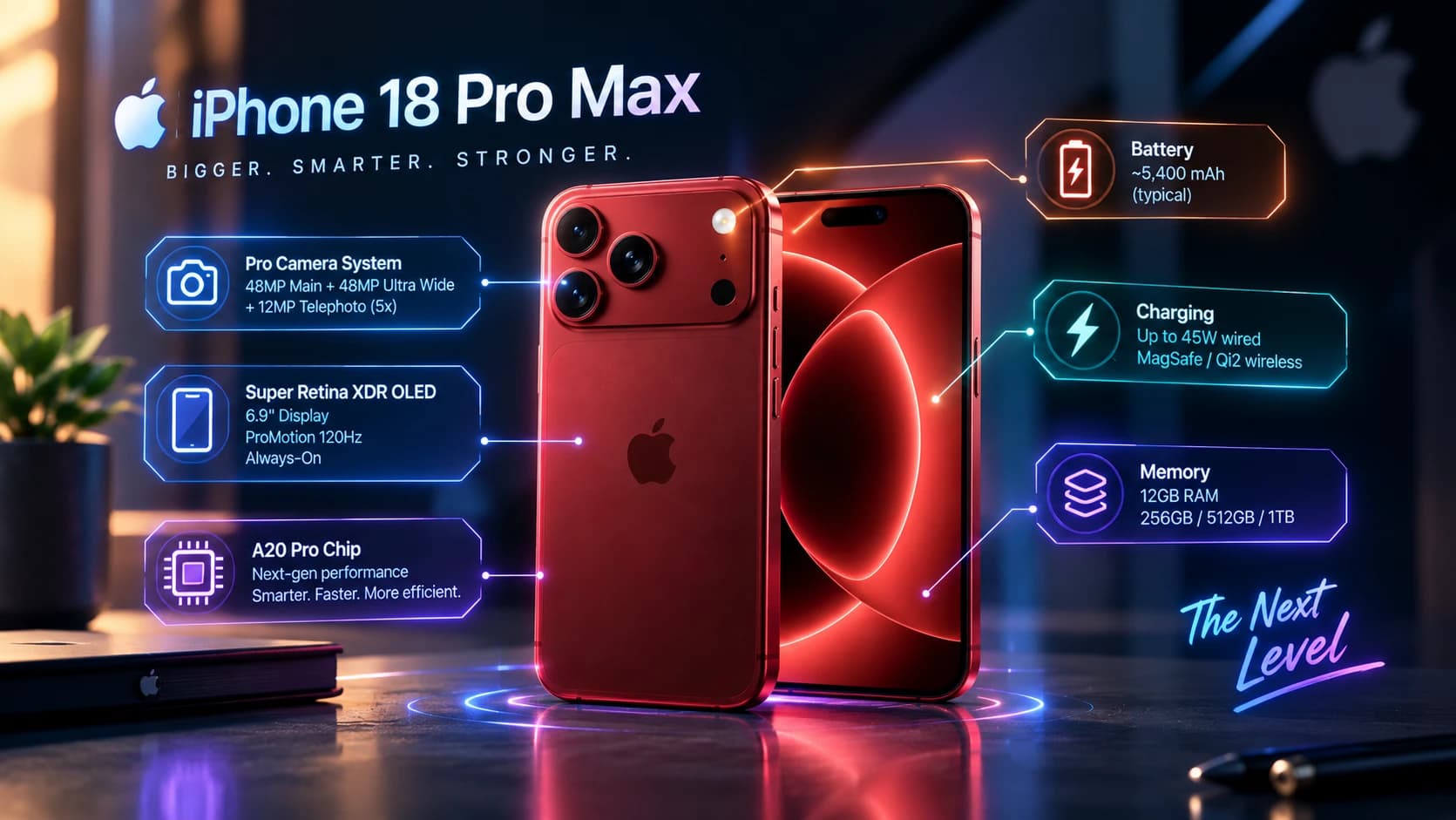
iPhone 18 Pro Max Is Official: Full Specs, Price & Verdict

Category RatingsNEW
Pros
- First iPhone with a variable-aperture main camera (ƒ/1.48–ƒ/4.0)
- 7-core GPU up to 40% faster, Neural Engine doubled to 32 cores
- Tripled vapor chamber for 40% better sustained performance
- Largest battery in any iPhone — up to 45 hours video playback
- 60W charging hits 50% in about 15 minutes, up from 40W last year
- All three rear lenses 48MP, with 200mm 8x telephoto reach
- Apple C2 modem replaces Qualcomm across the lineup
- 2TB storage tier available for the first time
Cons
- Aluminum frame still scratches at the edges; no return to titanium
- 249g makes it the heaviest iPhone Apple has ever shipped
- $100 price rise over the iPhone 17 Pro Max
- 60W charging still trails Android flagships, and no charger in the box
- eSIM only in the US — no physical SIM tray
- Front camera unchanged at 18MP
- Dynamic Island shrunk but under-display Face ID still missing
Full Specifications
Detailed breakdown behind each category score
Short answer: it's real, it's official, and the guessing is over. The iPhone 18 Pro Max landed on September 9 with Apple's first 2nm chip, a 48MP main camera that can actually change its aperture, all three rear lenses matched at 48MP, and the biggest battery Apple has ever put in an iPhone. It starts at $1,299 — a hundred dollars more than last year, not the three hundred half the internet was bracing for. Below is the full spec sheet, section by section, plus a look at which rumors Apple confirmed and which ones it quietly buried.
A quick word on where we're coming from. We spent two days with the iPhone 17 Pro Max last year when a friend picked one up on launch day, and that phone is the yardstick we're using here — the scratches that showed up on the aluminum frame within a week, the way the camera plateau made it wobble on a desk, the heat that built up during long gaming sessions. Those are the things we're watching for this time. We haven't held an 18 Pro Max yet, and neither has anyone outside Apple, because retail units don't arrive until September 18. When we get one, we'll come back and replace Apple's numbers with our own. For now, everything below is what Apple actually announced, with the parts that still need real-world testing clearly marked as such.
iPhone 18 Pro Max Release Date and Price
Apple announced the iPhone 18 Pro and iPhone 18 Pro Max on Wednesday, September 9, 2026, at its "Surprise and Shine" event in Cupertino. It was the first keynote run by John Ternus, who replaced Tim Cook as CEO on September 1 — Cook is still around as executive chairman, but this was Ternus's stage.
If you're planning to buy, the dates are worth writing down, because Apple broke its own pattern this year:
| What | When |
|---|---|
| Announced | Wednesday, September 9 |
| Pre-orders open | Saturday, September 12, 5 a.m. PT / 8 a.m. ET |
| iOS 27 released | Monday, September 14 |
| In stores | Friday, September 18 |
| Second wave of countries | Friday, September 25 |
That Saturday pre-order is the one that trips people up. Apple almost always opens orders on a Friday, and if you sleep through this one thinking you have another day, you'll be looking at October delivery estimates for the popular configurations.
Now the price. The iPhone 18 Pro Max starts at $1,299 for 256GB, and the smaller iPhone 18 Pro starts at $1,199. In India it opens around ₹1,79,900. Apple is also selling a 2TB Pro Max for the first time, which is a first for any iPhone.
So the Pro Max went up by $100 over last year's $1,199. That's a real increase and worth being annoyed about, but it's also a lot less than what was being reported all summer. Leaked carrier sheets and several analyst notes had the Pro line rising by $200 to $300 on the back of memory and component costs. That didn't happen. Ming-Chi Kuo and Jeff Pu, who both argued Apple would eat most of those costs rather than pass them to buyers, called this one better than the leak mill did — and we said on this page in August that the price was the number we trusted least. It turned out to be the number the leaks got most wrong.

Hardware and Software: The Chip Did More Than the Node Change Suggested
| Spec | Detail |
|---|---|
| Operating System | iOS 27 |
| Chipset | Apple A20 Pro |
| Fabrication | 2nm |
| CPU | 6-core, with integrated Neural Accelerators |
| GPU | 7-core, up to 40% faster than A19 Pro |
| Neural Engine | Dual 16-core (32 neural cores total) |
| Cooling | Vapor chamber, 3x the surface area of last year's |
| Modem | Apple C2 |
We spent weeks writing that the 2nm process was the whole story and the rest was a quiet year. That was half right, and the half we got wrong is the interesting part.
The node shrink is real and it does what node shrinks do — better performance per watt, less heat for the same work. But Apple did not stop there. The GPU went from six cores to seven and Apple claims it's up to 40% faster. The Neural Engine doubled to a dual 16-core setup, 32 neural cores in total, with roughly 50% more memory bandwidth feeding it. That's about twice the on-device AI compute of the A19 Pro, which matters a lot more this year than it did last year given how much of iOS 27's Siri work happens on the phone rather than in the cloud.
The part we care about most, though, is the vapor chamber. Apple tripled its surface area and says sustained performance holds up as much as 40% better. If that's true in practice, it's the direct answer to the complaint we had about the 17 Pro Max — that phone got uncomfortably warm during long gaming sessions and throttled noticeably once it did. We'll be testing exactly this when a review unit arrives, because a spec sheet claim about thermals is worth very little until you've had the phone hot in your hand.
One more change that slipped past most of the launch coverage: Apple has moved to its own C2 modem. We flagged before the event that Apple might split suppliers by region depending on mmWave support. It didn't — the C2 is in there, Qualcomm is out, and Apple is claiming lower power draw as a result. Whether real-world signal strength holds up against Qualcomm's silicon is a genuine open question, and one that teardowns and field testing will answer long before Apple does.
Display: Same Screen, Smaller Island
| Spec | Detail |
|---|---|
| Display Type | Super Retina XDR OLED, LTPO |
| Screen Size | 6.9 inches |
| Resolution | 1320 × 2868 |
| Refresh Rate | 1–120Hz ProMotion, Always-On |
| Peak Brightness | 3,000 nits outdoor |
| Protection | Ceramic Shield 2 |
| Cutout | Dynamic Island, redesigned and smaller |
Size, resolution, and refresh rate are all carried over from the 17 Pro Max, which is exactly what we expected — Apple was never going to resize the Pro Max panel this year.
Here's where we have to correct ourselves. Going into the event, we reported that Apple was moving to a punch-hole cutout and shifting Face ID sensors under the display, based on reporting from Mark Gurman and The Information. That didn't happen. The Dynamic Island survived. It's smaller and it's been redesigned — it now holds three Live Activities at once instead of two — but it is still very much a Dynamic Island, and Face ID is still living inside it rather than under the panel.
We flagged that one as unconfirmed at the time rather than reporting it as settled, which was the right call. Several outlets ran it as fact and are quietly editing their pages today.
The one number worth adding that we didn't have before: 3,000 nits of peak outdoor brightness. That matches what Samsung is doing on the Galaxy S26 Ultra and it's the spec that actually decides whether a screen is usable in direct sunlight.
If Apple's other September announcement is what's really pulling at you, our foldable iPhone vs Galaxy Z Fold 8 comparison covers that side of the launch — a completely different phone from this one, but the right thing to read if what you actually want is more screen.
Camera: The Rumor We Doubted Turned Out to Be the Headline
| Camera | Resolution | Focal length | Aperture |
|---|---|---|---|
| Fusion Main | 48MP | 24mm (1x / 2x) | ƒ/1.48 – ƒ/4, variable |
| Fusion Ultra Wide | 48MP | 13mm (0.5x / macro) | ƒ/2.2 |
| Fusion Telephoto | 48MP | 100mm / 200mm (4x / 8x) | ƒ/2.8 |
| Front (Center Stage) | 18MP | — | ƒ/1.9 |
Video: Dolby Vision up to 4K at 120fps, ProRes RAW, Apple Log 2, spatial video. Zoom stops at 0.5x, 1x, 2x, 4x, and 8x.
This is the section where we were most wrong, and it's worth saying so plainly. Our pre-launch spec sheet listed the main camera at a fixed ƒ/1.6 and treated variable aperture as a rumor that probably wouldn't survive. It survived. It's the headline feature of the entire phone.
The mechanism is a genuine piece of engineering, not a software trick. Six laser-cut blades on a rotor open and close the main camera between ƒ/1.48 and ƒ/4, either automatically based on the scene or manually from four fixed stops in the Camera app — ƒ/1.48 for low light, ƒ/1.8 for portraits, ƒ/2.8, and ƒ/4 when you want a whole group in focus rather than one face. Apple is opening an API so third-party camera apps can drive the aperture across an even wider range, which is the kind of detail that tells you Apple expects working photographers to use this.
Whether it makes a visible difference in ordinary photos is the open question. Phone sensors are small, and depth of field at ƒ/4 on a 24mm phone lens is not the same conversation as ƒ/4 on a full-frame camera. Our guess is that the low-light end matters more than the stopped-down end for most people, and we'll find out when we shoot with it.
The rest of the system: all three rear lenses are now 48MP, so detail no longer collapses when you switch away from the main camera. The telephoto reaches 4x optically at 100mm and 8x at 200mm — that 8x is the reach that used to require a Samsung.
And the one we got right: every leak roundup this month, Gulf News among them, insisted the front camera was jumping to 24MP. We published 18MP and said we weren't going to pretend to know which was correct. Apple's own tech specs list an 18MP Center Stage camera at ƒ/1.9. The 24MP sensor didn't arrive.
If you want to see how a different flagship handles multi-lens hardware, our Z Fold 8 camera review goes through Samsung's current approach in detail.
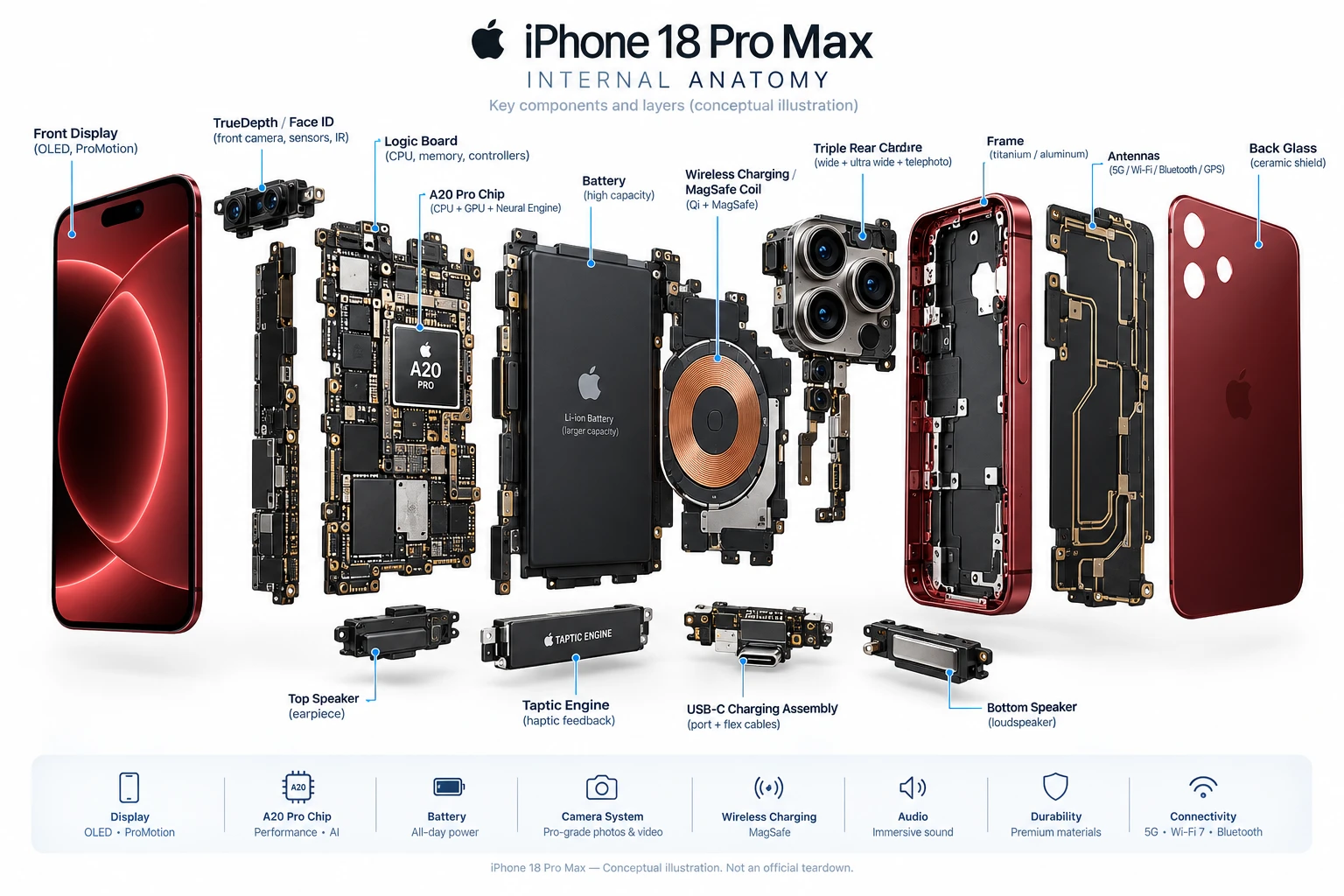
Design: Heavier, Yes — But Not Thicker, and Still Not Titanium
| Spec | Detail |
|---|---|
| Dimensions | 163.4 × 78.0 × 8.75 mm |
| Weight | 249g |
| Build | Ceramic Shield 2 front, aluminum frame, aluminum or Ceramic Shield back |
| Colors | Black, Silver, Glacier, Burgundy |
| Water Resistance | IP68, up to 6m for 30 minutes |
Two corrections to what we published before the event, and one of them cuts in Apple's favour.
We said the phone would be both thicker and heavier. It's heavier — 249 grams against 233 on the 17 Pro Max, a 16-gram jump that makes this the heaviest iPhone Apple has ever shipped. But it is not thicker. Apple's own tech specs put it at 8.75mm, which is exactly what the 17 Pro Max measured. Same footprint, same depth, more weight. That extra 16 grams is going somewhere useful — the bigger battery and the enlarged vapor chamber both have to live inside a body that didn't grow.
We also had the colors wrong. The Coffee Brown, Purple, and Burgundy lineup that "showed up consistently across multiple independent leak sources" turned out to be one leak repeated by everyone. Apple is selling four finishes: Black, Silver, Glacier, and Burgundy. Burgundy was the only one the rumor mill actually landed.
What hasn't changed is the material, and this is still the thing we'd complain about. Apple stayed on aluminum instead of going back to titanium. On our friend's 17 Pro Max, the aluminum frame picked up visible scratches within about a week of ordinary pocket use — no drops, no keys, just normal handling. Nothing about this year's build suggests that changes. If you were on the fence about a case, don't be. At 249 grams you'll feel this phone in a pocket regardless, so the extra millimetre of a case costs you less than the scratches will.
Battery and Charging: The Section We Got Most Backwards
| Spec | Detail |
|---|---|
| Battery | 5,567mAh (eSIM models) / 5,391mAh (physical SIM models) |
| Video playback | Up to 45 hours (up from 39) |
| Typical use | Up to 30 hours |
| Wired charging | 50% in about 15 minutes with a 60W adapter |
| Wireless charging | 25W MagSafe, 50% in 30 minutes |
| RAM | 12GB |
| Storage | 256GB / 512GB / 1TB / 2TB |
First, the battery number. Apple doesn't publish mAh figures, and there are two of them here depending on where you buy. Models without a SIM tray — which includes the US — get 5,567mAh. Markets that still ship a physical SIM slot get 5,391mAh, because the tray takes up the space. Both figures come from regulatory filings, not Apple. What Apple does publish is the runtime: up to 45 hours of video playback on the Pro Max, against 39 hours on the 17 Pro Max. Six extra hours is the largest single-generation battery gain Apple has claimed on an iPhone.
Now the part where we were wrong, and it's worth owning. We wrote a whole paragraph arguing that 40W wired charging was uncompetitive and that Apple was never going to move on charging speed. Apple moved. The 18 Pro Max hits 50% in about 15 minutes on a 60W adapter, down from 20 minutes at 40W last year.
Is 60W competitive with Android? Not really — flagships in this price range have been pushing 80W and beyond for years, and you still don't get a charger in the box. But "Apple hasn't moved in years and won't this year" was our claim, and it didn't hold up. That's a 50% jump in adapter wattage in a single generation.
The 2TB tier is new for the Pro Max and a first for any iPhone, which matters if you shoot ProRes RAW regularly. RAM stays at 12GB.
Connectivity: Apple's Own Modem, Finally
| Spec | Detail |
|---|---|
| Modem | Apple C2, with mmWave 5G in the US |
| Wireless chip | Apple N1 |
| Wi-Fi | Wi-Fi 7 (802.11be), 2×2 MIMO |
| Bluetooth | 6 |
| Other | Second-generation Ultra Wideband chip, Thread |
| SIM | eSIM only in the US; physical SIM retained in some markets |
We flagged before the event that Apple might split modem suppliers this generation — its own C2 in most markets, Qualcomm kept in US units because mmWave was Qualcomm's strength. That's not what happened. The C2 is in every model, mmWave included, and Qualcomm is out of the iPhone entirely. Apple pairs it with the N1 wireless chip for Wi-Fi and Bluetooth and a second-generation Ultra Wideband chip.
This is a bigger deal than it sounds. Apple spent close to a decade and a reported few billion dollars getting to the point where it could drop Qualcomm from its flagship, and it just did. Whether the C2 holds signal as well in weak coverage is the question that actually affects you day to day, and it's one that only shows up in real-world testing — not on a spec sheet, and not on launch day.
Worth knowing before you order: in the US these are eSIM-only phones. Apple's tech specs say plainly they don't accept physical SIM cards. If you travel and rely on picking up local SIMs, check that your usual carriers support eSIM before September 12.
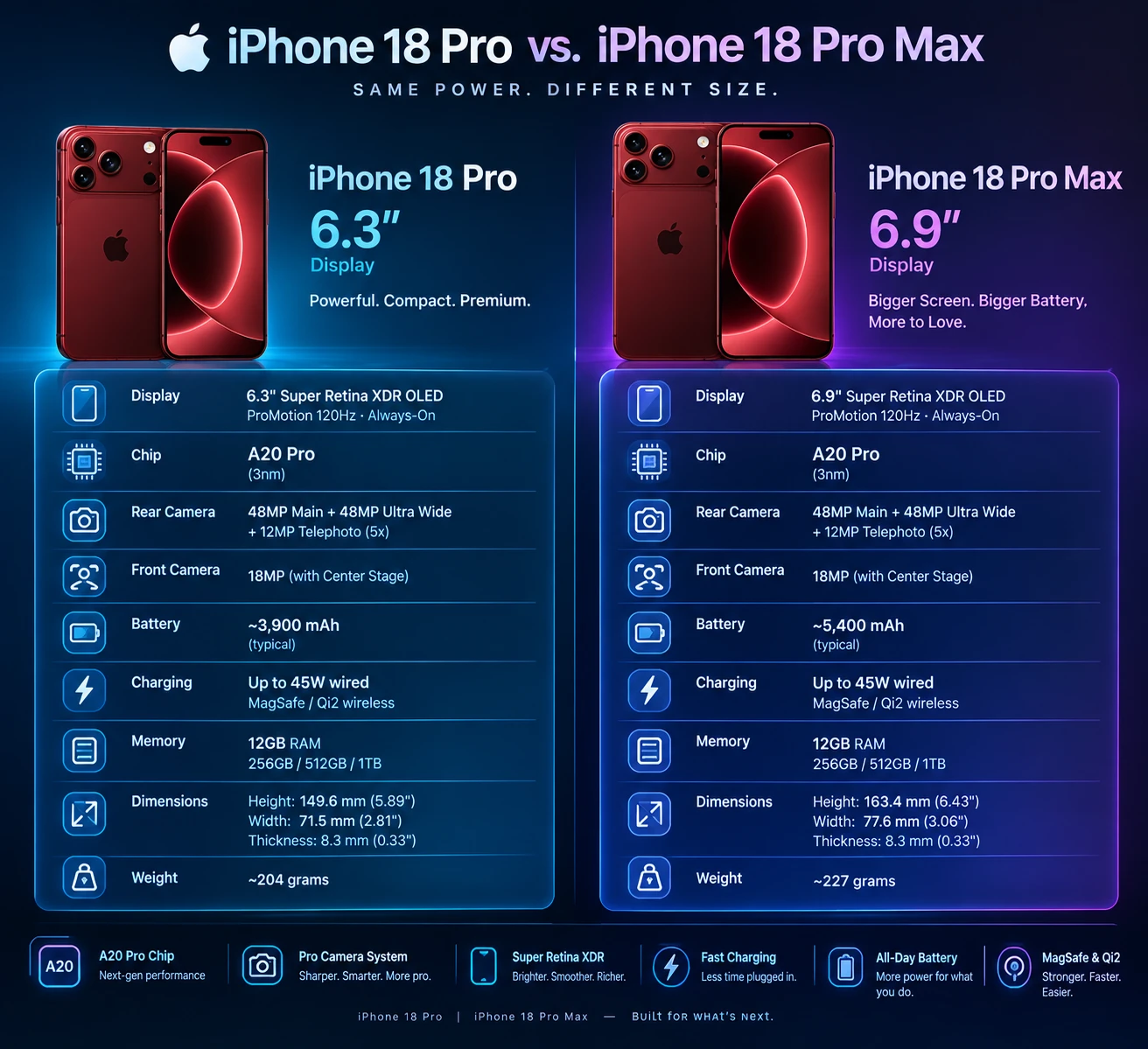
iPhone 18 Pro vs iPhone 18 Pro Max: What Actually Separates Them
Almost nothing, and that's the honest answer.
Both phones get the same A20 Pro, the same three 48MP cameras, the same variable-aperture main lens, the same 12GB of RAM, the same storage tiers up to 2TB, and the same vapor chamber. The variable aperture is not Pro Max-exclusive, despite what several leakers claimed — Apple put it on both.
What you're paying the extra $100 for is size and endurance:
| iPhone 18 Pro | iPhone 18 Pro Max | |
|---|---|---|
| Display | 6.3-inch | 6.9-inch |
| Weight | 211g | 249g |
| Video playback | Up to 36 hours | Up to 45 hours |
| Price (256GB) | $1,199 | $1,299 |
That's 38 grams and nine hours of video. If you want the biggest screen and the longest battery Apple sells, pay the hundred dollars. If you don't, the 18 Pro is genuinely the same phone in a smaller shell this year, which has not always been true of Apple's Pro lineup.
Who Should Buy the iPhone 18 Pro Max
Buy it if you're coming from an iPhone 15 Pro Max or older. The gap is real at that distance: 45 hours of video playback against whatever your battery holds now after three years of cycles, a genuinely faster GPU, and a camera system where all three lenses shoot 48MP instead of dropping resolution the moment you zoom. If you shoot a lot and care about control, the variable aperture is the reason to buy this phone — being able to stop down to ƒ/4 for a group shot or open to ƒ/1.48 in a dark restaurant is the first camera feature in years that changes what the phone can actually do, rather than how fast it does it.
Skip it if you're on a 17 Pro Max. You already have the 6.9-inch panel, 12GB of RAM, three 48MP-class lenses, and a battery that lasts a full day. What you'd be paying $1,299 for is the variable aperture, the better cooling, and six extra hours of video. That's a good year of improvements, not a necessary one. Wait for the 19 Pro Max unless the aperture control is specifically what you've been missing.
Think harder if the weight matters to you. At 249 grams this is the heaviest iPhone Apple has made, and the difference between 233 and 249 grams is something you notice by the end of a long day, not in a store. If you've found the 17 Pro Max already borderline, hold this one in your hand before ordering.
Consider something else entirely if a folding screen is what's really pulling at you. Apple announced the iPhone Duo at the same event — its first foldable, $1,999, with a 7.6-inch inner display and a 5.4-inch cover screen. It doesn't ship in September, though: pre-orders open October 16, well after the Pro Max is already in people's hands. Samsung's foldables, by contrast, have been on sale since August. Our Best Foldable Phones 2026 roundup and our look at the Galaxy Z Fold 8's new Wide form factor are both worth reading before you spend $1,299 on a slab phone you might regret.
What We'll Update Once We Have One in Hand
Everything above now comes from Apple's own published specs and the announcement itself — not leaks. Where we got things wrong before the keynote, we've said so in the section it happened in rather than quietly editing the numbers: the variable aperture we doubted, the punch-hole cutout that never arrived, the charging speed we said wouldn't move, the colors that turned out to be one rumor everyone copied. We'd rather leave that record visible than pretend we called it all correctly.
What a spec sheet still can't tell you is the part we actually care about. Does the tripled vapor chamber keep the phone cool through an hour of gaming, or does it throttle the way the 17 Pro Max did? Does the aluminum frame scratch as fast as last year's did in a pocket? Does 60W charging feel meaningfully different day to day, or is 15 minutes versus 20 a difference only a stopwatch notices? Does Apple's C2 modem hold signal in weak coverage the way Qualcomm's did? We'll answer all of that once retail units arrive on September 18, and this page will be updated with our own numbers.
In the meantime, if you're cross-shopping against Android, our Samsung Galaxy S26 Ultra vs iPhone 17 Pro Max comparison is still the closest thing to a real-world head-to-head we have — we're working on the S26 Ultra versus 18 Pro Max version now. And if a clamshell is more your speed than either a slab or a book-style fold, our Galaxy Z Flip 8 vs Razr Ultra 2026 comparison covers that end of the market in the same depth.
When does the iPhone 18 Pro Max come out?
What colors does the iPhone 18 Pro Max come in?
Leaks consistently point to Coffee Brown, Purple, and Burgundy, though Apple has not confirmed final color names.
Does the iPhone 18 Pro have a Dynamic Island?
How much RAM does the iPhone 18 Pro Max have?
Is the iPhone 18 Pro Max going to be more expensive than the iPhone 17 Pro Max?
Bottom Line
The variable-aperture camera is the real story here — the first time an iPhone lets you actually control depth of field, and the first genuinely new photographic tool Apple has shipped in years. Add the 2nm A20 Pro, a tripled vapor chamber, six extra hours of video, and 60W charging, and this is a stronger year than the spec sheet suggests. What holds it back is physical: 249g makes it the heaviest iPhone ever, and the aluminum frame still scratches. Worth it if you're on a 15 Pro Max or older, or if you shoot seriously. Skip it if you bought a 17 Pro Max.

Written by
Asif IqbalSenior Writer
Asif Iqbal is the Founder & CEO of Tech Vault AI, leading the team's hands-on testing of AI tools and SaaS products & Tech reviews. He's focused on cutting through marketing hype to help readers find what actually works.
iPhone 18 Pro Max Is Official: Full Specs, Price & Verdict reviews
Loading reviews...
Questions & Answers
Loading questions...
📬 Get the Latest Reviews in Your Inbox
Once a week — AI tools, SaaS & gadget reviews delivered straight to your email.